
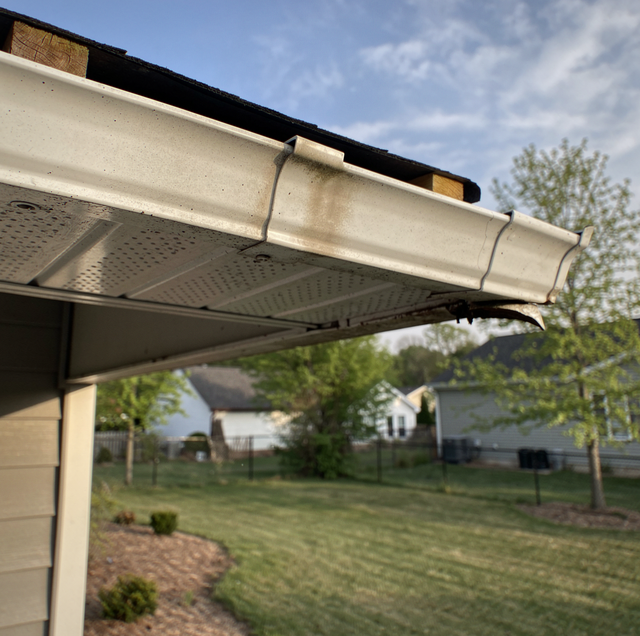
If a fascia board failed the way you would expect a painted board to fail, you would have watched it happen across two or three seasons: chalk on the surface, then hairline checking, then a run of trim that looks tired from the driveway. That is not the order this one goes in. The face you can see is the driest surface on the board. Its back side, nailed against the cut ends of the rafters and shaded all day, is where water arrives and where it sits, and the wood there can be soft through half its thickness while the front still holds a coat of paint and still takes a nail. The soffit tucked in behind it goes second, for the same reason.
What the Two Boards at the Eave Hold Up
Two boards close the eave, and each does a different job. The fascia is the vertical board running along the ends of the rafters, capping the cut ends and holding them in a straight line so the roof edge does not wander. It is also the nailing surface out there: the gutter hangs on it, and the soffit's outer edge is carried by it or by a nailer behind it. The soffit is the horizontal panel closing the underside of the overhang, running from the fascia back to the wall, where it sits in a channel against the siding.
The soffit does one thing the fascia does not. On a vented attic, it is the intake. Air enters through the perforations in the panel at the eave, rises along the underside of the roof deck, and exits at or near the ridge. That whole path depends on the opening at your eave staying open.
So the eave you are looking up at is a load path and an air path sharing two boards. Everything hanging out there is fastened into the fascia, and everything the attic breathes comes in through the soffit. When the fascia goes soft, it stops doing both jobs at once, so trouble reaches you as two symptoms before it reaches you as a bad board.
Why Does the Back Face Fail First?
The back of a fascia board faces a cavity. Nothing dries it: no sun reaches it, and the air behind it moves only when wind pushes it. What does reach it is water, delivered from above and held there by gravity, and on a board primed on its face and edges and left bare behind, nothing stands between water and wood.
The paint on the front works against you. A cured exterior film slows water vapor moving through it, which is part of what the film is designed to do. Water that got in from behind has to leave through that same face, slowly, so the board holds a raised moisture content for weeks instead of an afternoon. That is the condition decay needs, and why the front can look sound long after the wood behind it stopped holding a fastener.
Failure shows up somewhere other than the board. A fastener needs sound fiber packed around it to hold, and decayed fiber lets it work loose under load. So what you notice first is a gutter line dipping between hangers, or a soffit panel dropped at its outer end. Reading the decay itself, what it looks like and how you tell it from weathering, is a rot question rather than an eave one, and the answer is the same at a porch column as at your eave.
From the ground, note where the paint on your fascia is failing. Worst along the shaded bottom edge and at the board joints points to water behind it. Worst across the open sun-struck face points to weathering.
The Water That Arrives From the Gutter Line
A gutter hung at the eave is fastened to the fascia, its back flange flat against the board with no air gap, so what gets in there stays wet far longer than on an open face. Hanging or replacing that trough is gutter work and a separate trade; the board underneath it is eave work.
It gets in two ways, and one brings on the other. A trough that has stopped draining fills to its back edge and spills backward against the fascia rather than over the front lip onto the surface that cannot dry. The weight settles the run: a gallon weighs a little over eight pounds, so standing water pulls the hangers down and tips the trough toward your wall.
The fasteners are a path of their own. Every hanger, spike, or screw is a hole driven through the primed face into the middle of the board, and water reaching one travels along it into fiber that never had a coat. That is how your fascia ends up wet in a row of spots while the wood between stays sound.
Cold weather works those seams open. Water expands about 9% when it freezes, so a wet fastener hole or a wet joint between fascia and soffit is pushed wider on every freeze and takes more on the thaw. Freezing also puts the water in one place: heat escaping into the attic melts snow on the roof above, the meltwater runs down to the overhang, which sits over open air at outdoor temperature, and refreezes there, standing water at the eave. Warm months give you no rest: wind-driven rain reaches the same joint from the side.
How a Closed Eave Puts Water Back on the Board
A soffit that has taken water sags, swells at its edges, or drops out of its channel, and a panel in that state closes the intake it was carrying. The exhaust at the ridge does not stop. It keeps moving air, and that air has to be replaced from wherever the attic leaks worst.
With the eave shut, the leakiest path left is the ceiling below. Attic air gets replaced through recessed light housings, the attic hatch, gaps at the top plates, and the holes cut for plumbing, which means it comes out of your house. That air carries the humidity your household makes. In cold weather, it meets a roof deck sitting below its dew point, condenses on the underside of the sheathing, and runs downhill to the lowest point it can reach, arriving at the eave on the top plate, in the soffit cavity, and on the back of the fascia.
That closes a loop. Water from outside softens the board, the soft board lets the soffit drop, and the shut intake starts delivering water from inside to the same wood. In warm weather, the loop does not stop: a closed eave leaves your attic hotter and slower to dry after rain.
The Drip Edge and Where It Sends the Water
A drip edge is a bent strip of metal running along the roof's lower edge, one leg lying on the deck under the roof covering, the other hanging down in front of the fascia. The bottom of that leg is bent a second time, out and away from the board, into a hem standing the metal's lower edge clear of the wood.
That second bend does the work. Water leaving an edge clings to it, follows the underside back toward the building, and runs along whatever it meets. Give it a plain, unbroken edge above your fascia, and that is the top of the board, and after that the back face. The hem interrupts the path: water arriving at the outward bend has nothing to cling to and falls clear.
So a drip edge stopping short of your fascia's face, or left when the board it was sized against got replaced with a thicker one, hands every rainfall to the top edge and back of the board. That is roof-edge metal and belongs to a roofer, but it is worth knowing where it sits: a board that goes soft again after you have replaced it is a reason to look at the metal above it, and at whether its lower edge finishes in a bend or just stops.
Frequently Asked Questions
Only if the board is dry through, and the can's label states what dry has to mean. Exterior coatings specify a minimum surface and air temperature for application and require a dry substrate, both printed on the container. A slow-drying film over a board carrying water on its hidden side seals the one face that could still release it, and the coating lifts from below within a season.
The rafter tail is the framing member your fascia is nailed to, so trouble there is a different scope from trim work. A screw that spins without biting at a tail location, or a fascia pulled forward with a gap at every rafter, means the wood behind is involved. That is framing repair, and it is worth having someone open one bay and look at the tail ends before new trim goes up.
No. Fascia runs long, and lengths get joined over a rafter tail with an angled scarf rather than a square butt, so the upper piece laps the lower and the seam sheds water instead of holding it. A replacement length is cut to land on a tail and joined the same way, so sound wood either side of your damage can stay. How far the repair runs depends on the framing behind it.
Coil stock bent over the board hides it and sheds rain, and changes nothing structural. It does not dry wood already wet, and it carries no load: your gutter hangers still reach through the metal into the board behind it, and so does every nail holding the wrap. A board that was soft when it got covered stays soft under there, and you find out at a hanger.
A soffit panel is supported at both ends. It sits in a J-channel or F-channel fastened to the wall, and its outer end rests on the fascia or a nailer behind it. A panel hanging down outside while the wall end holds has lost its support at the fascia end, which puts the fault in the board behind it. Your vinyl or aluminum is intact; the wood it hung from has gone.
Net free area is the open, unobstructed portion of a vented panel, published in square inches per lineal foot on that product's own literature. It describes the panel as it left the factory. Anything your eave has done to it since- a coat of paint bridging the perforations or insulation packed into the channel above- only takes the figure down, so read the published number as the ceiling on your intake.
A soffit and fascia repair has a fixed order to it — the back face and the end grain get sealed before the board goes up, and the trim gets closed in and finish-coated afterward, which is a sequence nobody can run backward once the board is fastened. Precision Home Worx serves Wilmington, Bear, and Newark. Call (302) 500-3676.

