

Decks, Porches & Porticos in Wilmington, DE
Deck Construction · Deck Roofs · Screened Porches · Porch Enclosures · Custom Porticos ($15K–$25K) · Trex · TimberTech · Pressure-Treated · Featured Specialty: Deck Roof + Screened Porch + Portico · 1-Year Warranty


Outdoor living projects from Precision Home Worx cover the full range — composite deck builds in Trex and TimberTech, screened porches that turn a backyard into a usable third-season space, custom porticos that change the look of a home's front entry, and the repair work on aging 1990s pressure-treated decks across Bear, Newark, and Hockessin. Three of these scopes are featured specialties: deck roofs, screened porches, and porticos.
Most of our deck builds run composite (Trex or TimberTech); about 60% of jobs go composite, 40% pressure-treated, depending on budget and intended use. A typical 12-by-18 composite deck with railings runs around $25,000 installed. Custom porticos ($15,000–$25,000) are the front-of-house counterpart — a structural addition that improves curb appeal and protects the entry door from weather.
-
Free in-home estimate within about a week. We handle New Castle County and Chester County permit coordination. Call (302) 321-3577 or use the contact form.
When Wilmington Homeowners Call About Their Outdoor Living Space
Most deck, porch, and portico calls fit one of these patterns:
1990s pressure-treated deck reaching end of life
Pressure-treated lumber decks from the 1985–2005 build era are now 20–40 years old. Common symptoms: board cupping or splitting, visible fastener corrosion, soft spots in the joists when you press a screwdriver into the underside, railing posts wiggling when leaned on. About 30% of PT decks from this era we look at need a full substructure rebuild, not just new boards on top.
Want to add a deck to a home that doesn't have one
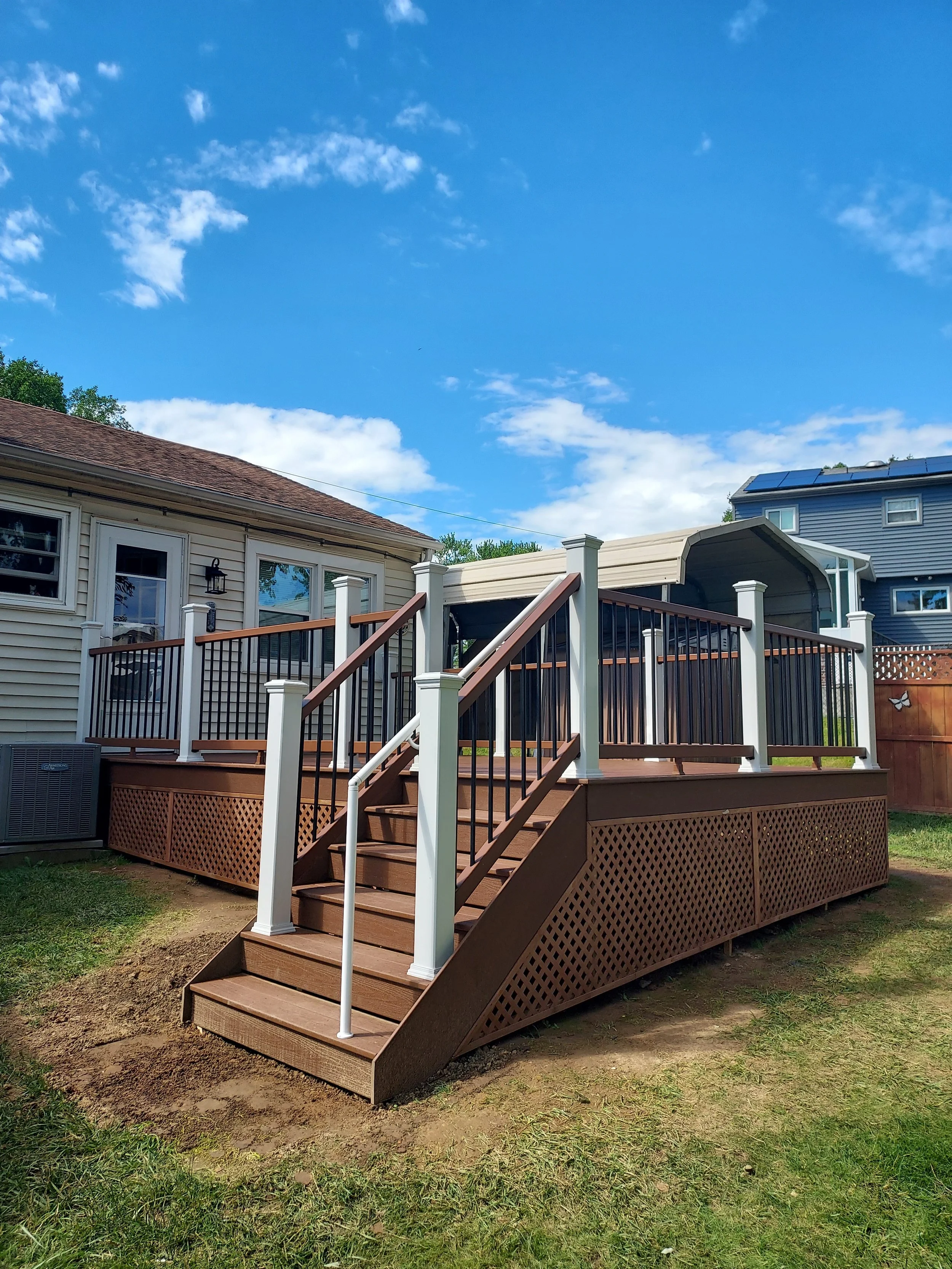
New deck construction on an existing home — typically off the kitchen or family room, sometimes a second-story deck off a primary suite. Trex or TimberTech composite is the most common choice; pressure-treated with stain-grade lumber for budget-tier projects. A 12-by-18 standard deck runs about $25,000 installed with railings, stairs, and railing lighting if requested.
Deck roof to convert open deck into all-weather space
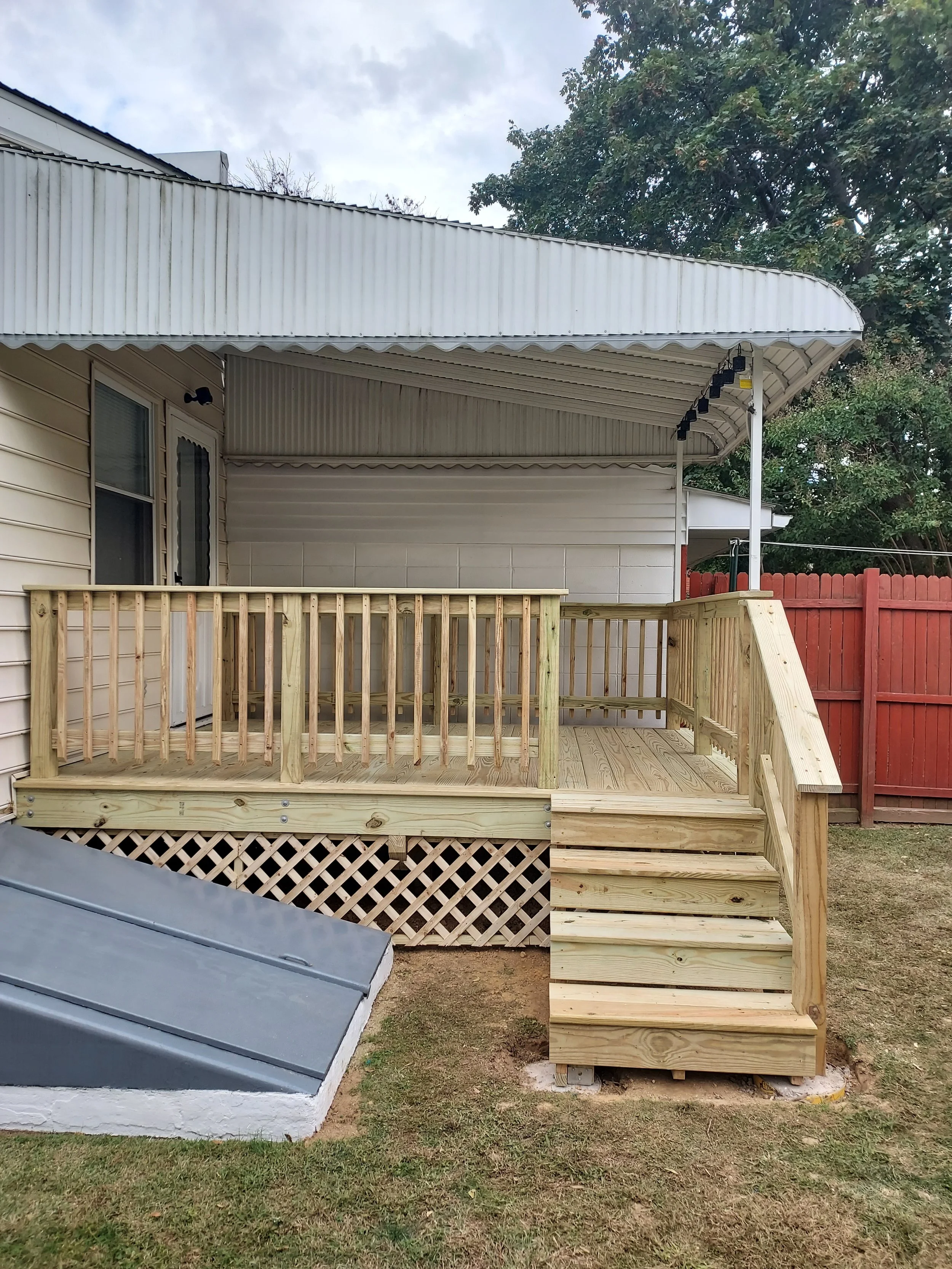
Deck roof/cover is a featured specialty. Adding a roof over an existing deck (or building a new deck with integrated roof) extends the usable season into spring rain and summer heat. Pergola-style covers, solid roofs with shingles to match the house, or shed-style covers tied into the existing roofline.
Screened porch — keeps mosquitoes and pollen out
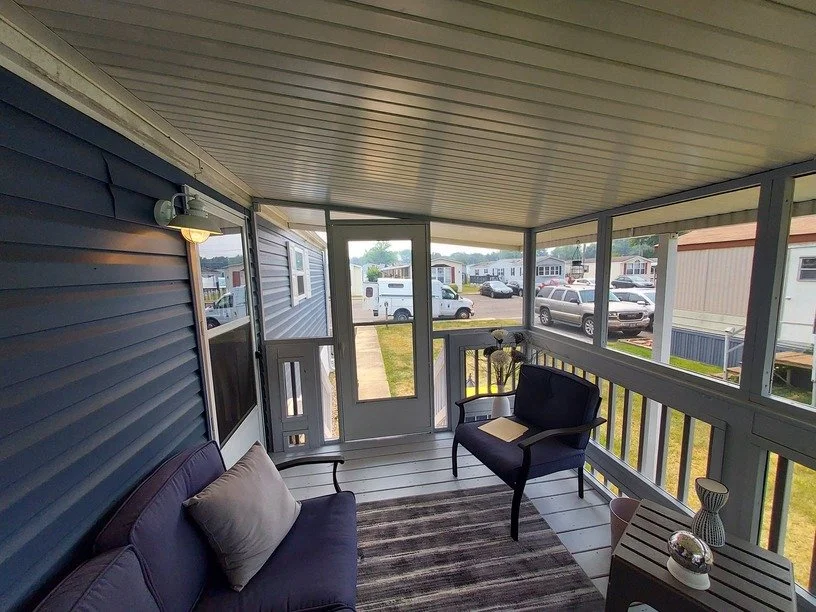
Featured specialty. A screened porch on the back of the house creates a third-season outdoor room. Northern Delaware mosquito season runs late May through September, and screen makes the difference between a usable outdoor space and one nobody sits in. Typical scope: framed walls with screen panels, screen door, painted ceiling, electrical for lighting and ceiling fan.
Custom portico for the front entry
Featured specialty. A portico changes the look of a home more than any other single addition — turns a flat-front colonial into something with architectural depth. Typical scope: gable or hip roof, structural columns (often wrapped in PVC or aluminum), brick or stone base, matching shingles or standing-seam metal. $15,000–$25,000 typical range.
Porch enclosure to add living space
Converting an existing covered porch into enclosed space — adding walls, windows, electrical, sometimes HVAC tap-in. The work is closer to room addition than deck work; we handle the structural and finish scope and refer HVAC to a licensed specialist when the homeowner wants the space heated and cooled.
Local Conditions That Affect Deck & Porch Work in Northern Delaware
Northern Delaware's deck and porch realities are shaped by freeze-thaw exposure, the local housing-era job mix, and the permit-and-HOA framework that varies by municipality.
Northern DE freeze-thaw cycles — PT decks fail faster than the brochures suggest
Northern Delaware sees 30+ freeze-thaw cycles per winter. Each cycle stresses wood fibers in pressure-treated decking, accelerates fastener corrosion (especially galvanized in older builds), and widens any existing checking or splitting. National manufacturer warranties on PT lumber assume mild climates — actual Northern DE PT deck life is typically 15–25 years before serious rebuild work, not the 40+ years some brochures suggest.
Brandywine Hundred custom porticos and porch additions
Hockessin, Greenville, Centreville, Chadds Ford, and Garnet Valley homes built between 2000 and 2020 are the strongest market for custom porticos. Premium materials (real brick or stone bases, copper-clad accents on some models, premium PVC columns), gable or hip roof styles that match the house, and integrated lighting. Typical investment: $20,000–$30,000 for the premium tier vs. the $15,000–$20,000 standard.
1990s PT decks across Bear, Newark, Hockessin — the end-of-life wave
The 1985–2005 build era across Bear, Newark, Hockessin, and newer Wilmington developments produced a lot of pressure-treated decks. Those decks are now 20–40 years old, and many are reaching the substructure-rebuild threshold. The visible board surface might look okay (especially after a recent power wash and re-stain), while the joists, ledger board, and footings underneath have deteriorated. Honest assessment requires getting under the deck — which is exactly what we do at the estimate.
New Castle County and Chester County permit thresholds
New Castle County requires a permit for decks over 30 square feet — meaning essentially every real deck. Permit fee and inspection coordination are routine, but add 2–3 weeks to the project timeline. Concord, Birmingham, Pennsbury, and Thornbury townships in Chester County each handle deck permits slightly differently. We pull the permit and coordinate the inspections — the homeowner doesn't have to handle the paperwork.
HOA architectural review — common in newer developments
Newer developments (Bear, parts of Hockessin, Pencader, Concord Township, PA) often have HOA architectural review requirements for deck additions. The HOA may require specific composite color choices, specific railing styles, or limits on deck height or size. The homeowner submits the HOA review — we provide the drawings and material specs needed for the application.
Our Reviews
What's Covered
Deck Construction (New Build)
New deck construction from footings to railings. Concrete footings (sized per local code), pressure-treated framing (joists, beams, ledger board with proper flashing), composite or PT decking boards, railings, stairs, and railing lighting if requested. Typical 12-by-18 deck timeline: 2-day demo (if existing deck) + 3-week build.
Deck Roof / Cover (Featured Specialty)
Adding a roof to an existing deck or building a new deck with an integrated roof. Three common styles: pergola (slatted, partial shade only — $5,000–$10,000), solid-roof shingled cover matching the house ($12,000–$20,000), or standing-seam metal cover for a premium look ($15,000–$25,000). Structural ledger tied into the existing house framing.
Porch Enclosure
Converting an existing covered porch into an enclosed space — adding walls (insulated framing, drywall interior, siding exterior to match), windows (Pella or Andersen), electrical for full room use, optional HVAC tap-in (referred to licensed specialist). Closer to a room addition than typical deck work. Typical scope: $30,000–$50,000.
Deck Repair & Replacement
Surface board replacement (new boards over existing substructure if the substructure passes inspection): $4,000–$8,000 for a standard deck. Full substructure rebuild + new boards: $12,000–$20,000. Substructure-only repair (joist sistering, ledger reflash): $3,000–$6,000.
Screened Porch (Featured Specialty)
Framed walls with screen panels (typically charcoal-tone screen for visibility), screen door (latching kick plate at the bottom), painted ceiling, electrical rough-in for ceiling fan, and outlets. Built on an existing porch or new construction with an integrated roof. Typical scope: $15,000–$25,000 for a 10-by-12 to 12-by-16 screened porch.
Portico (Featured Specialty)
Structural columns (PVC-wrapped, aluminum, or stain-grade hardwood), gable or hip roof matching the house, brick or stone base, integrated lighting, matching shingles or standing-seam metal. $15,000–$25,000 typical; premium Brandywine Hundred builds run $20,000–$30,000.
What's NOT included: Large-scale decks (2,000+ square feet, multi-level commercial-scale) are out of our current capacity. Pool decks integrated with pool wiring/plumbing require licensed specialty work — we'll refer you. Hot tub deck integration we handle on the structural side; electrical for the tub itself is licensed-electrician scope.
Pricing
Project-based pricing reflecting size, material, and roof complexity. Every estimate is written and good for 30 days. Permit fees passed through at cost.
| Service | Typical Range | Notes |
|---|---|---|
| Deck — surface board replacement only | $4,000–$8,000 | Existing substructure passes |
| Deck — substructure-only repair | $3,000–$6,000 | Joists, ledger, flashing |
| Pergola-style deck cover | $5,000–$10,000 | Partial shade |
| Deck — full substructure rebuild + new boards | $12,000–$20,000 | End-of-life PT deck |
| Solid-roof deck cover (shingled, matches house) | $12,000–$20,000 | Featured specialty |
| Standing-seam metal deck cover (premium) | $15,000–$25,000 | Premium look |
| Screened porch — standard build | $15,000–$25,000 | 10x12 to 12x16 |
| Portico — standard | $15,000–$25,000 | PVC columns, gable roof |
| Portico — premium (Hockessin/Greenville tier) | $20,000–$30,000 | Brick base, stain-grade columns |
| New deck build — composite (12x18 Trex/TimberTech) | $25,000 | Per example |
| Porch enclosure (room addition scope) | $30,000–$50,000 | Closer to room addition |
What affects the price
Material
Material — Trex/TimberTech composite vs. pressure-treated lumber swings the budget $5,000–$10,000 on a standard deck.
Size
Size — square footage drives material and labor proportionally.
Roof complexity
Roof complexity — pergola vs. solid shingled vs. standing-seam metal each represent a very different scope.
Foundation depth
Foundation depth — Northern DE frost line requires footings 30+ inches deep; rocky soil in Brandywine Hundred premium sites adds time.
Permit & coordination
Permit and inspection coordination — pass-through cost, 2–3 weeks added to timeline.

How a Deck or Porch Project Actually Happens
Design discussion — composite vs. PT, size, railing, lighting
We talk through material choice, deck size and layout, railing style (composite, aluminum, or cable), stair location, and lighting (LED post caps, riser lights, or down-lighting). Most homeowners haven't seen the actual composite samples in person — we bring physical samples of Trex Transcend, Trex Enhance, and TimberTech AZEK lines.
Material order & lead-time
Trex and TimberTech composite: 2–4 weeks lead time from order. Pressure-treated lumber: in stock at regional suppliers (84 Lumber, Home Depot Pro). Standing-seam metal roofing: 3–6 weeks. Custom railings: 3–4 weeks.
One-year warranty + manufacturer pass-through
One-year workmanship warranty dated from completion. Manufacturer warranties on Trex and TimberTech composites pass through directly to you — typically 25–50 years on the boards themselves, often pro-rated.
Written estimate within about a week
Itemized: footings, framing, decking material, railings, stairs, lighting if requested, permit fees, inspection coordination, and timeline. Every material selection includes a link to the exact product.
Build day(s) — 2-day demo + 3-week build typical
The typical timeline is a 2-day demolition (if replacing the existing deck), followed by a 3-week build for a standard deck. Footings dug and inspected (county inspector visit), framing built, decking boards installed, railings set, stairs assembled, lighting wired, and final inspection coordinated.
Site visit & measurement (free)
Jimmy comes to your home with a tape measure, stake-out string, and sample composite boards. Walks the existing structure (if there is one), assesses the substructure on existing decks, measures the footprint, and notes sun exposure/view orientation. Booties on at the house entry; outdoor work at the deck site.
Permit pull & HOA review
We pull the New Castle County or Chester County permit. The homeowner submits any HOA architectural review with drawings and material specs we provide. Combined timeline for permit + HOA review: 2–4 weeks typical, sometimes longer in slower review periods.
Final walk-through & sealing
Pressure-treated decks get stained or sealed before we leave (Cabot Australian Timber Oil or similar; homeowner-selected color confirmed in writing before application). Composite decks don't need sealing. Final walk-through with the homeowner: railing security check, board surface inspection, stair tread alignment, and lighting test.
Why Precision Home Worx for Your Deck or Porch
Three featured specialties — deck roofs, screened porches, porticos
The skill carries forward — we know what works, what fails, and what changes when you add a roof over an existing deck instead of building it integrated from the start.
Honest composite vs. pressure-treated recommendation
Our actual job book is 60% composite, 40% pressure-treated. We're not a composite-only shop pushing the upgrade on every customer, and we're not a PT-only shop avoiding the conversation. The right answer depends on your budget, your intended use, your sun exposure, and how long you plan to own the home.
Permit and inspection coordination — handled in-house
New Castle County permits, Chester County township permits, and county inspector coordination — all handled. The homeowner doesn't fill out paperwork or call the inspector. Adds 2–3 weeks to the timeline (the permit-and-inspection process is what it is) but takes the friction off your plate.
Substructure honesty on old PT decks
About 30% of pressure-treated decks from the 1985–2005 era look fine on top but have failing joists, ledger boards, or footings underneath. Most contractors quote a board replacement on the visible surface and leave the failing substructure in place — and the homeowner gets the same problem again in 5 years. We assess the substructure first and recommend the actual right scope: surface only, substructure repair, or full rebuild.
Trex and TimberTech — real brands, regional availability
Trex Transcend, Trex Enhance, TimberTech AZEK — three real product lines stocked at regional suppliers. Color matching available 15+ years from now for board replacement after wear or damage. Off-brand composites disappear from the market within 5 years and color matching becomes impossible.
FREE 2nd opinions on outside quotes
Already have a quote from a deck contractor or chain installer? Email it to Jimmy or have him stop by. He'll review it for free — flag anything that's substructure-deficient, double-check the per-square-foot pricing against Northern Delaware market rates, and tell you whether the price is fair. No pressure either way.
Composite vs. Pressure-Treated Decking: When the $5K Upcharge Is Worth It (And When It Isn't)
The biggest decision on any new deck build is composite (Trex, TimberTech) versus pressure-treated lumber. The cost difference is real — about $5,000–$10,000 more for composite on a standard 12-by-18 deck. The marketing pitch for composite is simple: it never needs staining, lasts longer, and looks nicer. The marketing pitch for pressure-treated is: half the price. Both pitches are partially true. The honest answer depends on your specific situation.
When is a composite worth the upgrade? You're planning to stay in the home long-term (10+ years) and want zero maintenance. Your deck gets significant sun exposure (south- or west-facing), which accelerates PT staining and re-staining cycles. You're in a Brandywine Hundred premium home, and the deck connects to a primary outdoor entertaining area where appearance matters consistently. You don't want to spend a weekend every other year power-washing and re-staining. In all these cases, the composite upcharge pays back over 10–15 years in maintenance costs and convenience.
When pressure-treated is the right call. Budget is the dominant constraint, and the $5,000–$10,000 differential is the difference between building a deck this year and not. You're planning to sell the home within 5–7 years, and the upgrade premium won't fully recapture in resale. The deck is partly shaded and stays dry — north-facing decks under tree cover see much less wear than full-sun decks. You're willing to do (or have done) a weekend of staining every 2–3 years. PT decks built and maintained well in Northern Delaware for the last 20–25 years; the maintenance is real, but it's not impossible.
The 60/40 reality at Precision Home Worx. Our actual job book runs about 60% composite, 40% pressure-treated. The split tells you the honest market position: composite is the right answer for most premium and mid-tier customers, but PT remains the right answer for budget-conscious projects and certain use cases. Anyone who tells you composite is always right, or PT is always right, is selling a position, not giving advice.
The 5-question test. Ask yourself:
(1) How long do you plan to own the home?
(2) Is the deck in full sun or shade?
(3) What's your maintenance willingness (1 = none, 5 = happy to power-wash annually)?
(4) Is the deck a primary outdoor entertaining area or a utility space?
(5) Is the $5,000–$10,000 differential a budget-breaker?
If you scored mostly toward long-ownership + full-sun + low-maintenance + entertaining + budget-OK, composite is right. If you scored short-ownership + shade + maintenance-OK + utility + budget-tight, PT is right. Jimmy walks through this calculation with you at the free estimate.
Materials We Install
Our published material list:
Trex — Transcend (premium tier), Enhance Naturals (mid-tier), Enhance Basics (value tier)
TimberTech — AZEK Vintage and Harvest lines (premium); Pro Reserve and Pro Terrain (mid-tier)
Standard pressure-treated southern yellow pine from regional suppliers (84 Lumber, Home Depot Pro)
Cedar tone or stain-grade for premium PT projects
Composite railing matching deck boards · Aluminum (Westbury, Trex Signature, or similar) · Cable rail with stain-grade hardwood posts
FAQs
Typical timeline is 2-day demo (if replacing existing) plus 3-week build for a standard 12-by-18 deck. Premium projects with custom railings and integrated lighting can run 4–6 weeks. Permit-and-inspection coordination adds 2–3 weeks to the front of the project before build day.
A 12-by-18 composite deck with Trex or TimberTech runs about $25,000 installed. Pressure-treated versions of the same deck run $15,000–$18,000. Larger decks scale roughly proportionally; smaller decks (8-by-10 to 10-by-12) typically run $12,000–$18,000.
Both are excellent and we install both. Trex has slightly broader color options at the value tier (Enhance Basics line); TimberTech has the best premium-tier look in our experience (AZEK Vintage line with the wood-grain detail). Pricing is comparable. We'll bring samples of both to the estimate.
Yes if the deck is over 30 square feet — meaning every real deck. New Castle County permit costs around $200–$400 plus inspection coordination. Chester County township permits vary. We pull the permit and coordinate inspections.
Newer developments in Bear, Hockessin, and Concord Township PA often require HOA architectural review. The homeowner submits the HOA application — we provide the drawings, material specs, and color samples needed for the application.
Only if the substructure passes inspection. About 30% of older PT decks have failing joists or ledger boards underneath that won't safely support a new surface — those need substructure rebuild before any new decking. We'll inspect at the estimate and tell you straight whether substructure-only repair is enough or if a full rebuild is the honest answer.
No. Precision Home Worx isn't currently taking on large-scale or commercial-scale deck projects. Residential decks up to typical home sizes (under 800–1,000 square feet) are within our scope. For larger work, we'll refer you to a Delaware specialty contractor.
Not currently. We accept major credit cards, Zelle, checks, and cash. For deck and porch projects over $5,000, standard terms are 50% on order (when materials get ordered), balance at completion.
Our work is backed by a one-year comprehensive workmanship warranty dated at end of project completion. Covers framing, fasteners, railings, stairs, and the install of decking material. Manufacturer warranties on Trex (25–50 years pro-rated) and TimberTech (25-year residential limited) pass through directly to you.
Where We Build Decks, Porches & Porticos
Precision Home Worx serves Northern Delaware and southern Chester County, PA — within roughly a 15-mile radius of Wilmington:
Wilmington (19801–19809)
Back decks, porch enclosures, porticos on row homes.
Claymont (19703)
Post-war home decks, deck-roof additions.
Greenville / Centreville / Montchanin
Premium porticos, standing-seam metal covers.
Winterthur / Rockland / Yorklyn
Brandywine Hundred premium custom work.
Hockessin
Pike Creek and Hockessin Greens deck additions, screened porches.
Newark
University area + Pencader Hundred, 1990s PT deck rebuilds.
Bear • New Castle • Delaware City
Heavy 1990s PT deck end-of-life replacement market.
Garnet Valley • Glen Mills • Chadds Ford (PA)
Brandywine Valley premium porticos and porches.
Ready to Build Your Deck or Portico? Call Precision Home Worx
Call Jimmy directly at (302) 321-3577, or fill out the contact form. We respond within 24–48 hours and schedule your free in-home estimate within about a week.
Monday – Sunday, 7 AM – 8 PM
221 New York Ave, Claymont, DE 19703

