
Composite vs. Pressure-Treated Decking: Which Holds Up Better?
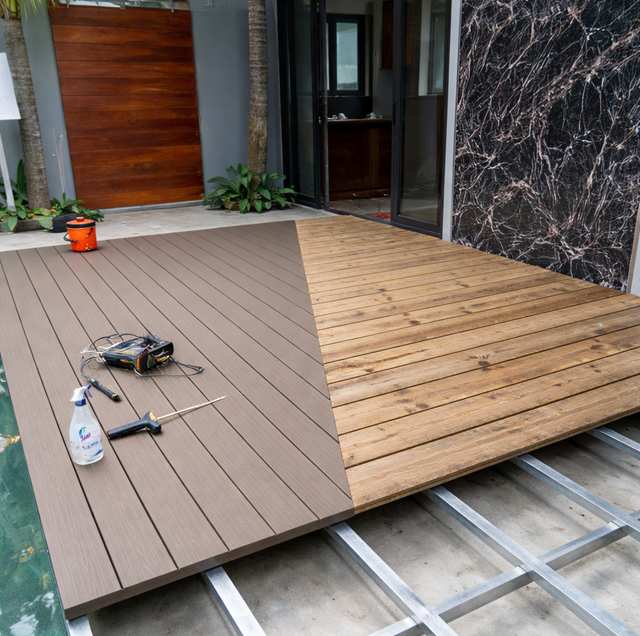
Quick Answer: Composite decking resists moisture, rot, and insects without staining or sealing, but runs hotter underfoot. Pressure-treated lumber resists decay chemically but absorbs moisture and needs periodic resealing. Pick based on how much upkeep you want to take on.
Every deck rebuild reaches one material decision that shapes years of upkeep afterward: composite decking or pressure-treated lumber. Both do the same basic job: they span the joists and take the weather, but they get there through opposite strategies. Composite works by keeping moisture and ultraviolet light away from a core that would otherwise degrade. Pressure-treated lumber works by chemically resisting the organisms that break wood down, while still being wood that absorbs, moves, and needs upkeep. Neither material is better across the board. The right pick depends on how much maintenance you want to take on, how the deck will get used, and which trade-offs you'd rather live with for the next couple of decades.
What Composite and Pressure-Treated Decking Actually Are
Modern composite decking is almost always capped composite: a core built from wood fiber and recycled plastic, wrapped in a separate protective outer shell, the cap, that does the actual weather-resisting. That cap keeps moisture, UV, and staining agents away from the core underneath, and it's also why color on a capped board runs through the shell rather than sitting on top of it the way a stain sits on wood. A scratch or a gouge doesn't expose a different-colored layer underneath the way a scuffed, sealed board can.
Pressure-treated lumber is still solid wood, most often southern yellow pine, run through a pressure cycle that forces a chemical preservative deep into the fiber. That preservative gives the wood real resistance to rot fungi and wood-boring insects. However, it doesn't change wood's basic behavior: the boards still absorb and release moisture with the weather, swell and shrink along the grain, and need a separate finish, a stain or sealer, applied afterward to slow that moisture movement and hold their color.
The Comparison, Attribute by Attribute
| Attribute | Composite Decking | Pressure-Treated Lumber |
|---|---|---|
| Moisture & Rot Resistance | Cap sheds water and resists rot inherently; core doesn't feed fungi | Preservative resists decay, but the wood still absorbs moisture and can rot where the treated layer is cut or gouged |
| Maintenance Cadence | No staining or sealing needed; periodic cleaning keeps mold and mildew off the cap | Needs sealing or staining on a schedule tied to how the wood is wearing, not a fixed number of years |
| UV & Heat Behavior | Cap resists fading, though darker colors can get notably hot underfoot in direct summer sun | Grays and roughens at the surface under UV unless resealed; generally cooler underfoot than dark composite |
| Freeze-Thaw Behavior | Core doesn't absorb water the way wood fiber does, so ice has less to work with structurally, though boards still expand and contract with temperature | Absorbs water into checks and fastener holes, where repeated freezing and thawing can widen cracks over a winter |
| Fastener Considerations | Typically uses hidden-fastener clip systems designed for the board's groove; face screws where visible fastening is used | Needs fasteners rated for treated lumber, hot-dip galvanized or stainless; standard uncoated steel corrodes against the preservative |
| Workability | More particular to cut and fasten; the manufacturer sets blade type, joist spacing, and board gap | Cuts, drills, and shapes easily with common tools; forgiving for field trimming, notching, and custom on-site work |
How Each Material Handles a Full Year of Weather, Not Just One Season
Freeze-thaw cycling gets treated like the headline stressor for outdoor decking in a cold-winter climate, but it's really just one half of what either material goes through across a year, and both materials face the other half too.
Pressure-treated lumber: In winter, water that's soaked into a check, a fastener hole, or an end grain cut can freeze, expand, and push that opening a little wider, then thaw and let more water in for the next freeze. Repeated over a whole season, that cycle can turn a hairline check into something you'd notice by spring. In summer, the stress just shows up differently: humidity keeps the boards swollen for longer stretches, straining fasteners and finish, while UV breaks down the surface lignin that gives the wood its color, which is why unsealed PT decking grays and roughens even through a dry summer with no freezing involved at all.
Composite decking: Because the core doesn't absorb water the way wood fiber does, freeze-thaw cycling has far less to work with structurally; there's no wet fiber inside the board for ice to expand against. What composite does face year-round is thermal movement: the boards expand and contract with temperature swings more than wood does, in both directions, so a board fastened too tight in cold weather can buckle once summer heat expands it, and one fastened without enough gap in hot weather can gap excessively once winter contracts it. Direct summer sun adds a second factor lumber doesn't deal with the same way: a dark-capped board can reach a surface temperature well above the surrounding air, which matters for bare feet even though it has nothing to do with the material's durability.
Maintenance Cadence: What Each One Actually Asks of You
Composite: No staining, no sealing, ever, is the standard pitch, and it's largely true. What composite does still need is periodic washing, mainly to keep mold, mildew, and pollen film from building up on the cap's surface, since a textured cap can hold grime the way a smooth painted surface wouldn't. A deck-safe cleaner and a soft-bristle brush, rinsed well, handle most of it.
Pressure-treated: The upkeep is real and recurring: cleaning debris out of board gaps, checking hardware for seasonal movement, and resealing on a schedule best judged with a quick water-bead test on the wood rather than a fixed calendar interval.
Fasteners and Hardware: A Detail That Gets Skipped
For pressure-treated lumber: the same copper-based preservative that resists rot is mildly corrosive to standard steel. Fasteners in direct contact with treated wood need a rating for treated-lumber contact, hot-dip galvanized at minimum or stainless steel for anything visible or structural, since an uncoated screw or joist hanger can corrode noticeably faster embedded in PT stock than it would in untreated wood.
For composite decking: most manufacturers specify a hidden-fastener clip system matched to the board's groove profile, which also gives the surface its uninterrupted look with no visible screw heads. Where a board does get face-screwed, composite-specific screws with a self-countersinking head are the standard choice, since a generic deck screw can mushroom the cap material around the hole instead of sitting flush.
Workability: Field-Cutting, Trimming, and Custom Work
Pressure-treated lumber is forgiving to work with on-site. It cuts cleanly with a standard circular saw blade, takes a screw anywhere without splitting if it's pre-drilled, and can be notched, beveled, or trimmed to fit an odd angle or an out-of-square ledger connection without much fuss. That workability is a real advantage on a deck with custom framing, curved stair stringers, or built-in benches and planters that need field adjustment.
Composite is less forgiving. Manufacturers specify a particular blade type to avoid melting or tearing the cap, a minimum joist spacing that's often tighter than what wood needs at the same span, and a board gap that can shift depending on the installation temperature, since the boards will expand or contract after they're fastened. None of that makes composite hard to install correctly, but it does mean the margin for improvising a cut or a fastening method on-site is smaller than it is with lumber.
Which One Fits the Project in Front of You
Composite and pressure-treated decking are both proven materials, chosen by different builders for different priorities rather than because one is objectively the stronger product. A deck that gets heavy use and infrequent attention, a rental property, a second home, or a homeowner who'd rather not think about resealing gets more out of composite's low upkeep. A deck that needs custom framing, odd angles, or stair stringers cut to fit an uneven yard, or a homeowner who's comfortable with a periodic sealing routine, gets more out of pressure-treated lumber's workability. Whichever material ends up on the joists, the freeze-thaw and UV cycling covered above happen to both, every single year, and building the maintenance plan around the whole year instead of whichever season is outside the window right now is what keeps either material performing the way it's built to.
Frequently Asked Questions
Yes, and this is actually the standard approach. Nearly all composite decking sits on a pressure-treated or engineered-lumber substructure, joists, beams, and posts, because composite boards aren't rated as structural framing material on their own. What changes between a wood deck and a composite deck is usually just the visible surface material and its fasteners; the substructure underneath is pressure-treated either way, and it needs the same freeze-thaw and moisture planning regardless of what's fastened on top of it.
The gap between PT boards is mainly for drainage and general wood movement, not thermal expansion, so lumber doesn't carry a manufacturer-specified tolerance the way composite does. Composite expands and contracts more with temperature, so manufacturers typically specify both a board-to-board side gap and a separate, usually larger, butt-end gap where two board lengths meet; getting that butt-end gap wrong, rather than the side gap, is the more common installation mistake, since it's easy to butt two lengths tight and not notice until a hot day pushes them together.
Yes. PT lumber is rated by exposure category: above-ground contact for framing and decking that stays clear of soil and standing water, and ground-contact, which carries a heavier preservative retention, for posts set in or near soil or for a ledger board where moisture tends to concentrate at the house connection. Composite doesn't come in these grades, since composite boards are never used as ground-contact structural members the way a post can be.
Early, uncapped composite, sold widely in the late 1990s and 2000s, used a wood-plastic blend with no protective outer shell, so the exposed wood fiber in the mix could still absorb moisture and grow mold, and its color faded unevenly as the plastic broke down under UV. Capped composite, the standard sold now, solved both problems by wrapping that same core in a separate weather-resistant shell, which is why most of the mold and fading complaints tied to composite decking trace back to that older, uncapped generation rather than what's on the market today.
Some, but differently than wood does. Most capped composite goes through an initial color shift in the first few months outdoors as the surface finishes weathering in, then holds its color far more evenly than PT lumber afterward, since the color runs through the cap rather than sitting on the surface the way a stain does. Manufacturers typically note that early settling period on the product data sheet so it isn't mistaken for a defect.
No, and it's worth checking both before deciding. Composite manufacturers typically back the material itself with a longer limited warranty than a lumber mill offers on PT stock, since composite is a manufactured product built to a consistent spec. A PT lumber warranty, when one exists, usually only covers the wood against structural decay from the preservative failing, not against warping, checking, or surface graying, which mills treat as normal wood behavior. Exact terms vary by brand and are worth confirming directly rather than assuming.
Talk through composite vs. pressure-treated decking — get hands-on input on which material fits your deck rebuild. Precision Home Worx serves Wilmington, Bear, Newark. Call (302) 500-3676.


