
Cracked Drywall: What the Crack’s Shape Really Says
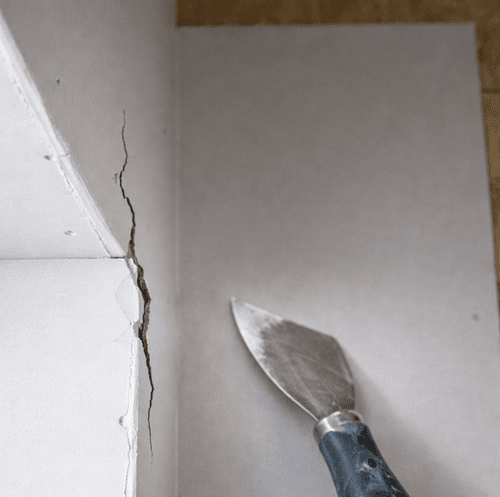
A crack running straight down a taped seam and a crack angling out from the top corner of a door frame can look nearly identical on a quick pass through a room, both thin, both painted over, both easy to ignore. But they record two different stories about what is moving behind the wall. The seam crack is usually a tape joint giving up its grip. The corner crack is drywall reacting to stress that has to travel somewhere, and where that stress comes from is the question worth answering before anyone reaches for the spackle knife.
Most cracked drywall is cosmetic. Framing shifts with the seasons, tape joints fail, and gypsum panels flex without anything structural happening. Shape and direction narrow the list of suspects, but two cracks that look nearly identical can have opposite causes, and staring at one longer won't settle which is which. What closes that gap is what's inside the crack right now and what happens to it after it gets patched properly, two tests most homeowners never think to run.
Quick Answer: Crack shape narrows the suspects, but two tests settle it: what's inside the crack (old paint and dust mean it's settled, clean dust means it's active) and whether a patch holds. Reopening within weeks of a repair signals ongoing movement.
What the Crack's Shape Still Tells You
Direction and location are a reasonable first filter: a hairline crack running straight along a taped seam, vertical or diagonal at roughly 45 degrees off a door or window corner, is almost always ordinary stress finding the weakest plane in the wall, and a stair-step crack following mortar joints in a block or brick wall points to differential movement worth a second look. Pattern and direction are covered in more depth elsewhere on this site. Shape gets you a rough sort, not a diagnosis: two hairline diagonal cracks off the same style of corner can be a settled non-issue in one house and an early warning in another, and shape alone won't tell them apart. The two tests below do a better job.
The Debris Test: Dating a Crack From What's Inside It
Before doing anything else to a crack, gently work the tip of a putty knife into it and widen it slightly. What comes out, and what's visible along the exposed edges, tells you roughly how long the crack has existed and whether it's still active.
A crack that's been open a while usually shows it: layers of old paint built up along the edge from however many repaints the wall has seen, plus a fine coating of household dust settled into the gap. That combination points to a crack that opened once and has mostly sat there since, a strong mark in the cosmetic column regardless of shape.
A crack that's new or still opening looks different: the gypsum dust along the break is bright white rather than yellowed, and if it's torn through the paper facing, the paper edges look fresh rather than dulled with age. Neither has had time to happen yet, meaning the crack is either brand new or still actively growing, and that changes how closely it's worth watching.
It's a field read, not a lab result, but paired with the patch test below, it sorts a crack better than width or angle ever will alone.
The Patch Test: The Most Reliable Signal a Homeowner Has
Shape and debris both describe a crack at a single moment; the patch test describes what the wall does next.
A proper patch means taping the crack, applying two or three thin coats of joint compound feathered wide, sanding smooth, priming the bare compound, and painting to match, not a quick smear of spackle over the top. Once that repair is done and fully cured, the wall goes quiet for a while. What happens after that is the actual test.
A crack that stays gone through a full swing of weather, a dry winter stretch and a humid summer one, or the reverse, was almost certainly a one-time event: a seasonal movement cycle or a settling episode that released and finished. Nothing behind that patch is still active, whatever the crack's original shape or width happened to be.
A crack that reopens tells a different story, and timing is the part most people skip past. Reopening within a few weeks of the patch, well before any real change in the weather, points toward movement that's ongoing right now rather than tied to a season, since ordinary cyclical flexing needs a real humidity or temperature swing to trigger it. A crack that comes back a full year later, during the next comparable weather stretch, fits normal seasonal cycling, finding the same weak spot again rather than something new. A hairline reopening in exactly the old spot, short of the crack's original width, is a milder result than a full-width return, worth watching rather than escalating right away.
This test beats a first look at shape because it measures whether movement is still happening, not just what a crack looked like once.
When the Crack's Own Angle Shifts
One detail shape-reading usually misses: the angle of a diagonal crack isn't always constant along its length, and when it changes, that shift is telling you something the starting angle alone can't.
A diagonal crack that holds a steady, steep angle from corner to end behaves like ordinary corner-stress cracks, tracing a direct path away from the opening. A crack that starts steep near the corner but gradually flattens the farther it travels is picking up a different kind of stress, more in line with the lateral pressure behind a horizontal crack than the shrinkage stress behind a corner crack. That flattening, not just the fact that the crack started diagonal, is the part worth noting, and it's easy to miss on a quick glance since the crack still reads as "diagonal" from across the room.
The reverse, a crack that starts shallow and steepens toward vertical as it travels, generally reads the other way: settling back into ordinary shrinkage stress rather than picking up anything more serious. Neither direction of change is a verdict by itself, but it's information a static vertical-versus-diagonal read throws away entirely.
Horizontal Cracks: What Actually Deserves a Closer Look
A horizontal crack has an outsized reputation for meaning trouble, and in the wrong location that reputation is earned. On a below-grade or foundation wall, a long horizontal crack usually points to lateral pressure pushing in from one side, soil or water pressure outside the wall, a different and more serious mechanism than vertical shrinkage cracking. Above grade, a long, unbroken horizontal run that doesn't follow any seam is unusual enough to be worth a professional look rather than a routine patch.
But not every horizontal line in a wall is that crack, and two common ones aren't. Standard drywall panels are typically hung horizontally in a home, which puts long taped butt seams running across the wall at a fairly consistent, mid-wall height. A crack following one of those horizontal seams is a normal taped-joint failure, the same mechanism as a seam crack running vertically, and it deserves the same cosmetic read rather than an automatic escalation just because the seam runs sideways instead of up and down. The second exception is a horizontal gap at the wall-to-ceiling joint that opens in cold weather and closes back up when humidity returns; that pattern is truss uplift, a seasonal movement in roof framing rather than anything wrong with the wall, and it's covered in more depth elsewhere on this site rather than repeated here.
A long horizontal crack that isn't following a seam, isn't at the ceiling line, and is on a below-grade or foundation wall: treat it as a pattern that needs a professional look rather than a routine patch, even while it's still narrow.
Where Patching Ends, and an Engineer's Assessment Begins
Reading a crack, its shape, what's inside it, and what it does after a patch, is a diagnostic starting point, not a structural determination. Patching and repairing drywall, including cracks that turn out to be cosmetic, is handyman and maintenance work handled directly, in-house. Figuring out why a wall or foundation is actually moving, and what needs to happen to stop it, is different work entirely, and it belongs to a structural engineer or another licensed professional who can assess the framing, foundation, or masonry in person.
When a crack lands in the worth-a-closer-look category, whether that's a horizontal crack on a foundation wall, a crack that keeps reopening within weeks of a proper patch, or any crack paired with doors that no longer latch or a floor with a new slope, the honest next step is flagging it rather than patching over it and hoping it holds. A repair on a wall still moving underneath won't hold, and covering the evidence without addressing the cause just delays a harder conversation later. The role here is reading the wall accurately, repairing what's actually cosmetic, and pointing toward the right professional the moment a pattern crosses into structural territory.
Frequently Asked Questions
It works, but it takes a slightly wider look. On a heavily textured wall, like knockdown or orange peel, the texture compound sheds a coarser debris than a smooth wall does, so a thin dust film is harder to read; widen the test window an inch or two rather than checking just the hairline itself. On a wall with several repaints, count matters more than color: several distinct paint layers at the edge means the crack has survived that many repaint cycles, a rough stand-in for age when the newest layer alone doesn't tell you much.
Yes, and it's worth tracking separately from the flattening itself. A crack that flattens near where it starts, right at the door or window corner, is more likely to pick up header or framing stress close to the opening. One that stays steep near the corner and only flattens well out toward the middle or far end of its run is more consistent with pressure acting on the wall itself, farther from the opening, rather than stress gathered at the header. Neither location changes the basic read that flattening deserves a second look, but it helps narrow down what's actually pushing on the wall.
Generally, yes. Homes built on a slab rarely have exposed block or brick wall inside living space, so stair-step cracking usually shows up outside on an exterior masonry foundation wall, where it's easier to spot early rather than hidden behind drywall. A home with a basement or crawlspace is the setting where a stair-step crack in masonry is more likely to show up as a stepped line in a finished wall, since block foundation walls there are often covered over.
It should factor in, but it isn't the deciding clue by itself. Cold, dry winter weather pulls moisture out of framing lumber and can widen gaps at seams and corners; a hot, humid summer stretch does the same in reverse, swelling the wood and stressing the same joints differently. A crack that shows up every winter and closes back up by summer is behaving like ordinary seasonal cycling regardless of which season it's checked in. What matters more than the calendar is whether the crack holds the same shape and width across a full cycle of both extremes.
It can cost you the one read that actually helps. Fresh paint covers the old-paint-and-dust signs that mark a settled crack and the clean-gypsum signs that mark a new one, so once it's painted, dating the crack from what's inside it isn't an option until it reopens and exposes fresh edges again. A better sequence is to gently open the crack slightly with a putty knife, check what's inside it before doing anything else, and only paint once you've noted what you found. That short check asks almost nothing of you and turns a guess into an actual answer.
Most cracks in a home earn a shrug once you know what to check: a straight hairline at a seam, dated by what's inside it as old news, gone for good after a proper patch. The ones that deserve a slower look are the outliers: a crack that reopens within weeks of a real repair, one whose angle shifts as it travels, or a horizontal line on a foundation wall that isn't following any seam. Checking what's inside a crack and watching what happens after it's patched tells you which kind is on your wall better than a glance ever could.
Have a cracked wall patched and repaired, or get a pattern that looks like more than cosmetic damage flagged before it spreads further — schedule a drywall assessment. Precision Home Worx serves Wilmington, Bear, and Newark. Call (302) 500-3676.


