
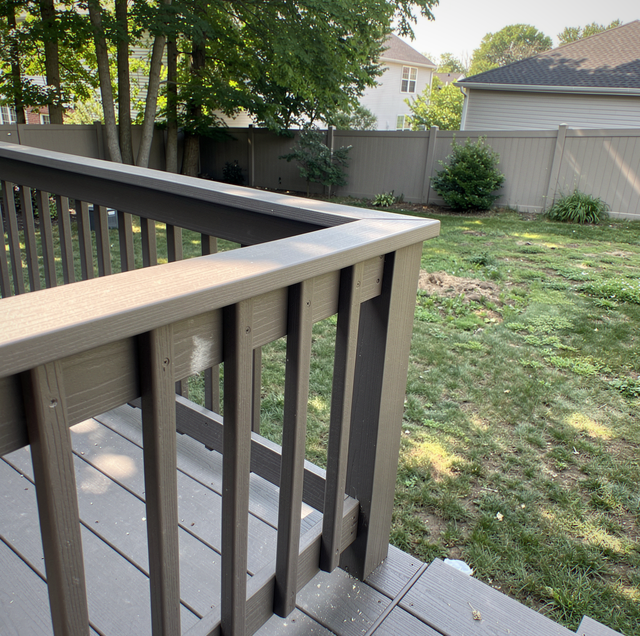
A deck railing does one job no matter what it's built from: stop a person's weight from going over the edge, through a post that's tied into the deck's framing rather than screwed to whatever board happens to sit underfoot. Past that shared requirement, wood, composite, cable, glass, and metal solve the problem in different ways, and each trade off view, upkeep, and how the posts attach to the structure in ways that shape years of maintenance and how the deck reads from the yard. A side-by-side look at view, upkeep, what wears, and how posts attach sorts the five by what sets them apart.
| Material | View | Upkeep | What Wears | Posts and Attachment |
|---|---|---|---|---|
| Wood | Traditional, mostly closed by balusters | Stain or seal on a cadence judged by how the finish looks, not a fixed calendar date | Splits, checks, and fasteners that work loose | Notched or bolted into the framing; needs solid blocking under the post |
| Composite | Same closed baluster look as wood, more color choice | No staining or sealing; occasional cleaning | Cap can chalk or dull unevenly with age | Bolts to composite or treated posts the same way wood does |
| Cable | Mostly open; the horizontal lines stay visible | Periodic re-tensioning as the cable settles | Turnbuckles and fittings loosen; wire can corrode at swaged ends | End posts absorb the whole run's tension and need reinforced framing |
| Glass | Most open of the five; close to unobstructed | Glass cleaner only; no fading to manage | Gaskets holding the panel age; a panel can crack on impact | Metal or wood posts frame the panel; the base track ties into the deck's rim |
| Metal | Partial, set by picket spacing | Powder-coated aluminum needs little; painted steel needs repainting eventually | Aluminum resists corrosion; steel rusts once its coating breaks | Through-bolted, or surface-mounted to the top of the decking |
What a Railing Has to Do
Before any material choice, a railing has one structural job: resist someone's weight pushing sideways or leaning into it, and carry that load down through a post into the deck's framing. The builder designs the posts, connections, and infill to the railing requirements that apply to the deck; that engineering sits underneath the material choice, not on top of it. The material you pick changes the view, the upkeep, and how the infill attaches between posts. It doesn't change the requirement that the posts underneath be tied into real framing.
Wood and Composite
Wood and composite share the same basic railing shape: a top and bottom rail with vertical balusters between posts, closing off most of the view. Wood is the traditional choice, cut and fastened on-site with common tools, and it can be painted or stained if you want something other than its natural tone. Composite railing mimics that closed profile in a capped, pre-colored material that needs no paint or stain.
A humid summer followed by a freeze-thaw winter puts real, repeated stress on any railing material built from wood fiber. Where that seasonal swing runs hard, an unsealed wood rail checks and cups as moisture moves in and out of the fiber, and fasteners at the joints loosen with it; in a milder climate the same wood still moves with the weather, but that stress stays slight. A capped composite rail sheds that moisture, so the wet-freeze cycling that works on bare wood has little to act on.
Cable
A cable railing replaces the baluster infill with horizontal steel cables run under tension between a run of posts, which is what gives it a mostly open view compared to a solid baluster line. The end posts at each run carry the cumulative pull of every cable strung between them, so those posts and their framing connection need to be built heavier than a baluster post would be. Cable doesn't stay tensioned forever: the wire settles slightly as it's used and as temperature swings stretch and relax it, so a cable rail needs periodic re-tensioning at the turnbuckles rather than a one-time setup. Because the cables run horizontal, some designs add a rigid intermediate rail so the run doesn't read as a climbable ladder, and closer cable spacing limits the gap a child or pet could slip through, a consideration a solid infill material doesn't raise the same way.
Glass
Glass panels set into a frame or base track give the most open view of the five, with a top rail or post structure holding the panel rather than a row of balusters interrupting it. Because the panel is a single solid barrier rather than a series of gaps or horizontal lines, it offers no footholds in the infill, which suits decks where kids or pets are a factor alongside the view. Upkeep runs to glass cleaner rather than stain or sealer, and the panel itself doesn't fade the way a painted or stained material can. What wears on a glass railing is the hardware holding it: the gasket or spacer seated between the panel and its frame ages with UV and weather exposure over the years, and a panel can crack from a direct impact even though the glass itself doesn't degrade sitting in place.
Metal
Metal railings, with aluminum or steel pickets set between posts, land between wood and glass in openness, since the view through them depends on how far apart the pickets are set. Aluminum resists weathering on its own, though its mounts need to be kept from direct contact with treated lumber, and it carries a factory powder coat that needs little beyond occasional cleaning. Steel offers a different look and stiffness but relies on its paint or coating to keep rust off; once that coating chips or wears through, exposed steel corrodes and needs attention before the rust spreads under the remaining finish. Both metals attach to the deck the same two ways every material does here: bolted through the rim joist or a post, or surface-mounted to the top of the decking.
The Posts and Connections Under Any Railing
Every material above rests on the same foundation: a post that has to withstand someone leaning on or falling into it, not just carry its own weight. A post can attach two ways. Bolting through the rim joist or a doubled joist connects the post to the deck's structural frame rather than to the decking alone. Surface-mounting a post to the top of the decking with a base plate skips that connection to the frame entirely, so the fasteners holding the plate down do all the work that a bolted connection would share with the framing underneath. Neither method is wrong on its own, but a surface-mounted post requires fewer fasteners and needs solid blocking under the decking at that spot rather than open space between joists.
A loose railing post can give way the moment someone leans on it. If a post wobbles at its base, keep people off that section and leave the connection to a deck builder to rebuild into the framing.
Matching the Railing to the Deck
The railing material doesn't have to match the decking board underfoot, but it does have to match the deck's intended use and what's already built. A deck with kids or pets weighs the closed view of wood, composite, or metal against the open sightlines of cable or glass differently than a deck built purely for a view does. Whatever material ends up between the posts, the posts and their connection into the framing are what the railing's real job depends on, and that part of the decision matters more than the color or profile on top of it.
Frequently Asked Questions
No. Railing height and strength requirements apply regardless of the infill, and the builder designs the posts to meet them; glass infill must also be safety glass rated for railing use. Switching between wood, composite, cable, glass, or metal pickets doesn't raise or lower what the structure underneath has to do.
Because a horizontal cable can deflect between posts under a sideways push, cable systems are designed with closer post spacing than a picket or baluster railing requires for an identical run, so the wire stays within its rated deflection rather than bowing under load. That closer spacing is one reason a cable railing's post count doesn't map directly onto a baluster railing's layout even when both run the same distance.
Through-bolts alone allow a post to lever against the rim board; a builder adds a tension tie or hold-down that anchors the post to a joist running into the deck, so the sideways load is transferred to the framing.
Yes, as long as the existing posts and their connection to the framing can take the different load paths each material imposes; cable's end-post tension and glass's panel weight don't distribute the same way a row of balusters does. The posts themselves may need to be reinforced or replaced along with the infill rather than reusing the original posts as-is.
It depends on the metal. A powder-coated aluminum rail's factory coat is cured under conditions a touch-up can't match, so a worn aluminum rail is repainted with an aluminum-specific primer or replaced. A painted steel rail can be sanded back to sound metal and repainted, which is part of why steel remains a viable choice for someone willing to keep up with the maintenance.
There's no fixed schedule; it depends on the run's length, how the cable was installed, and how much temperature swing the deck sees, all of which affect how quickly the wire settles. A cable rail is worth checking by hand periodically rather than on a calendar, since a cable that's gone slack enough to sag or feel loose at a post is a clear sign it needs attention, not a specific number of months or years.
Ask about the railing on your deck build or repair — posts tied into the framing, with the infill chosen for your view and upkeep. Precision Home Worx serves Wilmington, Bear, and Newark. Call (302) 500-3676.

