
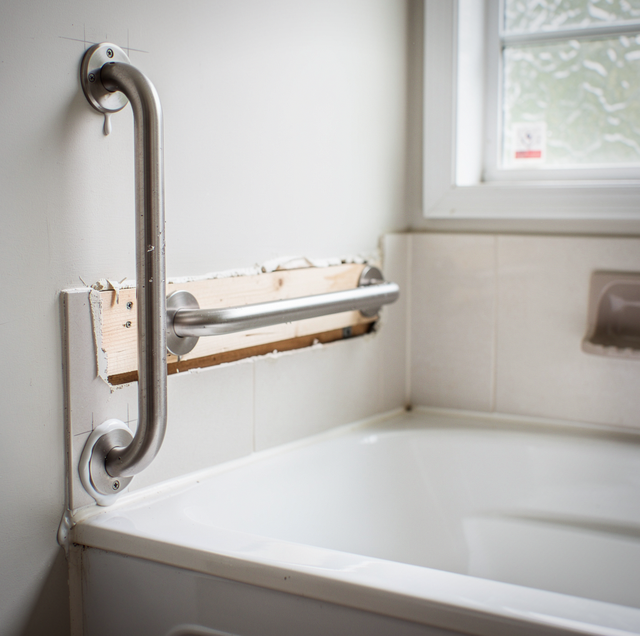
There is a stubborn idea that any grab bar, as long as it's labeled "grab bar" and screwed to the wall, will hold a person's weight in an emergency. It won't, at least not reliably, and the reason has nothing to do with the bar itself. Drywall alone was never designed to bear a sudden, sideways load from someone catching their fall. A grab bar is only as strong as what its screws bite into, and in most bathrooms, that's the part nobody thinks to check before installing one.
Why Drywall Alone Fails Under Real Weight
Standard drywall, whether it's half-inch or five-eighths, is a gypsum panel meant to hold light, evenly distributed loads like a picture frame or a towel hook. A grab bar sees a completely different kind of force: a sudden, often diagonal pull from a person's full body weight, sometimes 150 to 250 pounds, applied in a fraction of a second. Drywall anchors rated for that kind of static pull-out force exist, but even the best ones are only as strong as the paper and gypsum core surrounding them, and that core crumbles under a sharp, off-angle jerk in a way it wouldn't under a slow, steady pull. A bar mounted only into drywall can look perfectly secure for months and then fail at the exact moment someone actually needs it, which is the worst possible time for a fastening problem to show up.
What Actually Needs to Be Behind the Bar
The fix is finding solid backing, a wood stud, a horizontal blocking board installed between studs, or in some bathrooms, a layer of half-inch plywood mounted behind the drywall during a remodel specifically to support future grab bars. Wall studs in most homes sit 16 inches apart on center, which rarely lines up with where a grab bar actually needs to go relative to a tub, toilet, or shower entry. That mismatch is exactly why so many grab bars end up mounted into drywall alone: the "correct" spot for the bar and the nearest stud are almost never in the same place.
The better approach is installing horizontal blocking, a piece of dimensional lumber run between two or more studs at the height grab bars are likely to be needed, either during a bathroom remodel or as a standalone project before the bars go in. That blocking gives solid backing across the entire span where a bar might be mounted, rather than being limited to whatever two stud locations happen to exist.
Finding What's Already There
Before assuming a wall needs new blocking, it's worth checking what's already behind it. A stud finder that detects density changes can reliably locate studs in most walls, though tiled bathroom walls with cement backer board sometimes confuse basic stud finders because the backer board itself reads as solid. Tapping the wall and listening for a duller, more solid sound versus a hollow one is a rough secondary check, though it's far less precise than an actual stud finder or, in a remodel situation, simply looking at the framing directly before drywall goes back up.
Toggle Bolts Aren't a Substitute for Studs
Heavy-duty toggle bolts are sometimes marketed as strong enough to mount a grab bar without hitting a stud, and while they distribute load better than a standard drywall anchor, they still rely on the drywall itself as the primary holding surface. Manufacturer testing for most toggle-bolt-mounted grab bars assumes installation into framing for the rated weight capacity to apply; when used in drywall alone, that rated capacity doesn't transfer the same way, because the failure point becomes the gypsum core tearing around the toggle, not the bolt itself failing.
Bar Placement Matters as Much as Backing
Even with solid backing, a grab bar in the wrong spot doesn't help much. Bars near a tub are most useful when mounted vertically at the entry point, where someone is stepping over the tub wall and needs something to hold while shifting weight, and horizontally along the back wall at a height that roughly matches where a hand naturally reaches while seated or standing in the tub. Toilet-area bars work best mounted at a height and angle that matches how someone actually pushes up from a seated position, angled slightly rather than perfectly horizontal, since a horizontal bar forces an awkward wrist angle during the push.
Why This Gets Overlooked So Often
Grab bars are frequently added as an afterthought, purchased online and installed with whatever anchors came in the box, often by a well-meaning family member working quickly to make a bathroom safer after a fall or a diagnosis changes what a household needs. That urgency is understandable, but it's also exactly the situation where checking for solid backing gets skipped, because the goal in the moment is to have a bar on the wall, not necessarily to have the right blocking behind it.
What a Proper Installation Actually Involves
A grab bar installed the right way starts with locating framing, not just picking a spot that looks convenient next to the tub or toilet. Once studs or blocking are located, the flange holes get marked, pilot holes drilled to avoid splitting the wood, and lag screws or heavy-duty structural screws driven into solid framing rather than relying on the drywall anchors that usually ship in the box with a big-box-store bar. If the ideal mounting location falls between studs with no blocking behind it, the honest answer is that the wall needs to be opened, blocking added, and the drywall patched before the bar goes in permanently, rather than settling for a compromise position just because it happens to line up with a stud.
Silicone sealant around the base of each mounting flange matters more than it might seem. Bathroom grab bars sit in a wet environment daily, and water that gets behind an unsealed flange can wick into the wall cavity around the screws, slowly rotting the wood blocking or framing it's anchored to. A bar that was mounted correctly five years ago can still fail today if water crept in around an unsealed flange the entire time, which is why sealing the perimeter isn't a cosmetic step; it's part of what keeps the mounting solid for the long run.
Retrofitting an Older Bathroom Without a Full Remodel
Many older homes have bathrooms built well before accessibility was a design consideration, which means walls with no blocking anywhere near the tub or toilet. Retrofitting doesn't have to mean gutting the room. A targeted section of drywall, sized just wide enough to reach the studs on either side of the intended bar location, can be cut out, blocking installed and screwed into the studs, then the drywall patched, taped, and refinished to match the surrounding wall. That targeted approach keeps the project contained to a repair rather than a remodel, while still giving the grab bar the same solid backing it would get in a newly built bathroom.
Frequently Asked Questions
Yes, with the right approach: drilling with a masonry or diamond-tipped bit at a slow speed to avoid cracking the glaze, then anchoring into whatever is behind the tile, ideally a stud or blocking rather than just the backer board. Rushing the drilling step or using a standard wood bit on tile is the most common cause of tile cracking during a grab bar install.
Bars mounted into solid framing or blocking with the correct fasteners are typically rated for 250 to 300 pounds of static load, well above what a sudden grab during a slip would generate, whereas the same bar in drywall alone often can't be reliably rated much past casual, steady-pressure use.
Yes, and this causes real confusion. Towel bars are built for light, steady loads and often use thinner-walled tubing and lighter mounting flanges; grab bars use thicker tubing and reinforced flanges specifically because they're engineered for a sudden, jarring pull, not just to hold a towel's steady weight.
A common reference point is 33 to 36 inches above the floor, though the right height depends on the person's height and mobility, which is why a bar installed for one household member sometimes needs adjusting if another family member relies on it later.
Yes, though it requires opening a section of drywall to install blocking between studs, then patching and refinishing that section, which is a smaller-scope repair than a full remodel but still more involved than a same-day bar installation. The opening is usually narrower than people expect, often just wide enough to reach the two studs on either side of the bar location, roughly a foot to eighteen inches, and the blocking itself is typically a piece of 2x6 or 2x8 lumber screwed directly into those studs. The bar can't go back on that same visit either, since the patched drywall needs to dry and be primed before it can hold paint or texture that match the rest of the wall.
No, effectiveness comes entirely from the mounting, not the finish. Manufacturers do offer bars finished to blend with bathroom hardware rather than looking clinical, which matters more for whether a household is willing to install them at all than for how well the bar performs once it's up.
The next grab bar that goes into a bathroom, whether it's a first installation or a replacement for one that's been loose for months, only needs one question answered before the drill comes out: what's actually behind that spot on the wall? Studs, blocking, or backing plywood turn a grab bar into hardware that holds; skipping that check just puts off finding out the hard way.
Schedule an accessibility modification — get grab bars, ramps, or other safety upgrades installed into solid backing that holds. Precision Home Worx serves Wilmington, Bear, and Newark. Call (302) 500-3676.


