
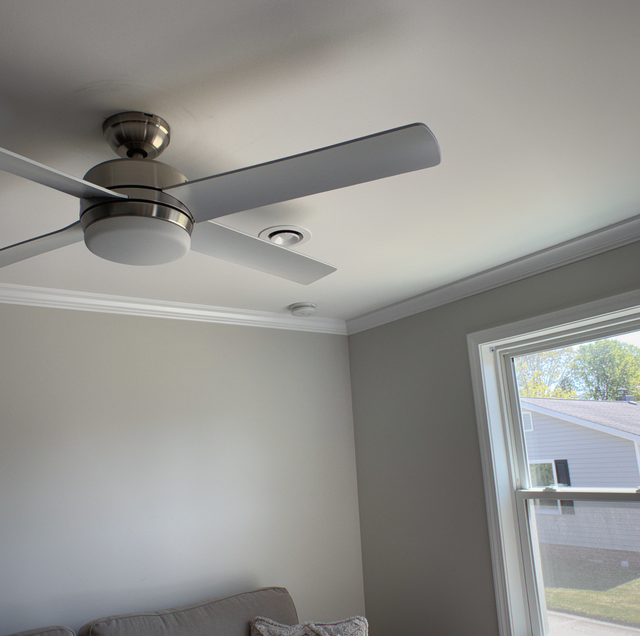
Ask five homeowners why their ceiling fan wobbles and four will blame the fan itself, as though you bought a cheap unit destined to shake loose above your head. That belief survives because a wobble looks like a flaw in your fan. It usually is not. Your wobble more often starts with dust on your blades, a bent arm from shipping, or a box behind your ceiling never built to carry a spinning load.
Knowing which of those is happening under your fan tells you whether your own screwdriver will settle it in your house, or whether you need someone qualified to open your box. What follows walks you through both, six causes you can check yourself, and where your part in the job ends.
Blade Wobble Versus Mount Wobble
Every ceiling fan wobble sorts into one of two families, and telling them apart takes about thirty seconds. Turn the fan on low and watch the blade tips from across the room, rather than standing underneath them. If one tip traces a wider circle, or dips lower at one point in its rotation, the problem sits at blade level.
If every blade tip stays level and the whole fixture still rocks or shudders at its base, the wobble is coming from above the blades, at the downrod or the mounting bracket. A blade problem is something you handle yourself; a mount problem can mean the box behind your ceiling was never built for a fan's weight.
Six Common Causes, Side by Side
Most service calls for a wobbling fan trace back to one of six causes, and those six split cleanly by family, as the table below shows.
| Cause | Which Family | What You'll Notice |
|---|---|---|
| Dust buildup on one or two blades | Blade | One blade dips lower on each rotation |
| A bent blade arm or bracket | Blade | Uneven gap between blade tips and ceiling |
| Loose blade screws | Blade | A faint clatter that starts and stops |
| Warped blade material | Blade | Wobble that worsens the longer the fan runs |
| Loose downrod or canopy screws | Mount | The whole fixture sways, not just the blades |
| A ceiling box not rated for fan weight | Mount | Wobble returns right after tightening |
Reading down that table moves from the causes you can clear with a cloth and a screwdriver to the ones that need the ceiling opened, which is also the order worth checking. The last row is the one homeowners miss most, since tightening everything within reach does nothing if the box itself is flexing behind the plate.
When the Ceiling Box Is the Real Problem
A ceiling box built for a five-pound light fixture and one built for a spinning fan are not interchangeable, even though both look identical once the canopy is screwed over them. A fan box has to hold up under a rotating load and the vibration that comes with it, hour after hour, for years.
A box that was never rated for that duty will flex almost imperceptibly with every rotation, and you will not see that flex from the floor. What you will feel, if you press a hand flat against the ceiling near the mount while the fan runs, is a faint pulse timed to the blade rotation, and that pulse is the box working loose from the framing a little more with every hour the fan spins. On the electrical service page, the pattern shows up by construction era: homes built between 1995 and 2010 commonly have ceiling boxes that weren't rated for fan weight, and a fan swap was frequently done years later without anyone swapping the box underneath it for a fan-rated one. Tightening the fan's mounting screws against a box like that buys you a few quiet weeks at most, because the screws anchor into a box that already has slack, not solid framing.
The fix in that case is not another turn of a screwdriver; it means replacing the box with one rated for fan duty and anchored to a joist, a step that goes past general tightening and belongs with whoever handles the fixture side of your job. A box that has flexed for years can also loosen the wire connections inside the canopy, turning a mechanical wobble into an electrical question. Homeowners who skip that step and simply reinstall the same fan on the same box usually see the wobble return within a season, because nothing about the framing behind the plate has changed. Catching it during the fan swap, not after a second failed fix, is what keeps the repair to one visit and not two.
What Warps a Fan Blade Long Before You Ever Notice the Wobble?
Plastic and pressed-wood fan blades absorb moisture unevenly, and a bathroom-adjacent fan or one mounted over a sunny window will pick up humidity on one face faster than the other. That uneven absorption bends the blade a few degrees along its length, and a few degrees at the tip becomes a visible wobble once the fan spins fast enough to magnify it.
Heat plays a similar role: a blade that sits closer to a recessed light or a sun-facing window cycles through more expansion and contraction than its neighbors, and repeated cycles eventually bend the material that started out flat. Dust adds a second, faster kind of imbalance on top of any warping already underway. A blade coated more heavily on its leading edge behaves as if it were carrying slightly more mass at that point, and mass sitting off-center at the tip of a spinning arm shows up as motion you can see from across the room.
Wipe each blade with a damp cloth along its full length, not just the top surface, since dust collects on the underside too. Between warping and dust, warping is the cause that keeps coming back after a cleaning fixes things for a week or two. If tightening and dusting settle a wobble and it returns within a month on the same blade, that blade has likely warped enough that cleaning will not hold the fix, and it becomes a candidate for replacement. A blade replaced on its own, without checking whether its neighbor is warping too, can leave you back on the ladder within another season.
Fixes You Can Try From a Ladder
Start with the balancing kit that came with the fan, or a universal kit from a hardware store, since it carries both the clip and the weights. Clip it to the middle of each blade in turn, run the fan on medium, and move the clip toward the tip in small steps; your fan should settle within four or five tries. Then stick an adhesive weight at that spot and remove the clip.
Before reaching for the kit, check the simpler causes first. Confirm every blade screw and blade-arm screw is snug, since a loose blade behaves like an unbalanced one even when the blade itself is fine. Check that all four or five blades sit at the same distance from your ceiling; a gap of even a quarter inch on one blade points at a bent arm, not a balance problem.
If the downrod itself has any play, tighten the setscrew at the top where it meets the mounting bracket, and check the canopy screws holding that bracket to your ceiling plate. A fan that still sways after every blade is balanced, every screw is snug, and the downrod is tight has told you the wobble was never about the blades, and that finding is your cue to stop working from the ladder.
Where a Handyman's Scope Ends and an Electrician's Begins
Replacing fans, swapping light-duty boxes for fan-rated ones, and reinstalling a fan with a wobble check built in are all handyman work. Everything past the fixture is a separate boundary, stated upfront before homeowners find it mid-repair. A crew that tells you where a job stops saves you a second appointment.
Panel upgrades, whole-home rewiring, and any work that touches a live circuit beyond swapping a switch or an outlet cover go to a licensed Delaware master electrician, not a general handyman crew, and that boundary is set before you ever book a visit.
Any repair beyond blade screws, balance clips, and mounting hardware should be handled by a licensed electrician, since the risk of electric shock begins once a canopy comes down on a live circuit.
That boundary exists because a wobble sometimes turns out to be a symptom of something upstream, at the switch or the circuit feeding the room, not anything happening at the ceiling box itself. A flickering fan light paired with a wobble, or a fan that changes speed on its own, points at wiring, and wiring beyond a cover plate is where the licensed side of the trade takes over from you.
The Part That Fails First When a Wobble Gets Ignored
A wobble left alone for months does not stay cosmetic. The motor bearing inside the fan housing is built to spin true on a load balanced within a narrow tolerance, and every rotation spent off that tolerance wears the bearing surface a little more unevenly than a balanced fan would. None of the six causes above wear that bearing quickly on their own, but stacked over a full season, an unbalanced blade and a flexing box feed the same wear from opposite ends of the fan, quietly, long before either one ever actually gets fixed.
Bearings fail gradually at first, as a faint hum that was not there before, and then abruptly, as a fan that seizes, grinds, or stops holding its speed. Of everything covered here, the bearing fails first, and once it goes, your fan needs replacing, not repairing, even if the box behind it was fine the whole time. A worn bearing costs more to replace than catching a wobble early ever costs you.
Chase a wobble down within the first week or two, before it costs you more than a tightened screw. A blade adjustment or a tightened screw costs you almost nothing. A seized bearing costs you the whole fixture, and an undersized mounting box costs you a second visit regardless of which one gets fixed first.
Frequently Asked Questions
Most fans settle within four or five tries once you find the blade that needs the weight, so plan on fifteen to twenty minutes for your first attempt. A fan with a warped blade takes longer to settle, since you are testing whether balancing helps at all before deciding the blade needs replacing, which can add 10 minutes to your afternoon.
A fan mounted to a box that has worked loose over years of vibration can eventually separate from its bracket above your head, though that is rare and takes years of neglect. Treat sway at the base as the sign to act on quickly, since your own tightening cannot fix a mounting problem, and it is one you should not leave through another season while you make up your mind.
No. Most wobbles trace back to dust, a loose screw, or a blade that needs balancing, and none of those touch the box behind your ceiling plate. A box swap only becomes necessary once you have ruled out every blade-level cause and your fan still sways at its base after tightening and balancing everything above it, which is why you should check the easy causes on your own before assuming the box is the problem.
Turn the fan off at the wall switch before you touch any screw, and cut power at the breaker before you open the canopy itself, since a screwdriver against a live connection is how a simple tightening job turns into a shock hazard for you. None of the balancing or tightening steps described here require the canopy to come off, and every screw they touch sits well clear of any wire, which keeps your job on the switch and off your breaker.
A wobble that returns on the same blade within a month usually means that blade has warped enough that balancing only masks the imbalance temporarily, rather than correcting it for good. At that point the blade is worth replacing, not the balance you already dialed in, and a mismatched replacement blade can reintroduce the same wobble on a different arm if you grab whatever fits the socket instead of matching the original. Order that blade from your fan's maker, and give it a full week before you trust your fix.
Sort the symptom, not the repair. A fan that shakes, rattles, or hangs crooked is a mechanical fault, and it stays with whoever handles your fixture, up to and including the box behind it. A fault that shows up in how the fan behaves electrically is a different animal: a light that flickers as the blades turn, a speed that drifts with nobody near the wall control, a switch that runs warm, or a breaker that trips whenever the fan starts. Those point upstream of your ceiling, into wiring that a master electrician should open, and no tightening at blade level will quiet them. If you notice any of that alongside the wobble, say so when you book your visit, and the right trade shows up the first time.
A wobble diagnosis and, if needed, a fan-rated box swap — pinpoints whether your ceiling fan's wobble is due to a loose blade, a bent bracket, or a box that was never built to support a spinning ceiling fan, with a written scope before any work starts. Precision Home Worx serves Wilmington, Bear, and Newark. Call (302) 500-3676.


