
How Long Does a Bathroom Remodel Take? The Wait Isn’t the Work
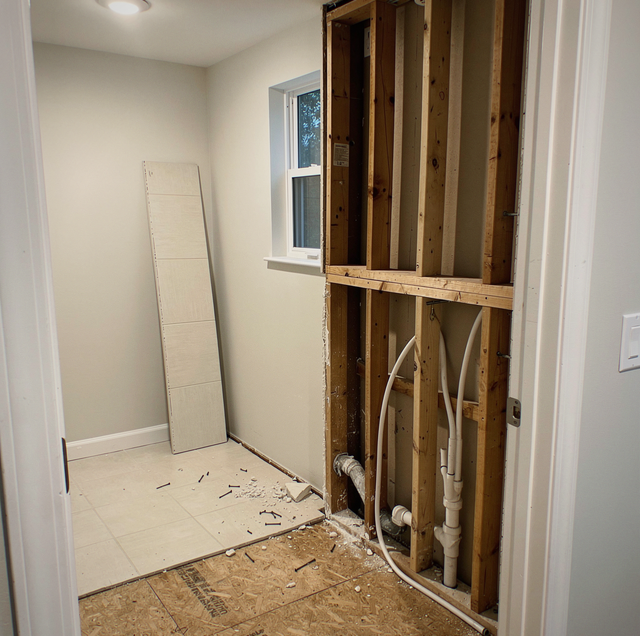
The tub surround comes off the wall before lunch on the first day of demo, and that is usually when a quoted timeline stops being reliable. Not because the crew fell behind, but because until that wall is open, nobody actually knows what is inside it. The working numbers look like this: active on-site work on a full bathroom gut generally runs two to four weeks, and the total elapsed time from order to finished room commonly runs six to twelve weeks. The gap between those two figures is where four separate clocks sit, all of them outside the crew's direct control: what demo uncovers, when an inspector can get to the site, how long a chosen material takes to arrive, and how long wet materials need to cure before the next layer goes on top of them. Knowing which of those four is running at any given point is the difference between feeling stuck waiting and understanding exactly what you're waiting on.
The Discovery Window: What Demo Has to Reveal Before a Date Means Anything
A bathroom remodel quote is built on what is visible: the layout, the fixtures coming out, and the general condition of the tile. It cannot get built from what is inside the wall, because nobody can see that until the wall comes down. That is the discovery window, and it is the first of the four clocks that actually control how long the job takes.
Three findings show up often enough that a crew expects at least one of them on a bathroom of any real age. Rot behind a tub or shower surround, worked in over years by a failed seal, leaves soft framing that has to come out and get replaced before anything new can bear weight there. A joist bay sized for an older build, or just built light to begin with, will not support a cast-iron tub or a stacked-stone shower base without added blocking underneath. And a drain that sits in the wrong spot for the new layout means moving cast-iron or galvanized pipe, not just swapping a new fixture onto the existing line.
None of that shows up in a walkthrough. It only shows up once the surround is off and the subfloor is exposed, which is why a firm finish date given before demo starts is a guess dressed up as a schedule. A real schedule is built from what is actually behind the wall, and that information does not exist until after demo, not before.
The Rough-In Wait Runs on the Inspector's Calendar, Not the Plumber's
Once the discovery issues get handled, rough plumbing and electrical go in: supply lines, drain and vent piping, and wiring for new outlets, a vent fan, or updated lighting, all run through open framing before anything gets covered. The physical work moves fast. A plumber and an electrician can usually rough in a single bathroom in a day or two. What is not fast is what comes next.
Where a rough-in inspection applies, drywall does not go up until it occurs, and scheduling that visit is the local building authority's responsibility, not the crew standing in the room. Your local building office is the only place that can tell you how its own queue runs. What crews commonly see is a rough-in inspection adding several days to a week onto a schedule, with the inspector's queue driving that, not the plumber's pace or the quality of the work behind the wall. A crew that finishes rough-in on a Tuesday can still be waiting into the following week for someone to sign off on it.
That wait is dead time for the crew. It does not have to be dead time for you. It is the window to lock in any material decision still open, because the material clock has usually been running since the day of the quote, whether anyone was thinking about it or not.
The One Decision That Blows Every Schedule: Choosing Materials After the Job Starts
Every material in a bathroom remodel has a lead time, and that clock starts the day a selection is finalized, not the day it is installed. A tile sitting in stock at a local supplier can be picked up the same week. A tile that has to come from a specific manufacturer run, or a vanity built to a nonstandard width, can take considerably longer, and that clock runs whether or not the crew is standing in the room waiting on it.
The single decision most likely to blow a schedule is choosing tile, a vanity, or fixtures after demo has already started, rather than before the contract is signed. At that point, the material clock and the construction clock are working against each other rather than alongside each other, and the crew either stalls, waiting on delivery, or moves ahead on unrelated work while the room sits unfinished around a hole where the vanity belongs.
Shower glass is the one material that cannot get front-loaded no matter how early it gets chosen. A frameless enclosure gets fabricated to the finished opening, and the opening is not finished until the tile is set. The glass fabricator has to template the actual space, not a set of drawings, because the tolerances are too tight to estimate from a floor plan. That means shower glass ordering can only start after the tile clock finishes, adding its own fabrication time on top of everything that came before it, no matter how early the style itself got picked.
A shower enclosure gets templated only after the tile is set, then typically takes one to two weeks to fabricate before installation. Scheduling that measurement as soon as tile goes in keeps this last step from adding extra idle days.
Cure Time Is Physics: Waterproofing, the Flood Test, and What Goes on Top
The last clock is the one with no way to talk it down: cure time. A waterproofing membrane goes onto the shower walls and pan first, and it has to cure fully, typically a day or two depending on the product and the room's temperature, before it can be tested. That test is a flood test: the pan gets filled and left standing, usually for a full day, to confirm nothing is weeping through a seam or a drain connection before anything permanent covers it.
Only once that membrane passes does tile go down over it, set in thinset mortar that needs its own cure window, commonly one to three days depending on the product and how much moisture is in the air, before grout can go into the joints. Grout clears in two stages, and they are not the same event: a tiled floor can be walked on well before the shower can be run, and the grout itself generally needs roughly 24 to 72 hours before any water exposure, depending on the product. Caulk at the corners and the tub-to-tile line needs its own day to set before the room counts as finished.
None of that compresses for a tighter deadline. A crew can move faster through the labor-intensive steps, but wet material cures at a fixed rate no matter who is watching the clock, which is why the finish stage is the one part of the job where adding more hands on-site does not buy back time.
A flood test holds standing water over whatever room sits below the bathroom. Watch the ceiling underneath during the test, not just the pan, so a weeping seam gets caught before it soaks finished drywall.
Which Clocks Can Overlap, and Which Cannot
Of the four clocks, only one can start running before the crew ever shows up: material lead time. A tile, vanity, or fixture ordered the day a design is finalized is often sitting in a warehouse by the time demo starts, which means the clock has already run for most of its duration before the job clock even begins. The other three run in a fixed order. Demo has to happen before rough-in, because the walls have to be open before new pipe or wire goes in. Where an inspection applies, rough-in has to clear it before it gets covered, because nothing goes over it, not drywall, not backer board, not tile, until that sign-off happens. And the finish sequence cannot start until rough-in is closed in, because waterproofing and tile go over finished walls, not open framing.
Shower glass sits outside all of it. It is the only piece of the material clock that never gets front-loaded because its start date is set by the finish sequence reaching the tile, not by when it was chosen.
| Clock | What starts it | Can it run early? |
|---|---|---|
| Material lead time (tile, vanity, fixtures) | Selections finalized | Yes, the earlier the better |
| Demo and discovery | Crew on-site | No, has to happen first |
| Rough-in and inspection | Demo complete | No, waits on the inspector's queue |
| Shower glass fabrication | Tile installed | Never, always last |
The discovery window and the inspector's queue sit mostly outside your control. What gets picked, and when, does not.
Frequently Asked Questions
It changes the cure clocks, which are the ones nobody can hurry. Thinset, grout, and waterproofing membranes all set by giving up moisture to the surrounding air, so a cold, damp, unventilated bathroom in January pushes each of those windows toward the long end of its range, while a warm, dry room in July lands near the short end. Running heat and a fan in the room through the finish stage is the one legitimate way to keep winter from stretching them.
Once the tub or shower comes out, that fixture is unusable until the finish sequence is complete. If the toilet and sink sit on a separate line from what is being replaced, some projects leave those running until close to the end. A second bathroom elsewhere in the house usually determines how disruptive the project feels day-to-day more than the schedule itself does.
A failed inspection goes back into the same scheduling queue as the original request rather than getting a same-day fix-and-recheck. That is why even a minor correction found at rough-in can cost closer to a full week than a single afternoon.
Less than most people expect. A powder room and a full bath both wait out the same membrane cure, the same flood test, and the same inspection queue. A smaller footprint speeds up demo and tile-setting labor, but it does not shrink the clocks that have nothing to do with square footage.
It depends on which part. A partial delivery of field tile can usually be started on, because tile gets set section by section and the balance of the order has the setting and curing time to catch up. A back-ordered trim piece cannot: bullnose, edge pieces, and niche trim get set in the same pass as the field tile around them, so a missing trim run stalls the wall it belongs to rather than costing an hour at the end. Separately, the drain body and the shower pan assembly must be on site before waterproofing starts, because the membrane is bonded around them.
Whether it does, and for which parts of the job, gets set by the local building department rather than by the scope of the work alone. That is the same office that controls the rough-in inspection queue, so it has a hand in both when the project can start and how the middle of it moves.
Schedule a bathroom remodel estimate — get a timeline built around your layout, your material choices, and your local inspection schedule instead of a guess. Precision Home Worx serves Wilmington, Bear, and Newark. Call (302) 500-3676.


