
Garbage Disposal Repair or Replace: Where the Line Is
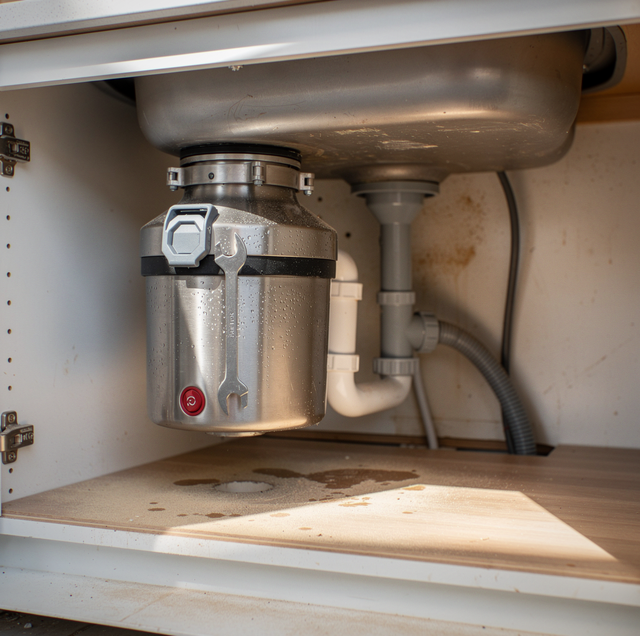
A garbage disposal arrives as a single object, though only part of it can be serviced. The wall switch, the power cord, the sink flange the unit hangs from, the dishwasher inlet fitting, and the rubber gasket at the discharge elbow are separate components with their own replacements. The grinding assembly is sealed. The motor, the rotor shaft, the flywheel, the impellers, and the chamber walls they spin inside share one housing that was never meant to come apart, and none is sold separately.
That split makes the repair-or-replace question answerable. A disposal that will not run may need nothing more than a button pressed on the underside; it may also have a burned motor winding inside a shell you cannot open. From the top of the sink, the two look identical. What separates them is which layer the fault lives in: the serviceable hardware wrapped around the motor, or the sealed unit itself.
Quick Answer: Faults in a disposal's switch, sink flange, gaskets, and hose fittings are repairable because those parts are sold separately. Faults inside the sealed motor housing are not, because the housing itself is the failed part.
Before anything else, the ground rules. Every check below starts with the disposal's circuit switched off at the breaker panel, not just flipped off at the wall switch. A wall switch interrupts one leg of the circuit, can fail closed, and, in some installations, controls a receptacle whose other half stays live. The breaker is the only control that reliably kills the whole run. And nothing goes into the grinding chamber at any point, under any condition, powered or unpowered: no hand, no fingers, no forearm.
Never put a hand inside a garbage disposal chamber, even with the breaker off. The shredder ring and impeller edges hold glass shards, bone splinters, and metal fragments, and a wedged object can release under finger pressure and cut deeply.
When the Overload Protector Trips
Every disposal carries a thermal overload protector, a small red or black button on the bottom of the unit. It opens the motor circuit when the windings get hotter than the motor can shed that heat: a stalled flywheel, too much waste at once, or a long heavy run driving them past their limit.
A popped protector produces total silence, which is why it gets mistaken for a dead motor. Give the unit ten minutes to cool, cut power at the breaker, press the button until it seats and stays in, then restore power.
If it runs normally, the protector did what it exists to do. If it pops again within seconds, either the flywheel is still stuck, or the motor is drawing high current on its own.
Jams at the Impellers and Flywheel
The impellers are blunt lugs that swing loose on a spinning turntable, throwing waste outward against a fixed shredder ring whose teeth do the shearing. A jam occurs when something wedges between the impeller and the ring, or under the turntable, and stops the flywheel dead.
With the breaker off, look into the chamber with a flashlight. Most disposals have a hex socket at the center of the underside, and a quarter-inch hex wrench usually clips to the side of the unit. Seat the wrench and rock it both directions until the flywheel turns a full revolution freely, working the wedged object loose.
With the breaker still off, and never with power restored, lift the object out from above with long tongs or needle-nose pliers, working by flashlight. No hand goes in. With the chamber clear, press the reset button, restore power, and run cold water while the unit spins up. A disposal that comes back cleanly has nothing wrong.
Humming with No Rotation
A hum means power is reaching the motor and the field is energized, but the rotor is not moving. Very different faults produce that same sound. The first is mechanical: the flywheel is jammed and the motor strains against something solid, which the wrench test resolves.
The second is internal. Disposal motors need a start winding to break away from a standstill, and some designs add a start capacitor. When that winding opens, or the capacitor fails, the motor energizes, buzzes, and never turns. The test is direct: if the hex wrench spins the flywheel through a full turn with no resistance and the unit still hums when powered, the chamber is clear, and the fault is inside the sealed motor. No part exists for it. That unit is finished.
Do not leave a humming disposal switched on while you sort out which it is. A stalled motor draws locked-rotor current, and every extra second cooks winding insulation that was intact moments earlier.
No Sound at All
Silence works from the outside in. Confirm the breaker is on and the unit is plugged in, since most are cord-connected to a receptacle inside the cabinet. Then cut power at the breaker, seat the reset button, and restore power, since a popped protector is the most common cause of a disposal that does nothing.
If those come up clean, the fault sits in the switch, the receptacle, the cord, or the motor, and telling them apart takes a meter on live terminals, which is electrical work. A worn wall switch is a common failure and a replaceable part, as is a damaged cord end, so confirming power reaches the unit is the diagnosis.
Once power is verified there, the reset is seated, and the flywheel turns freely by wrench, silence means an open winding or a thermal cutout stuck permanently open. Both are inside the housing. That is a replacement.
Leaks and Where They Come From
Water under the sink is the symptom where the decision turns on location: a disposal leaks from several places, and those carry different verdicts.
The sink flange: Water appears at the top rim, where the unit hangs from the drain opening, usually while the basin fills and drains with the disposal idle. The putty or gasket between flange and sink has dried and shrunk, or the mounting ring has backed off. Flange, gasket, and mounting hardware are separately available. Repairable.
The dishwasher inlet: Water drips from the side nipple where the dishwasher hose clamps on, and only during a dishwasher cycle. A loose clamp or a hose that has hardened and split at the barb is the usual cause. Repairable. The nipple is cast into the housing, so a crack there requires a replacement.
The discharge tube gasket: Water shows at the joint where the disposal meets the drain elbow. The flat gasket there compresses and takes a set over the years, and the bolts holding the flange relax with it. Repairable.
The body seam or the reset-button area: Weeping from the seam between the upper and lower housing sections, around the reset button, or from the bottom shell indicates that the grinding chamber has corroded through or that the internal seal between the chamber and motor has failed. There is no gasket to change, because the leak path runs through the metal itself. Shut that unit off at the breaker and leave it off until it is swapped: water tracking into a motor cavity is an electrical fault waiting to happen.
Finding which one you have takes patience. Dry the unit and the cabinet floor, then run one source at a time, starting with the two that need no power at the disposal: the basin alone, then a dishwasher cycle, and running the disposal only if both come up dry. If water appears on the lower housing or around the reset button during either of the first two, stop there. That is the breached-housing case, and the unit is not run again. Water travels down the outside of the housing before it drips, so a puddle underneath says nothing about where it started.
Wrap a dry paper towel loosely around the disposal body before you run each water source in turn. The towel marks the highest wet point, which is the actual leak origin, above the point where the drip finally lets go.
Corrosion That Keeps the Chamber Re-Jamming
A disposal that jams more often than it used to on the same loads it always handled is showing wear.
The surfaces inside the chamber that do the work all degrade together. The shredder ring's teeth round over and stop shearing, so fibrous material gets pushed around the wall instead of being cut. The turntable pits, and rough metal catches stringy waste that used to slide past. The impeller lugs wear at their contact faces and swing sloppily, losing the outward force that pins waste against the ring.
Each of those makes the next jam more likely, and rust flakes in the drain water are the sign. None of these components is sold as a repair part, and none can be reached without cutting the housing open. Repeated jamming with a chamber you can see is clear means a worn grinding assembly, and that assembly is the unit.
Where the Line Falls Between Fix and Replace
Everything outside the sealed motor housing is repairable, because it was built to come apart and go back together. Inside, the manufacturer designed a permanent enclosure and stocks no parts for what sits behind it. Symptoms sort cleanly on either side of that wall.
Repair territory: a protector that trips once and holds after a reset, a jam the hex wrench frees, a leak at the sink flange, a leak at the dishwasher inlet, a leak at the discharge gasket, a failed wall switch, a damaged cord end.
Replacement territory: a hum that persists with a flywheel that turns freely, silence with power confirmed at the unit, a protector that trips repeatedly on a clear and unloaded chamber, any leak from the body seam or the reset-button area, and a chamber that jams over and over on ordinary loads.
Those second cases end on durability. A burned winding will not be made dependable by anything attached to the outside, and a shell corroded through keeps wetting the cabinet floor, where the damage moves into the cabinet and the subfloor.
Age matters here only as a proxy for that wear; the checks above show where the grinding surfaces and the motor insulation actually stand.
The homeowner side stops the moment the sink connection or branch drain has to come apart, which is a drain handyman's work, and anything needing a meter on live conductors is a licensed electrician's call. What you carry into either conversation matters: you already know which side of the housing the fault is on, which makes the visit a defined repair or a swap.
Frequently Asked Questions
Odor lives above the waterline. The underside of the rubber splash guard and the upper chamber walls sit above the level water reaches, so flushing never scours them and food film builds into a biofilm there. Grinding a chamber of ice under cold running water reaches what flushing misses. The splash guard is a separately sold part, and a fouled one is worth swapping.
Usually the hose routing does. The dishwasher drain hose is meant to rise to a high loop fastened under the countertop, or pass through an air gap on the sink deck, before dropping to the disposal. A loop that has sagged or was never secured leaves the hose holding standing water the pump must clear every cycle, which reads as slow draining even when the disposal is fine.
Yes, in how it starts. A batch-feed unit has no wall switch. Its stopper carries a magnet, and seating and turning that stopper in the drain opening completes the start circuit, so it runs only with the cover in place. When one refuses to start, the stopper magnet or its matching sensor is a likelier culprit than the motor.
It depends on the sink's drain opening, which must be the standard three-and-a-half inches; on the clear height in the cabinet between the sink bottom and the trap; and on a switched receptacle near the unit. Homes on a septic system also need the unit chosen with that system in mind.
Both basins of a double sink usually share a single trap arm via a tee fitting. The disposal pushes a large volume of water and ground waste into that shared line at once, and a partial blockage past the tee sends the flow up into the empty basin. The disposal is revealing a clog it did not cause.
Grease pours in warm and congeals cool, coating the trap arm where nothing scours it. Coffee grounds and eggshell membrane grind into a fine sludge that settles in the same place. Long fibrous waste, like celery strings, artichoke leaves, and corn husks, rides the chamber wall and wraps around the turntable hub. Chemical drain cleaner belongs nowhere near a disposal, because it sits against chamber metal and seals.
Before you decide whether a disposal can be saved, have the fault traced — a technician can tell you if it is a serviceable part or a breached housing, and handle the drain connections either way. Precision Home Worx serves Wilmington, Bear, and Newark. Call (302) 500-3676.


