
Signs of Dry Rot on a Porch or Deck (Before It Spreads)
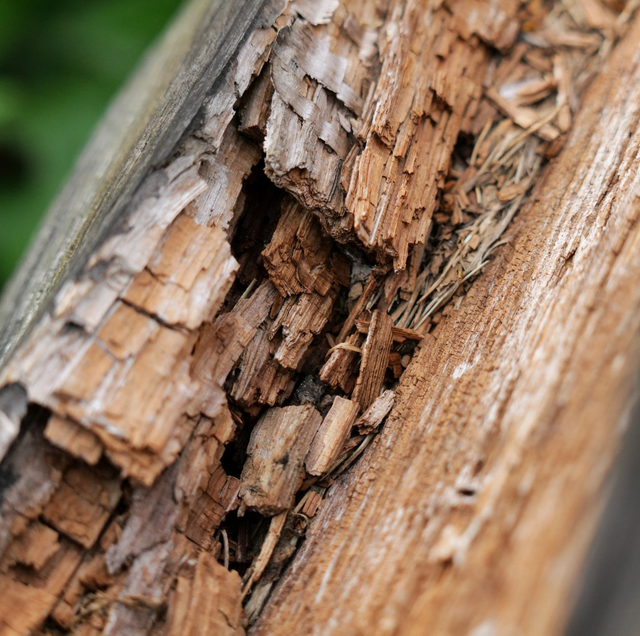
Quick Answer: Dry rot is fungal decay from sustained moisture, not dryness. Look for wood that's darker, spongy, or dull-sounding when tapped, especially at end grain and post bases. Press a screwdriver in: sound wood resists, rotted wood gives.
"It looked fine from six feet away." That's what a lot of homeowners say about a porch post or deck board that turned out to be hollow underneath the paint. Fungal decay doesn't announce itself with color first; it starts as a texture change you'd only notice by touch, and by the time the surface visibly darkens or crumbles, the fungus has usually been working for months.
That's worth knowing because "dry rot" is a misleading name. Nothing about the process is dry. It's a fungus feeding on wet wood, and the label just describes what's left behind once the moisture is gone. Knowing what to look for, and where, catches the problem while it's still a repair instead of a rebuild.
What Dry Rot Actually Is
Wood-destroying fungi feed on cellulose and lignin, the fibers that give a board its strength. The fungus needs a food source, oxygen, and sustained moisture, generally cited above 19-20% wood moisture content. Below that, spores can land on a board and never take hold. Above it, held there for weeks rather than a rainy afternoon, the fungus starts breaking the wood down from the inside.
Two types show up on porches and decks. Brown rot digests the cellulose and leaves the darker lignin behind, so wood cracks into a cube-shaped pattern and crumbles dry and brittle, the texture most people picture when they hear "dry rot." White rot breaks down both more evenly, so wood feels stringy or spongy rather than cubed, and sometimes looks bleached. Either way, damage runs through the fiber before it changes color, so the wood is weaker than it looks.
Moisture stress isn't seasonal. Humid summer air keeps framing at an elevated moisture content for weeks at a stretch, exactly the condition fungi need. Freeze-thaw winters don't kill an active colony; they just slow its growth while ice works joints and cracks open wider for the next thaw. Treat rot as a year-round risk, not something to check once and forget.
Where Moisture Pools (and Rot Follows)
Decay concentrates wherever water gets in and can't get back out, so exposure predicts the pattern of rot better than wood age does.
End grain: The cut end of a board, sawn at a post base, a stringer, or a deck board's edge, soaks up water many times faster than the face grain, the way a straw draws liquid up. Uncoated end grain is almost always the first place decay starts.
The ledger-to-house connection: Where deck or porch framing bolts to the house, flashing sheds water away from that joint. When it fails, water gets trapped between the framing and siding with nowhere to evaporate.
Post and column bases: A post bearing directly on concrete or soil keeps its cut end damp for days after a rain, and that end soaks up water faster than any flat face of the board, one of the most common rot locations on decks and covered porches alike.
Cracks and checking: As wood dries and shrinks, it develops surface cracks called checking. One that holds standing water instead of shedding it becomes a reservoir feeding decay inward.
Sealed-in moisture: Paint over wood that wasn't fully dry, or caulk over a joint with water still behind it, traps moisture in rather than out. Painted porch trim and columns are especially prone, since the paint can look intact for years while decay progresses underneath.
Surface Signs vs. Structural Signs
| Symptom | What It Usually Means | Urgency |
|---|---|---|
| Grayed, weathered color, no give when pressed | Surface graying from sun and weather, not rot | Cosmetic; cleaning and resealing is enough |
| Wood feels spongy or springs back under thumb pressure | Early-stage decay softening the fiber | Probe test and monitor closely |
| Screwdriver sinks in more than roughly a quarter inch with little resistance | Active decay has significantly weakened that section | Structural finding; repair or replace |
| Crumbles into small cube-shaped chunks when picked at | Advanced brown rot | Replace the member, don't patch over it |
| Stringy, bleached, or unusually light texture | White rot breaking down the fiber | Replace the member |
| Dark staining or musty smell at one spot | Trapped moisture, likely active decay underneath | Investigate that spot specifically |
| Small mushroom-like growths on or near the wood | Advanced, established fungal colony | Professional evaluation and likely replacement |
How to Test for It Yourself
The screwdriver, awl, or ice pick test is the fastest way to tell weathering from real decay. Press the tip in at a low angle at end grain, near ground contact, at any crack, and at a spot that looks fine as a baseline. Sound wood resists; decayed wood lets the tip sink in with little resistance, sometimes most of an inch.
A sound test backs this up without marking the wood: tap the surface with a hammer handle. Solid wood gives a clear, ringing knock; decayed wood underneath sounds dull and flat, even when the paint on top looks unbroken.
Texture tells you which type of decay you're dealing with: wood that breaks into small, dry, cube-shaped chunks is brown rot; wood that pulls apart in long, damp, stringy fibers is white rot. Once a probe confirms softened wood below the surface, that section needs repair, not a patch: decay-compromised fiber doesn't regain strength once it dries.
Porch-Specific Trouble Spots
A porch adds framing and finish details an open deck doesn't have, each with its own moisture trap.
Porch posts and columns: Many porch columns are decorative boxes built around a structural 4x4 or 6x6 post inside, with a cap and base trim detail. Water gets behind that trim easily, and since the structural post is hidden inside the box, rot can progress a long time before anyone probes underneath. Check every column base at the porch floor; intact-looking paint doesn't mean the wood inside is sound.
Porch flooring: Porch decking is often tongue-and-groove boards, painted rather than bare, laid with a slight slope away from the house so water runs off. If that slope has settled flat, or the paint film has cracked and let water in with no way back out, the joints between boards become a moisture trap invisible until one is pried up.
Porch floor framing and skirting: Joists under a porch floor often sit closer to the ground and get less airflow than open deck framing, especially where lattice or solid skirting encloses the space underneath. That low-airflow enclosure keeps elevated humidity around longer after a rain, the sustained-moisture condition decay fungi need. A crawlspace-style skirt is worth a flashlight check.
Wood Species and Treatment Make a Difference
Most modern deck and porch framing is pressure-treated pine, chemically treated to resist decay longer than untreated lumber. That protection has a limit: the preservative is driven into the outer wood, so a board that's field-cut or drilled exposes untreated wood at that cut. Manufacturers recommend brushing an end-cut preservative onto any field cut, and a lot of older decks were never treated that way, one reason cut ends are common early rot sites even on "treated" lumber.
Naturally rot-resistant species like cedar, redwood, and some tropical hardwoods contain natural extractives that slow decay without treatment. That resistance lives mostly in the heartwood, the darker core of the tree; lighter sapwood at a board's edge has little protection, so a board cut mostly from sapwood can decay nearly as fast as an untreated one.
Composite and PVC decking don't rot, since they contain no cellulose for a fungus to feed on. That doesn't extend underneath: the joists, beams, posts, and ledger holding up a composite deck or porch are still ordinary wood, so a flawless surface can sit over framing decaying unnoticed for years.
DIY Fix or Call a Pro?
A single soft spot found early, before it's spread past a few inches, is sometimes a simple board or trim-piece swap. Anything involving a post, column, ledger connection, or floor framing member is different: those pieces carry structural load, and cutting out decay without addressing what let moisture in buys the new wood the same short life the old wood had. A professional assessment can also confirm whether decay has spread past what's visible, since fungus travels along the grain well past where the surface shows any change.
Frequently Asked Questions
Yes, in a limited way. Some fungi grow thin root-like strands called rhizomorphs that carry moisture across a short gap into a healthy board touching an infected one, so a rotted board left in place is riskier than the same board removed. The spread is slower than most assume, typically inches per season, but it's a reason to remove decayed wood rather than leave it in place.
Not always; early on, the smell can be faint until the colony is established. A strong, persistent musty odor at one spot, rather than a general damp smell after rain, is a more reliable clue, and worth following with a probe test at that spot.
Often, yes, for a reason that has nothing to do with weather: pressure-treated lumber didn't become standard framing material until roughly the 1970s. A lot of older housing stock still has original porch framing with no chemical rot resistance at all, so the age of the structure matters as much as how humid a given summer is.
Mold and mildew feed on surface dirt and typically wash off without leaving the wood softer underneath. Decay fungi feed on the fiber itself, so a probe test at that spot still shows softened wood after cleaning. Normal resistance points to mold; a probe that still sinks in points to rot.
Often, yes. Wood-destroying fungi produce organic acids as a byproduct of digesting cellulose, and those acids accelerate corrosion in nearby steel, so hardware pulled from a rot-affected area often shows more pitting than hardware from dry wood. Replacing the wood without checking its fasteners can leave a weakened connection.
There's no fixed timeline; it depends on the moisture source and which fungus is active. A spot with a constant source, a failed flashing joint or a post base in standing water, can go from a soft spot to compromised structural capacity in one wet season. A spot that only gets wet occasionally can sit stable for years, which is why an annual probe check matters more than watching for symptoms alone.
Small Spot Now Beats Rebuilt Section Later
Dry rot is a moisture problem wearing a misleading name, and it rewards early attention more than almost any other porch or deck issue. A probe test at the handful of spots where water actually pools- end grain, post bases, the ledger connection, painted trim, cracks- takes a few minutes and tells you more than a visual scan ever will. Catch a soft spot while it's still a single board or post base, and the fix is small. Miss it for another season or two, and the same spot can take a section of framing with it.
Found a soft spot on a porch post or deck board? — Have it probed, diagnosed, and repaired now, while the fix is still a board or two instead of a rebuilt section. Precision Home Worx serves Wilmington, Bear, and Newark. Call (302) 500-3676.


