
6 Signs Your Deck Needs Repair Before It Gives Way
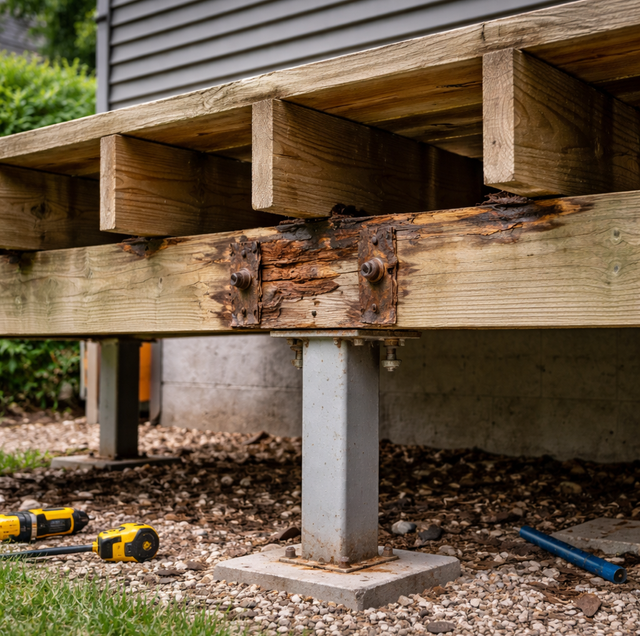
Quick Answer: A solid-feeling deck can still be failing where it matters. Watch for a wobbling railing, staining at the ledger board, a spongy frame, a leaning post, or rusted hardware, and get it inspected before it carries weight again.
A lot of homeowners treat deck safety as a wobble test: press on a board, give the railing a shake, and if nothing moves, the deck passes for another year. That test isn't wrong, exactly, but it checks for the wrong kind of failure. The parts of a deck most likely to give way in a real accident- the ledger board bolted to the house, the posts holding the structure off the ground, the joists you never see from above- rarely announce themselves with a wobble first. They tend to fail quietly at the connections, and by the time you feel movement underfoot, the damage has usually been building for a while.
So "does it feel solid" is the wrong first question. The better one is "what's actually holding this deck up, and when did anyone last look at it?" Deck boards get the attention because they're the part you touch. The framing underneath does the real work, and it's worth learning what to check.
Why "It Feels Solid" Isn't the Same as "It's Safe"
A deck carries weight through a chain of connections. The boards spread your weight to the joists below them, the joists carry it to the beams and posts, and the posts carry it down to footings in the ground, or in through the ledger board bolted to your house's rim joist. Every link in that chain matters, and a deck can feel rock solid while one link is quietly losing strength.
Weather works on that chain year-round, not just in one season. Freeze-thaw cycling over a full winter heaves footings, cracks concrete, and works fasteners loose as the ground swells and settles. Humid summers do a different kind of damage: trapped moisture speeds up wood rot at hidden joints and accelerates corrosion in the metal hardware holding everything together. Neither season alone is the problem. It's the moisture cycling between them, year after year, that slowly weakens the connections you can't see from the surface.
Symptom, Cause, and What To Do: Quick Reference
| Symptom | Likely Cause | What To Do |
|---|---|---|
| Deck bounces or feels springy when you cross it | Undersized, overspanned, or rotting joists | Have the framing inspected before it worsens |
| Railing wobbles or shifts at the base | Loose, rusted, or stripped post-to-frame connection | Repair before anyone leans on it |
| Gap, staining, or dark streaking where the deck meets the house | Ledger board pulling away, or moisture trapped behind it | Have the ledger and flashing inspected |
| Rust streaks bleeding from screws or brackets | Corroded hardware, often the wrong fastener type for treated lumber | Replace with corrosion-resistant hardware |
| One corner or edge of the deck sags or leans | A post footing has shifted, settled, or heaved | Have the footing evaluated and reset |
| Stair tread flexes, or the stairs feel loose | Rotted or loosely fastened stringer connection | Repair before using the stairs |
The Posts and Footings Holding the Deck Up
Rot at the base: Where a post sits directly against concrete or damp soil, moisture wicks into the end grain and rots the post from the bottom up, often invisible until the post is probed or the deck starts to lean.
Cracked or heaved footings: Freeze-thaw cycling can crack a concrete footing or heave it out of level, which throws the whole post out of plumb and puts uneven load on everything above it.
Missing or corroded post base hardware: Many decks anchor posts to their footings with a metal post base bracket that lifts the post's end grain above the concrete, keeping it dry. Older decks sometimes lack this detail, or the bracket itself has rusted through and needs replacing.
A post that's visibly leaning, twisting, or separated from its beam connection is a structural finding, not a cosmetic one, even if every board on the deck still looks fine.
The Ledger Board: Where the Deck Meets the House
The ledger board is the framing member bolted directly to your house's rim joist, and it's what lets a deck skip having a full row of posts along the house side. Most decks are built with a strip of flashing tucked behind the siding and over the ledger to shed water away from that joint. When the flashing fails, or the bolts loosen, water gets trapped where the deck meets the house, and that's a slow, hidden kind of rot.
Watch for a gap opening between the deck framing and the siding, dark staining or a chalky mineral trail on the wall just above the deck, soft or spongy wood where you can reach the rim joist, and bolts that look rusted or loose in their holes. Ledger failure is one of the most consequential deck problems a homeowner can have, because when that connection lets go, a whole section of decking can drop at once rather than one board giving way. If you can see daylight or feel any give where the deck meets the house, treat it as a priority.
Joists and Beams You Can't See From the Top
The joists run underneath the boards and do most of the work of holding your weight, but you'll rarely look at them unless you go underneath the deck or notice a symptom from above. A section that bounces or feels springy when you walk across it, boards that dip between their supports, or dark mold and staining visible from underneath are all clues that the framing, not just the surface, needs attention.
Joists connect to the ledger and beams with metal joist hangers, small brackets that hold the joist end level without notching the wood. A hanger that's rusted through, pulling away, or missing several of its nails carries only a fraction of its intended load, and it's a detail easy to miss unless someone actually looks underneath the deck.
Railings and Their Connections
A railing does a different job than the deck floor. The floor mostly resists weight pushing straight down; a railing has to resist someone leaning or falling sideways into it, which is a harder load for a loose connection to survive. Peeling paint or a faded rail cap is purely cosmetic. A post that shifts, twists, or separates at the base where it bolts to the frame is a different problem entirely, since that's the connection doing the actual work of keeping someone from going over the edge. Missing or loose balusters matter too, especially with kids or pets on the deck, even though they carry less structural load than the posts.
Fasteners and Hardware
Most modern deck lumber is pressure-treated with copper-based preservatives, and that copper corrodes plain steel fasteners faster than it would corrode hardware on untreated wood. Lumber manufacturers generally recommend hot-dip galvanized or stainless steel screws, bolts, and joist hangers for treated lumber, rather than standard zinc-coated hardware. Rust bleeding or black streaking around a screw head is often the first visible sign that a fastener is the wrong type, or is simply wearing out, even when the wood around it still looks sound. Nails that have popped up above the board surface are also worth resetting or swapping for screws, since a raised nail head is both a trip hazard and a sign the wood around it has started to move.
DIY Fix or Call a Pro?
Cosmetic issues are reasonable weekend projects: cleaning, sanding, resealing, or restaining faded wood, tightening a single loose baluster, or resetting a popped nail. Anything touching the posts, footings, ledger board, joists, or the structural connection of a railing is worth having a professional look at first. Those are the parts of the deck doing the load-bearing work, and a repair that doesn't address the connection underneath a symptom tends to come back.
Frequently Asked Questions
Once a year is a reasonable baseline, with a closer look after any major storm or an unusually hard freeze-thaw winter. A thorough inspection means probing the ledger, checking a few posts for movement, and looking at a sample of joists from underneath, not just walking across the surface and calling it good.
It depends on what's affected. Cosmetic wear doesn't limit use. If the issue involves a post, footing, ledger, or railing connection, keep foot traffic light and clear heavy items like planters, a grill, or a hot tub off the deck until it's repaired, since concentrated weight is exactly what a weakened connection struggles to carry.
It's the metal bracket that connects the end of a joist to the ledger board or a beam without needing to notch the wood. Filled holes aren't the whole story: the fasteners in them also have to be structural connector nails or joist hanger screws made specifically for hardware connections, not standard deck screws or roofing nails. Connector nails are shorter and thicker than typical framing nails and are engineered for the shear strength a hanger connection actually carries; a common deck screw or roofing nail can shear off under that load even when every hole looks filled. It's a frequent failure mode that's easy to miss on a casual look, because the hanger appears fully fastened.
Treated lumber contains copper compounds that react with plain steel faster than untreated wood does. The same reaction attacks aluminum even more aggressively than steel, which is why aluminum flashing or aluminum joist hangers should never sit in direct contact with modern copper-treated (ACQ) lumber; the aluminum corrodes through faster than steel does in the same spot. Not all silver-colored hardware is equally protected, either: hot-dip galvanized fasteners have a thick, rough, dull-gray coating from being dipped in molten zinc, while electroplated (zinc-plated) hardware has a thin, shiny coating that wears through quickly under that same copper exposure. Only hot-dip galvanized or stainless steel hardware is rated for direct contact with ACQ-treated wood; bright, shiny fasteners on a treated deck are a sign of the wrong type, even before any streaking shows up.
A small amount of give is normal in any wood-framed deck. Many decks are built with joists spaced sixteen inches apart; where they're spaced wider to save material, or were sized for a longer span than they should carry, the deck can feel noticeably springier even when the wood itself is otherwise sound. Bounce that gets worse over the course of a season usually points to rot or a failing beam rather than original spacing.
Yes. A roof structure ties into the house and the deck framing at additional points, and that tie-in can trap moisture where the roof meets the ledger or a support post, a stress point an open deck doesn't have. Those connection points, along with the posts carrying the roof's weight, are worth including in any inspection of a covered deck or portico.
The Real Test Isn't a Wobble
A deck that doesn't wobble isn't automatically a safe deck, and a deck that looks weathered isn't automatically a dangerous one. The parts that matter most, the posts and footings, the ledger board, the joists and hangers, the railing connections, and the fasteners holding it all together, are mostly out of sight. Checking them means looking underneath, probing where moisture collects, and paying attention to staining, gaps, and rust rather than waiting for something to feel loose. Cosmetic wear can wait for a cleaning and a fresh coat of sealer. Anything touching the structure underneath is worth a closer look before the deck carries a crowd again.
Not sure what's actually holding your deck up? — Get the posts, ledger, and framing inspected and repaired by a family-owned team before it's put to the test. Precision Home Worx serves Wilmington, Bear, and Newark. Call (302) 500-3676.


