
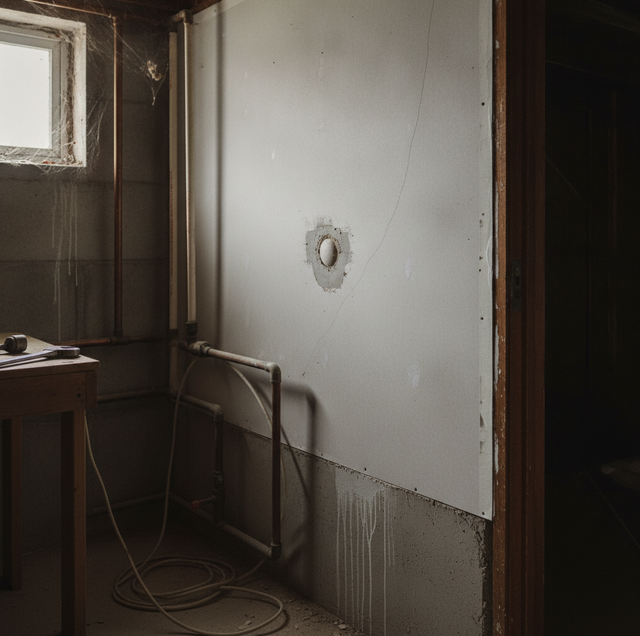
Run your hand across a wall in good light, and you can often feel it before you see it: a small, round bump under the paint, or a fine line creeping down from the top corner of a doorway. Those two blemishes, nail pops and cracks, are the most common complaints homeowners have about interior walls, and they almost always trace back to the same root idea. The wood behind your drywall is not sitting still. It moves, and the rigid gypsum panel fastened to it either loses its grip on a fastener or splits where the stress collects.
Understanding why they happen matters because the fixes that actually last are different from the quick spackle job most people try first. Here is what is going on behind the wall and how to read what you are seeing.
Why a Nail Pop Is Really the Wood Moving, Not the Nail
The name is a little misleading. A drywall fastener does not shoot itself out of the stud. What happens is that the framing lumber behind the panel shrinks as it dries, and the wood pulls back away from the nail head. Building scientists put it plainly: the wood shrinks, the fastener stays put, and the head ends up standing proud of the stud face. The drywall gets pushed forward, the paint and joint compound over the head crack, and you get that telltale bump or a small circular flake.
Framing lumber is often installed with a fair amount of moisture still in it. As it acclimates to the dry interior of a heated, air-conditioned house, it loses that moisture and gives up volume, mostly across the grain. A nail driven straight into the face of a stud is held only by friction along its shank, so when the wood shrinks and the panel flexes with seasonal humidity, that friction grip loosens and the head works its way toward you. Nails that were never driven quite deep enough, sitting a hair above the paper instead of dimpled just below it, pop first and worst.
Where Cracks Show Up and What They Are Telling You
Cracks follow stress, and stress is not spread evenly across a wall. It piles up at a few predictable spots, which is why the same cracks appear in house after house.
The corners of door and window openings are a classic example. A wall with a hole cut in it for a door is weaker at that opening, and any movement in the structure, whether from the house settling onto its foundation, framing shrinkage, or the whole assembly expanding and contracting with temperature and humidity, concentrates right at those corners. That is why a crack so often runs diagonally up and out from the top corner of a doorframe rather than straight down a flat, uninterrupted wall.
Seams are the other usual suspect. Where two drywall panels butt together, the joint is bridged only by paper or mesh tape embedded in compound. If that tape was not bedded well, if it was laid over too little mud or left with a bubble under it, the bond is weak, and a straight crack opens along the seam. You can often tell a taping-related crack from a stress crack because it runs dead straight along a panel edge, frequently in a long horizontal or vertical line, instead of angling off from a corner.
| What You See | Most Likely Cause | What It Points To |
|---|---|---|
| Round bump or flaking circle over a fastener | Framing shrinkage pulling wood off the nail head | Cosmetic, reset the fastener |
| Diagonal crack from a door or window corner | Stress concentration from settling or seasonal movement | Usually cosmetic; watch if it widens |
| Straight crack along a panel seam | Poor taping, weak tape-to-mud bond | Cosmetic, re-tape, and mud |
| Crack at the wall-to-ceiling joint that opens and closes with the seasons | Truss uplift moving the ceiling framing | Cosmetic movement, address at the joint |
| Wide, growing, or stair-step crack with sticking doors | Structural or foundation movement | Have it evaluated |
The Seasonal Movement Behind Recurring Cracks
Wood never fully stops responding to moisture in the air. Through a humid stretch it swells slightly; through a dry stretch it shrinks back. That constant, low-grade cycling is a big reason pops and cracks come back on walls that were patched cleanly a year or two earlier.
One specific version of this is truss uplift. In many homes built with roof trusses, the top and bottom chords of each truss sit in different moisture and temperature conditions. During cold, dry weather, the bottom chord loses moisture, and the truss arches slightly upward in the middle, lifting the ceiling drywall away from the interior wall it crosses. A crack opens along the wall-to-ceiling joint. When warmer, more humid weather returns, the chord takes moisture back on, the truss relaxes, and the same crack closes up again. A gap that appears every dry season and disappears when the air turns humid, then repeats the following year, is the signature of this movement rather than a failing wall.
New Homes and Fresh Remodels See the Most Pops
If your house is only a year or two old, or you recently had a room framed, insulated, and drywalled, expect a flush of nail pops and hairline cracks in that first year, and do not read it as poor workmanship by itself. The framing lumber has the most moisture to give up early on, so it does the most shrinking in those first several drying cycles. That is the peak window for the wood to pull off fastener heads and for seams to move. It usually calms down once the lumber reaches equilibrium with the conditioned air inside, which is one reason many builders schedule a warranty drywall touch-up near the end of the first year rather than the first month.
How to Read the Difference Between a Cosmetic Blemish and a Warning Sign
Most nail pops and most fine cracks are cosmetic. A hairline crack that stays the same width, does not lengthen, and is not paired with any other symptom is almost always just the wall responding to normal movement. The way to know is to watch it and look for company.
The signs that deserve a closer look are different in kind, not just degree. Cracks wider than a pencil line, cracks that keep growing or lengthening month over month, and cracks that run in a stair-step pattern through a block or masonry wall point to real structural movement. So do walls or ceilings cracking in more than one room at once, doors and windows that suddenly stick or will not latch, gaps opening between the wall and the trim or ceiling, and floors that feel uneven or sloped underfoot. Any of those, especially in combination, is worth having evaluated before you patch, because filling the crack without addressing what is moving underneath just hides the clue.
Making the Repair Hold Instead of Coming Back
A nail pop patched with compound alone almost always returns, because the compound does nothing about the loose fastener still sitting there. The lasting fix is to secure the framing to the panel again. The common method is to drive a drywall screw an inch or two above or below the popped fastener, into the same stud, sinking it just below the surface so the head dimples the paper without tearing it. That screw pulls the panel tight to the wood. Then you either drive the old nail back in below the surface or pull it, fill both spots with joint compound in a couple of thin coats, sand, prime, and paint.
Screws are worth calling out here. A properly set drywall screw holds far better than a smooth nail because its threads bite into the wood along the whole shank, so it resists the pull of shrinking lumber that works a friction-held nail loose. That is why modern drywall is screwed rather than nailed, and why using a screw to arrest an old nail pop works so reliably.
Cracks are repaired by reopening and re-bridging the joint. A stress or seam crack gets the loose material scraped out, then new tape, ideally set in compound with the movement in mind, feathered wide and repainted. But for a crack driven by ongoing movement, the order matters: address what is moving first. Truss uplift cracks, for example, are usually managed at the joint so the ceiling can move without dragging the wall finish, rather than by simply mudding the gap shut every year only to watch it reopen.
Keeping indoor humidity reasonably steady helps everything last. Wild swings in interior moisture drive the wood movement that loosens fasteners and reopens seams, so running a humidifier in dry months and a dehumidifier or good ventilation in muggy ones takes some of the cycling out of the framing and reduces how often the blemishes come back.
Putting the Signs Together
Read your walls in three parts. A bump over a fastener is the wood shrinking off the nail, and it needs the fastener reset, not just paint. A fine crack at a door corner or along a seam is stress finding the weakest point, and it is nearly always cosmetic. And a wide, growing, stair-step crack that arrives with sticking doors and uneven floors is a different animal that deserves a set of experienced eyes. Sort what you are seeing into those buckets, and you will know whether to reach for the screw gun or the phone.
Frequently Asked Questions
Because spackle sits on top of a fastener that has already lost its hold. Often, the original nail was overdriven at install, punching through the paper face of the drywall so it grips almost nothing, and it is the paper, not the softer gypsum core, that carries a fastener's hold right at the surface. Spackling over it just crowns a fresh compound that the still-loose nail pushes back out. The lasting fix is to sink a new drywall screw a couple of inches away where the paper is still intact, snug but not so deep that it breaks that paper, then patch with a setting-type compound rather than lightweight spackle, since setting compound shrinks less and won't telegraph the screw head as it dries.
An opening interrupts the wall, so any movement in the house funnels stress to those corners as the path of least resistance, and the drywall splits there first. What most people don't realize is that this is partly avoidable at hang time: drywall is supposed to be cut so a single panel wraps past the corner of the opening, putting the butt seam at least several inches to the side rather than landing a joint right on the corner where stress peaks. When a crack keeps returning from the same doorframe corner, no matter how often it's patched, a seam sitting right on that corner is often the reason, and the durable fix may mean cutting the joint out and re-bridging it away from the stress point rather than re-taping the same line.
Monitor it rather than guess. Mark each end of the crack with a light pencil tick and note the date beside it, or bridge the crack with a short strip of painter's tape or a thin smear of patching compound, then check it over several weeks that span a humidity swing. A crack that grows past your marks, tears the tape, or splits the test smear is still moving and should be looked at before you patch. One that holds still through a wet-to-dry change has essentially stopped and is safe to fill. This tells you something a single glance can't: whether you are patching a settled crack or covering active movement that will simply reopen. Pair that with the warning signs, cracks wider than a pencil line, a stair-step pattern, or sticking doors and sloped floors, and you'll know whether to fill it or have it evaluated.
That pattern is truss uplift, and it is movement rather than damage. In cold, dry weather, the bottom chord of a roof truss dries, and the truss arches up, lifting the ceiling off the wall; when humidity rises, it settles back, and the gap closes, so mudding it shut just tears again next winter. The practical fix hides the movement instead of fighting it. Crown molding installed so it fastens to the ceiling only, not the wall, lets the ceiling float up and down behind it while the joint stays visually closed. In new construction, the same thing is handled with floating-corner drywall clips, which hold the ceiling panel free of the wall's top plate, allowing it to move without cracking the finish. Once you know it's uplift, the goal is concealment, not sealing.
Yes on both counts. A smooth nail holds only by friction along its shank, so as the stud shrinks and the panel flexes, the head slowly walks forward; a drywall screw's threads bite the full length of the wood and resist that pull, which is why screws became the standard. Before screw guns were common, builders used ring-shank nails, ridged like tiny barbs, for the same reason, and those still pop less than smooth nails. But a screw can pop too if it's overdriven: sink it so hard that the head shreds the paper face, and it loses the surface grip that actually matters, and you've built in the next pop. The target is a screw set just below the paper with the face dimpled but not torn.
Steadying indoor humidity does the most because the wood movement behind pops and seam cracks tracks how much moisture the framing gains and loses. Holding the interior in a moderate band, very roughly the 30 to 50 percent relative-humidity range many homes aim for, with a humidifier in dry stretches and a dehumidifier or good ventilation in muggy ones, keeps the framing from cycling as hard. In new work, there's a construction step that helps too: running a bead of construction adhesive on the studs before the panel is screwed on bonds the drywall to the framing so it doesn't lean on the fastener alone, which is why glued-and-screwed walls pop far less than nailed-only ones. You won't stop movement entirely, but you can take the edge off it and make each repair last much longer.
See nail pops or cracks spreading across your walls and want them fixed so they stay fixed — schedule a drywall assessment. Precision Home Worx serves Wilmington, Bear, and Newark. Call (302) 500-3676.


