
Why Cabinet Doors Sag and Won’t Close: 6 Fixes
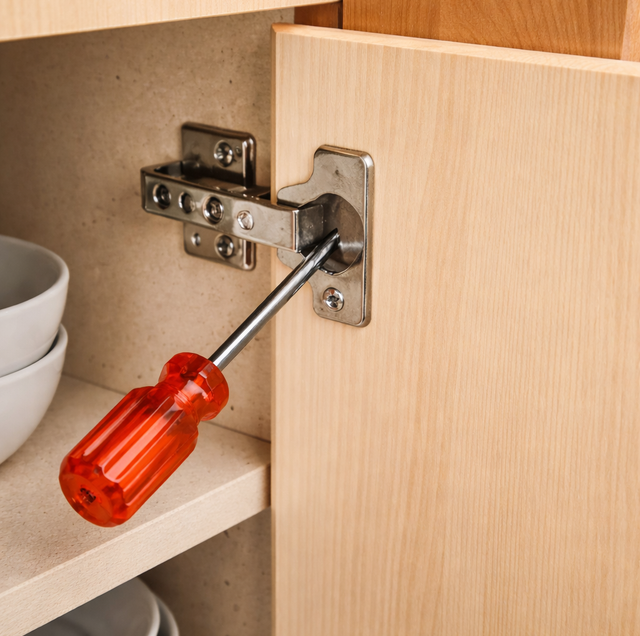
Quick Answer: A cabinet door usually sags because the hinge screws have pulled loose in soft particleboard, a hinge adjustment has drifted, or the door itself has warped or grown heavy. Most cases are corrected in minutes with a screwdriver and the three adjustment screws on a European hinge. A door that suddenly refuses to close often means the box holding the hinges has shifted, or the mounting has loosened.
What a Sagging Cabinet Door Is Really Telling You
A door that once closed flush and now hangs off-square, rubs the door beside it, or swings back open is rarely the door's fault alone. It is the hinge, the wood the hinge is screwed into, or the box the whole thing hangs from that has moved. The door is just the visible end of the problem.
The fastest way to read the failure is to look at the gaps. Close the door as far as it will go and study the seam around it. A door sagging at the outer edge, where the handle is, points to loose or worn hinges letting the door droop under its own weight. A gap that is wide at the top and pinched at the bottom (or the reverse) points to a hinge that needs a height or tilt adjustment. A door that touches its neighbor and stops points to a side-to-side setting that has crept outward. And a door that closes fine but drifts open on its own is a self-closing hinge that has lost its spring or a box that is no longer plumb.
A hinge is a small joint doing the same job a knee does: it carries weight, it pivots thousands of times, and the parts that hold it (the screws, the wood) wear before the hinge body itself gives out. Fix the anchor and the alignment, and the door falls back into line without replacing anything.
The Mechanisms Behind a Door That Won't Sit Right
Loose hinge screws in stripped particleboard: Most modern cabinets are built from particleboard or MDF with a thin laminate face. The hinge screws bite into that soft core, and after enough open-and-close cycles, the hole widens, and the threads lose their grip. The screw spins freely, the hinge plate tips, and the door drops at the corner nearest that screw. This is the single most common reason for a suddenly crooked door, and the screw often looks fine while doing nothing at all.
A European cup hinge that has drifted out of adjustment: The concealed hinge inside most cabinets built in the last few decades is a European cup hinge. It has built-in adjustment, and vibration, heavy use, or a bump can nudge those settings off. Nothing is broken; the door has simply wandered from where it was set.
Worn hinges: Older or heavily used hinges develop play in the pivot. The door then rocks slightly no matter how the screws are tightened, and no adjustment fully squares it. Worn face-frame or wrap-around hinges show this as a visible up-and-down wiggle when you lift the door edge.
A heavy or warped door: Solid-wood and thick painted doors are heavy, and weight alone slowly pulls hinge screws loose. A door can also warp: the two halves of a slab twist out of the same plane, so one corner reaches the frame while the opposite corner stands proud and will not latch.
Humidity swelling or drying the wood: Wood cabinet doors take on and give off moisture with the air around them. In damp stretches of the year, the door swells and can bind against its frame or a neighbor; in dry stretches it shrinks, gaps open up, and screws that were snug can loosen as the wood pulls back from them. The same door can rub in one part of the year and rattle in another, which is why an adjustment that felt perfect a few months ago may need a small correction later.
A cabinet box that has racked or pulled loose: If the box itself has shifted, no hinge tweak will hold. Base cabinets can rack out of square when a floor settles; wall cabinets can loosen at their mounting screws so the whole case tips forward or sags on one side. When two neighboring doors both go crooked at once, or a door that was fine yesterday binds hard today, suspect the box before the hinge.
How to Diagnose It in Two Minutes
Start with the screws. Open the door and give each hinge screw a gentle turn with a hand screwdriver. If one keeps turning without tightening, you have found a stripped hole. Next, grip the door by its free edge and lift gently: real movement at the hinge means worn hinges or loose plates, while a solid feel points you toward adjustment instead. Finally, hold a short level against the door face or sight the seam against the cabinet edge to tell a lean (side-to-side) from a droop (height) from a tilt.
The Three Adjustment Screws on a European Hinge
Open the door and look at the hinge arm. A European hinge gives you three separate movements, each on its own screw.
Side-to-side (in and out): The screw nearest the door cup, or a marked front screw, moves the door left or right across the opening. This is the one to reach for when a door overlaps or rubs the door beside it, or when the gap down one vertical edge is uneven. A quarter turn shifts the edge a noticeable amount, so go small.
Depth (in and out toward the box): The rear screw, often sitting in a slotted track, slides the door closer to or farther from the cabinet face. Use it when the door sits proud of its neighbors or presses too hard against the frame and will not close cleanly.
Height (up and down): Height is usually set at the mounting plate on the cabinet wall rather than the hinge arm. Loosen the plate screws slightly, lift or lower the whole door until the tops of adjacent doors line up, then retighten. This is the fix for a door that has dropped at one corner but whose hinges are otherwise sound.
Work one hinge and one screw at a time, closing the door to check after each small turn, and adjust the top and bottom hinges in tandem so you do not introduce a new tilt while curing an old one.
Fixing Stripped Screw Holes So the Fix Actually Holds
Tightening a screw that spins is pointless; the hole has to be rebuilt first. Three approaches, from quickest to most durable.
Toothpicks or matchsticks and glue: Remove the screw. Dip a few wooden toothpicks or a matchstick in wood glue, push them into the hole, snap them off flush, and let the glue set. The screw now bites into fresh wood. This is the standard quick repair and holds well for lighter doors.
A slightly larger or longer screw: Step up to a screw one size larger in diameter or a bit longer so the threads reach unworn material deeper in the panel. Keep the head shape the same so it seats properly in the hinge plate, and do not go so long that the tip breaks through the outside of the cabinet.
A glued wood dowel: For a badly chewed hole or a heavy door, drill the hole out clean, glue a hardwood dowel into it, let it cure, then trim flush and drill a fresh pilot hole in solid wood. This is the most durable repair and is worth the extra step on doors that have already stripped out once.
When the Door Drifts Open: Self-Closing Hinge Failure
Many European hinges have a built-in spring or a small hydraulic damper that pulls the door the last inch and holds it shut. When that mechanism tires, the door no longer stays closed and eases open on its own. A worn spring hinge is not adjustable back to life; the practical fix is to replace that hinge with a matching self-closing model, keeping the same cup diameter and mounting-plate style so it drops into the existing holes. Replace them in pairs on a door so both hinges pull with equal force.
Warped, Heavy, and Binding Doors
A warped door can sometimes be coaxed back by adjusting the hinges to split the difference, so no single corner stands far out. A mild warp may also relax if the door is laid flat with a modest weight across the high corner over several days. Doors that stay badly twisted are usually replaced. For heavy doors that keep loosening their screws, moving to the dowel repair above and adding a third hinge in the middle spreads the load so no single anchor carries all the weight. A door that binds only in humid stretches can be given a hair more depth or side clearance so it still closes when the wood is at its fullest.
When the Cabinet Box Itself Needs Re-Securing
If the doors keep going crooked no matter what you do at the hinge, the box has moved. On a base cabinet, check whether it has racked out of square and reset it with shims and fasteners so the face returns to plumb. On a wall cabinet, the concern is different and more serious: the case hangs from screws driven into the mounting rail at the back, and if those have pulled loose, the cabinet can tip or fall.
A wall cabinet that is sagging away from the wall, showing a gap at the top, or feeling loose when you tug it is a falling hazard, especially loaded with dishes. Re-securing it means driving proper fasteners through the rail into the wall studs, not just drywall, which is load-bearing work for a handyman or carpenter if the mounting is compromised. The hinge adjustments above are all screwdriver-level, and DIY-safe; a cabinet coming off the wall is not.
Frequently Asked Questions
A quick tightening pass once a year keeps small problems from becoming stripped holes. The kitchen doors under the sink and the trash pull-out take the heaviest daily use and loosen first, so give those a turn every few months rather than waiting for the annual check. Catching a slightly loose screw before it strips saves you the toothpick-and-glue repair entirely.
No. Traditional face-frame and wrap-around hinges have no built-in adjustment screws, so you cannot dial in height or depth the way you can on a cup hinge. Your options are to slightly elongate the screw holes with a small file to shift the door, shim behind one leaf with a thin cardboard sliver, or swap to adjustment hinges. A common upgrade is fitting inset European hinges that mount to a face frame and bring the three-way adjustment with them.
Lubricant only helps the narrow case of a stiff or squeaky pivot; it does nothing for a sag, a stripped screw, or a misadjusted hinge, and it can attract dust that gums up a self-closing damper. For a squeak, a dab of dry silicone or a light machine oil on the pivot barrel is enough. If the door still will not close after lubrication, the cause is mechanical and needs adjustment or a screw repair, not more oil.
Most European hinge and mounting-plate screws take a Phillips #2 bit, and many newer hinges use a Pozidriv or a Torx head instead, which look similar but cam out and chew the screw if you use the wrong bit. Check the cross pattern before you push hard: a true Phillips has a simple cross, Pozidriv adds faint diagonal lines, and Torx is a six-point star. Matching the bit is what keeps you from stripping the screw head while chasing a stripped hole.
When both center doors start rubbing at once, read the gap where they meet from top to bottom before you touch a screw. A wedge-shaped gap, tight at the top and open at the bottom, points to a box that has racked out of square, often because the floor or the base shims under the cabinet settled unevenly. Reshim and refasten the base to bring the case back to plumb, then fine-tune the side-to-side screw on each door. If the gap is even top to bottom but the doors still touch, the doors themselves swelled, and the fix is at the hinges, not the box.
If one hinge has worn out its pivot, the matching hinges on that door and on same-age doors nearby are usually close behind, so replacing a full run at once saves repeat trips and keeps the closing action consistent across the kitchen. Buy hinges with the same cup diameter, typically 35mm on European models, and the same opening angle so the doors clear their neighbors the way the originals did. Mixing worn and new hinges on one door leaves the closing force uneven and the door sitting slightly off.
Book a cabinet tune-up before a loose door drops off its hinges — square, snug, and closing right again. Precision Home Worx serves Wilmington, Bear, and Newark. Call (302) 500-3676.


