
Deck Board Replacement or Full Rebuild? How to Decide
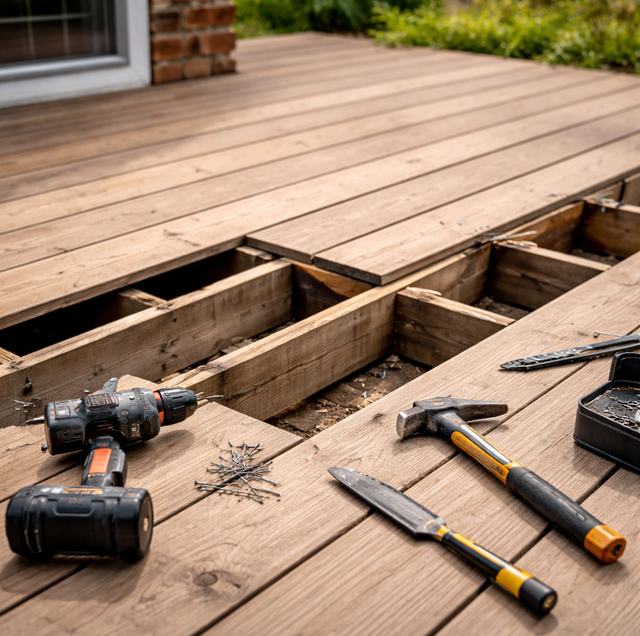
Quick Answer: Board replacement works when damage stops at the decking boards and the framing underneath tests sound. A full rebuild is the better call once the framing, ledger, or footings show rot, damage, or several boards failing at the same age.
Pull up one damaged deck board, and there are two very different things you might find underneath it: a joist that's dry, solid, and ready for a new board on top, or one that's soft, discolored, and holding moisture it shouldn't be. That difference, more than how bad the board itself looks, is what decides whether this job stays a quick board swap or turns into a full rebuild. Get that read right, and the choice between a repair and a rebuild tends to follow logically. Get it wrong, and a homeowner can spend a season replacing boards one at a time on a deck that needed to come apart from the framing up.
This isn't about spotting the first signs of trouble in a deck; that's a separate conversation about staining, sponginess, and rust bleeding from fasteners. This is about what happens once damage is already confirmed: how the scope gets decided, and why that decision has less to do with how bad the surface looks than with what's happening underneath.
Start With What's Actually Damaged, Not How Much
A deck carries weight through two distinct layers, and the decision about how to fix it depends almost entirely on which layer the damage has reached.
The decking boards: The surface you walk on. These take the most weather exposure, direct sun, standing water, and foot traffic, and they're designed to be the sacrificial layer that wears out and gets swapped on a normal cycle without touching anything underneath.
The structural framing: The joists that support the boards, the beams that carry the joists, the posts that carry the beams down to the ground, and the ledger board bolted to the house that lets the deck skip a full row of posts along that side. This layer is built to last for decades, not one board-replacement cycle, and it isn't meant to be opened up and swapped out casually.
Board-level replacement is a contained, reasonable repair exactly when the damage stops at the first layer. Pull a rotted or split board, confirm the joist under it is dry and solid, and put a new board down; that fixes the problem for good. The calculation changes once the second layer is involved. A rotted joist, a corroded and pulling-away ledger connection, or a shifted footing isn't a surface problem wearing a board-level disguise. It's evidence that the thing holding the boards up is what actually needs the work.
Reading the Pattern: One Board Down, or the Whole Deck Aging Out Together
Not every damaged board points to a structural problem, and not every case for a full rebuild needs rotted framing to justify it. Sometimes the framing is fine, and the deck still deserves a full rebuild, because of the pattern the board damage is showing.
A single failed board on an otherwise sound deck usually means something local went wrong: a knot that let water in, a spot that never dried out between rains, a board installed slightly proud that caught more foot traffic than the rest. Replace it, and the deck goes back to normal service.
Several boards failing within the same season, especially ones installed at the same time in the original build, tells a different story. Decking lumber has a service life, and boards milled, treated, and installed together tend to age together. If three or four boards have gone soft or split in the same year, on a deck old enough that lumber's typical lifespan is running out, the rest of the boards on that deck are very likely close behind, even the ones that still look fine today. Swapping the failed boards now and leaving the rest is a repair that's honest about today's problem and dishonest about next year's.
The Ledger Board Connection: A Common Trigger for a Full Rebuild
The ledger board is the framing piece that ties the deck to the house, lag-bolted into the house's rim joist, and it's one of the more common reasons a job that started as "replace some boards" turns into a full rebuild instead.
Unlike the joists and posts, which sit out in the open where a probe or a visual check can confirm their condition fairly directly, the ledger connection is partly hidden behind flashing, siding, and the house wall itself. When that connection has taken on moisture, whether from failed flashing, missing flashing on an older build, or bolts that have loosened and let water track behind the ledger, repairing it usually isn't a piecemeal job. The ledger runs the full width of the deck where it meets the house, and once that connection is compromised, the fix generally means opening up the whole joint, not swapping a board or two near the wall.
A ledger finding is worth treating as a strong signal toward a full rebuild, even if the decking boards themselves still look serviceable, because the alternative, patching around a compromised house connection while leaving it in place, tends to be a short-term fix on the one part of the deck doing some of the most consequential work.
Footings and Posts: The Foundation-Level Trigger
Below the ledger and the joists, the posts and their footings are the last link in the chain, and problems there change the calculation the same way a ledger problem does.
A post that has shifted, rotted at its base, or separated from its footing isn't something a board-level repair touches at all, since the posts sit entirely below the decking surface. But a compromised post changes what the framing above it can safely carry, which means any board replacement done on that section gets installed over a structure that isn't stable to begin with.
A footing that's cracked, heaved out of level, or was undersized for the deck built on top of it works the same way. Fixing a single footing is possible without touching the whole deck, but when several footings show the same age-related wear, or when the originals were never adequate for the deck's actual size and load, replacing the surface boards on top of that foundation solves the wrong problem.
Board Replacement vs. Full Rebuild: A Decision Framework
| Attribute | Points Toward Board Replacement | Points Toward Full Rebuild |
|---|---|---|
| What's affected | Damage confined to the decking boards themselves, the walking surface | Damage has reached the joists, beams, posts, or ledger connection |
| Structural condition below | Joists and beams probe solid, no give or crumbling wood | Joists or beams show rot, sponginess, or corroded hangers |
| Pattern of damage | One board, or a few, isolated and explainable by a local cause | Multiple same-age boards failing together, suggesting the whole surface is aging out at once |
| Ledger connection | Bolts tight, no staining or gap where the deck meets the house | Moisture, a widening gap, or loose bolts at the house connection |
| Footings and posts | Posts plumb and solid, footings level and uncracked | A post has shifted or rotted at its base, or footings are cracked, heaved, or undersized |
| Deck's overall age | Well within the framing's expected service life | Old enough that the framing itself is nearing the end of its lifespan |
Where a Structural Assessment Belongs in This Decision
None of the framework above replaces an in-person look by someone qualified to evaluate what's actually happening inside the framing. A deck and porch crew can probe a joist, check a ledger bolt, and read the pattern of board failures across a deck; that hands-on evaluation is what this decision is built on. What that same crew shouldn't do is size a replacement beam, calculate what a compromised post or footing was actually carrying, or sign off on a severe structural finding, extensive rot through multiple framing members, or a footing that's failed outright, without treating it as a case that may need a structural engineer or other licensed professional's assessment first. For the routine version of this decision, board damage confined to the surface, or ordinary wear on joists and ledger connections that a deck crew evaluates and repairs every week, that extra step usually isn't necessary. It's worth raising any time the damage looks more severe than typical wear, so the rebuild gets planned around what's actually there instead of a guess.
Let the Damage Set the Scope
A deck board replacement and a full deck rebuild solve two different problems, and mixing them up in either direction wastes time and effort. Replacing boards over a compromised ledger or a rotted joist buys a season, maybe two, before the same section fails again. Rebuilding a deck because a handful of boards weathered unevenly, when the framing underneath probes solid and the rest of the structure has years left in it, is more disruption than the actual damage calls for. The board damage that first gets your attention is rarely the whole story; what matters is whether the layer underneath it is still doing its job. Check that layer honestly, follow the pattern the damage is actually showing, and the right scope for the job becomes clear before the first board comes off.
Frequently Asked Questions
Usually, but "looks fine from above" has a blind spot worth checking first: the top edge of a joist, right where a board seam sits on it, traps moisture that never touches the underside you'd see with a flashlight from below. A quick probe at a few board seams, not just a glance underneath, is the more reliable check. It's also a good moment to swap in corrosion-resistant screws if the original fasteners were the wrong type for treated lumber, since you're already pulling and resetting boards anyway.
Look for consistency: the same board width and profile, the same fastener type and spacing, and no section that stands out as a later addition. A deck that's been expanded over the years, an added stair run or a bump-out for a hot tub, often mixes newer lumber with the original build, and that newer section will age on its own separate timeline rather than failing alongside the rest.
Not always. The strip of decking closest to the house often gets less sun and airflow than the rest of the deck, which slows drying after rain even with a perfectly sound ledger. The distinguishing check is whether there's an actual gap, staining, or give at the ledger connection itself, versus boards that are slower to dry because of shade and reduced air movement in that spot.
Sometimes they can. A solid footing, correctly sized for the deck's load, and set below the local frost depth can often stay in place, with the post and everything above it rebuilt on top of it. What usually forces a footing replacement isn't age by itself; it's a footing that's cracked, heaved, or was undersized from the original build, regardless of how old the deck is.
Cosmetic wear can sit for a while without getting worse. A confirmed finding at the ledger or a footing is different: freeze-thaw cycling works ice into that joint and widens whatever gap or crack is already there, but the same joint takes on wet-dry swelling through humid summer months and slow corrosion on the bolts and hardware year-round, so it isn't only a winter problem. Once the finding is confirmed, it's worth resolving on its own timeline rather than waiting for, or dreading, a particular season.
Yes. Treat it as two zones rather than one deck with a single verdict. The original framing might be old enough to warrant a full rebuild while a newer addition only needs board-level attention, or the reverse can be true if the addition was framed to a lighter standard than the original structure. A deck with mixed build dates usually needs its zones evaluated separately, not as one unit.
Schedule a deck assessment — get the framing checked before any boards come off. Precision Home Worx serves Wilmington, Bear, and Newark. Call (302) 500-3676.


