
Why Do Doors Swing Open or Shut on Their Own? The Real Cause
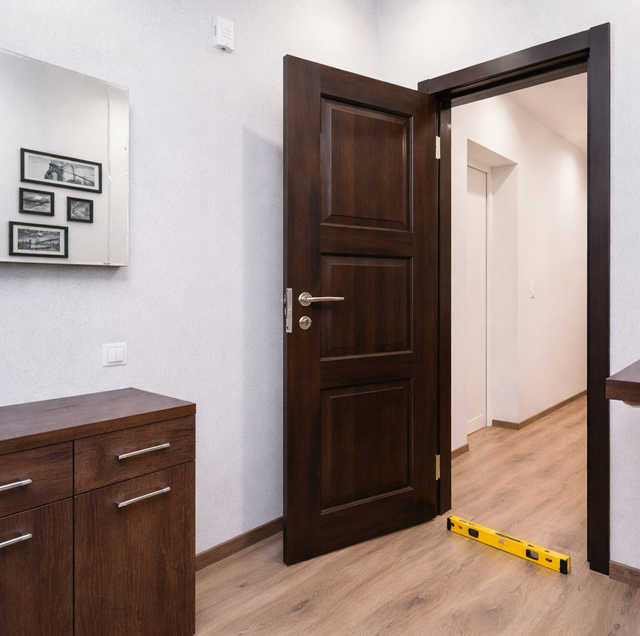
Finding a door swung shut and latched on its own some morning, with no draft in the house and nobody who slammed it, is the kind of thing that makes an older home feel like something's wrong with the foundation. A door that moves without anyone touching it is strange to watch the first time: you nudge it two-thirds open, walk away, and by the time you're back it's swung shut and clicked. Or the reverse happens, and a door you closed is standing open again by morning.
The actual explanation is less dramatic than settling badly, and more interesting than most people expect. It's geometry, not ghosts. A door hanging on hinges is a pendulum, and tilting the axis it hangs from by even a degree or two gives gravity a job to do whether you want it to or not.
Quick Answer: A door drifts open or shut on its own when its hinge line is out of plumb, so gravity pulls it toward whichever way is downhill. Check the jamb with a level, then correct it at the hinge or frame.
It's Not the House Falling Apart, It's One Line Out of True
Every door hangs from a hinge line: an invisible axis running from the top hinge to the bottom hinge on the jamb side. When that line is perfectly plumb, gravity pulls straight down through it and has nothing to grab onto, so the door has no reason to swing one way over another. Friction in the hinges holds it wherever you leave it.
Out-of-plumb framing changes that. A house doesn't need to be failing structurally for its door frames to drift a degree or two off true vertical. Lumber keeps moving for years after framing: joists creep under decades of load, foundations settle unevenly by fractions of an inch, and older homes have had longer for that drift to add up. None of that is a house in trouble on its own. A self-swinging door is one of the more sensitive early indicators of a small lean, because you'd never feel a one-degree tilt by eye. A hinge line that's one degree off plumb shows you every night, since gravity checks that alignment continuously in a way your eyes never do.
Think of the Hinge Line as a Ramp
Picture the hinge line as a slightly tilted flagpole instead of a plumb one, with the door hanging off it like a gate. A gate on a plumb post doesn't drift, because there's no downhill direction to fall toward. Tilt that post even slightly, and the gate becomes a ramp problem: gravity pulls the door's weight toward whichever swing position is now the lowest point it can reach while still hanging from that tilted line. Nothing pushes the door. It rolls downhill along an arc, the same way a marble settles into the low point of a tilted bowl.
That's also why a plumb frame produces a door that stays wherever you put it, while a leaned frame produces a door that drifts to the same spot every time. That reliability is what convinces people something's off about the house, when it's really the opposite: a system behaving with unusual precision.
Which Way It Swings Tells You Which Way the Frame Leans
This is the part most explanations skip: the direction a door drifts tells you which way the frame is out of plumb, not just that it is.
A door that swings shut on its own, sometimes hard enough to latch itself: The top of the hinge jamb has leaned toward the latch side, the direction the door closes into. That tips "downhill" toward closed, so gravity walks the door there and holds it.
A door that drifts open on its own and won't hold shut without the latch actively catching: The lean runs the other way, with the top of the hinge jamb tipped toward the hinge side, away from the latch. Now open is downhill, so the door swings away from closed and settles wide.
Two doors in the same house can lean opposite directions, because each reflects the framing right around it, not the house as a whole. One door swinging shut and another down the hall swinging open aren't contradicting each other; each is accurately reporting a local lean running the opposite way.
Hinge Wear Can Fake the Same Effect on a Frame That's Fine
Not every self-swinging door means the framing has moved. The hinge line only stays true if both hinges hold their original position, and years of weight cycling on those screws is enough to change that alone. When top-hinge screws loosen, the door's top edge sags forward while the bottom hinge stays put, drawing the effective hinge line off plumb even though the jamb underneath never moved. The door reads exactly like a leaning frame because, mechanically, it's now hanging from one.
A door that only recently started swinging, especially if it also sags at the bottom corner, more likely points to worn hinge hardware. One that's done it as long as anyone remembers, with tight hinges and an even reveal gap, more likely reports a frame lean present since the house was built, or one that shifted gradually over years.
Symptom, Likely Cause, and Fix
| Symptom | Likely Cause | Fix |
|---|---|---|
| Swings fully shut on its own, sometimes latches itself | Hinge-side lean tips toward the latch side | Check jamb plumb with a level; shim or reset the frame |
| Drifts open on its own, won't hold shut without the latch | Hinge-side lean tips toward the hinge side | Same plumb check; correct the lean at the frame |
| Started recently, also sags or drags at the bottom | Loose or worn top hinge screws, not the frame | Tighten or replace screws with longer ones into the stud |
| Has done it as long as you've lived there, hinges feel tight | Frame framed slightly out of plumb, or settled over years | Correct at the frame if the lean is more than a degree or so |
| Only one door in the house does it | Local framing issue at that opening | Address that opening alone |
| Several doors on the same wall or level all drift the same way | Broader settling affecting that section | Worth a wider look at that section |
Fixing It: Start Small
Check plumb before touching anything: Hold a level against the hinge-side jamb, top and bottom. A small lean, a bubble just off center, is exactly the tilt that explains a self-swinging door, often correctable without pulling the frame apart.
Rule out hinge wear first: Tighten every hinge screw; replace any that spin without biting with longer screws reaching past the jamb into the stud. If the drift stops, the hinge line was the real problem.
Shim behind a hinge leaf for a small lean: A thin shim behind the top or bottom hinge leaf tilts the effective hinge line back toward true without touching the trim, usually enough for a lean of a degree or less.
Reset the frame for a bigger lean: When the jamb itself is visibly out of plumb, shimming behind it top and bottom, then re-securing the casing, corrects the actual axis the door hangs from.
Swing the door to the middle of its arc and let go — the way it settles shows which way the frame leans. Confirm it with a torpedo level on the hinge-side jamb, top and bottom.
Frequently Asked Questions
Yes. A door drifting shut under gravity can still miss the strike plate if the same lean pushed the latch bolt out of line with the hole, so it slams shut but bounces open. Correcting the plumb lean usually fixes the drift, but check latch alignment separately afterward, since it may need its own small adjustment.
Almost never on its own. It typically takes only a degree or two of lean, a fraction of an inch over the doorway's height, to give gravity a clear direction to pull toward. What's worth a closer look is a self-swinger paired with cracks running from a frame corner or a visibly sloping floor.
It can, especially with a longer swing arc and little hinge friction, as with a wide interior door with no carpet drag underneath. A door drifting shut picks up speed on the way down, the same way anything does rolling downhill, so it can arrive at the jamb harder than the gentle drift it started as. An adjustable door closer, or correcting the lean, stops that acceleration.
Both, but exterior doors mask it longer. Weatherstripping adds enough friction around the whole perimeter to resist a small gravity pull that would move a lighter interior door freely, so the same lean can show up inside years before an exterior door on a similarly leaning frame follows suit.
A small shim correcting a degree or so of lean rarely creates a visible gap at the casing, since the correction happens behind trim that already has tolerance built in. A bigger correction, resetting a jamb leaned several degrees, can shift the reveal enough that the casing needs to be pulled and reset too.
A Door That Moves on Its Own Is Doing Exactly What Physics Says It Should
What a swinging door is actually telling you is small: one hinge line, tilted a degree or two, either in the framing or in a hinge that's loosened over time. Read it as a diagnostic clue rather than a verdict on the foundation, then let which way it drifts point you toward the fix. A level check on the jamb turns the guesswork into a plumb-bubble answer, and most of the time the correction that follows is a shim or a longer screw, not a project.
Got a door that swings on its own and you can't tell why — get the lean diagnosed and corrected instead of living with it. Precision Home Worx serves Wilmington, Bear, and Newark. Call (302) 500-3676.


