
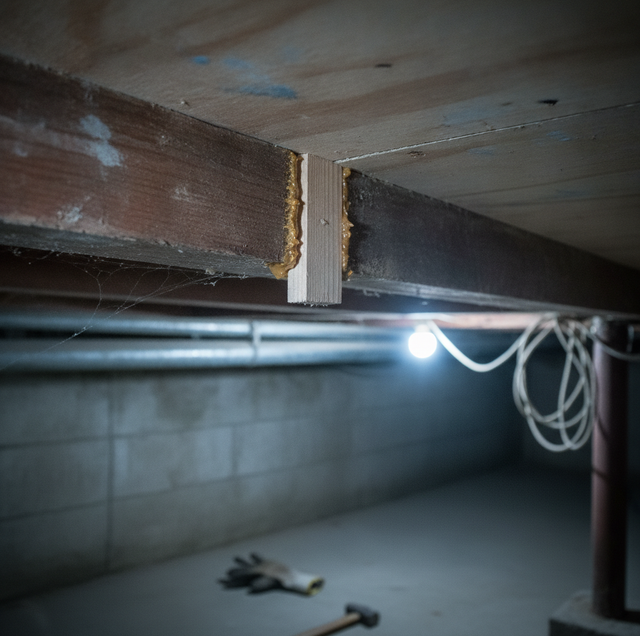
Most houses have that one board that reports every late-night trip to the kitchen. The sound feels random, but it never is. A squeak is friction, and once you know which two pieces are rubbing beneath your feet, both the cause and the repair stop being a mystery. You are hearing a small, specific movement, and small, specific movements can be stopped.
This walks through what makes a floor squeak, whether the noise is worth worrying about, and what it actually takes to quiet it.
A Squeak Is Movement Meeting Friction
When a floor is fastened tightly, nothing moves, and nothing makes noise. A squeak begins the moment a connection loosens, and a gap opens. Step on that spot and your weight forces two components to shift against each other, and the rubbing is the sound you hear.
Usually, one of two things is rubbing. Either a floorboard or the subfloor slides up and down the shank of a nail that no longer grips, or the subfloor lifts and drops against the top edge of a joist it has separated from. In both cases, the cure is the same idea: close the gap and stop the shift. Where the gap sits, and whether you can reach it, is what decides the method.
The Common Causes
Nearly every squeak traces back to a fastener or a gap, and the list is short.
Loosened fasteners are the leading cause. Foot traffic and years of flexing work nails and screws loose until the boards they hold can rock against them. Wood shrinkage feeds the same problem: as framing lumber dries and gives up moisture over the years, it pulls slightly away from the nail shank, opening the tiny gap that lets movement start.
The subfloor is the other big one. If a subfloor panel was never fastened tightly to the joists, or has worked free of them, it flexes and rubs against the joist edge or against the fasteners as you cross it. Humidity is the wildcard. Wood swells in damp stretches and shrinks in dry ones, so the same gap can tighten and go quiet one month, then reopen and sing the next.
| What's happening below | The squeak source |
|---|---|
| Nails or screws worked loose | Boards rock against the fastener |
| Framing dried and shrank | Gaps opened around the nail shank |
| Subfloor loose from joists | Panel flexes and rubs the joist |
| Humidity rising or falling | Wood swells and shrinks, gaps open and close |
Can It Be Fixed? Usually, Yes
The good news is that a squeaky floor is almost always fixable, because the repair follows the cause: re-secure the loose connection so the pieces can no longer move. What changes is your access.
When the underside is reachable from a basement or crawlspace, the work happens from below. A shim tapped into the gap between the subfloor and joist fills the space so the panel can no longer drop onto the fastener. Screws driven up through the joist into the subfloor pull the two back together. A bead of construction adhesive worked into the gap bonds the panel to the joist and cushions any remaining flex.
When there is no access from below, the fix goes from above, driving a fastener down through the finished floor into the joist. Squeak-repair kits are built for this. They use scored, breakaway screws: you drive the screw through the flooring into the joist, then snap the head off below the surface so nothing shows. The right approach depends on the floor type and where exactly the movement lives, which is why pinpointing the squeak comes before touching a single fastener.
Reading the Difference Between a Nuisance and a Warning
A plain squeak in an older home is usually just age doing its work. Decades of foot traffic, ordinary drying of old-growth framing, and the swing between humid summers and drier winters all loosen fasteners and open the small gaps from which squeaks come. That does not mean a floor is failing.
The signal to slow down is a squeak that arrives with company. If the same spot feels spongy or soft, dips underfoot, or shows staining or a musty smell, the noise may be riding on something more than a loose nail, such as a weakened joist or moisture in the subfloor. A squeak by itself is a maintenance item. A squeak plus give underfoot is a reason to have the structure and the framing looked at before anything gets fastened down over it.
Frequently Asked Questions
For a squeak between two hardwood boards, sifting talcum powder, powdered graphite, or a dry lubricant into the seam can hush it for a while by cutting the friction where board edges rub. The catch is that none of it stops the movement; it only makes the movement quieter. The boards still shift, the powder eventually packs down or works out of the joint, and the noise comes back. Treat it as a stopgap for a board-on-board squeak, not a repair, and never rely on it where the real motion is down at the subfloor or a fastener, since powder on top of the finish floor never reaches that.
A from-above fix only holds if the screw lands in a joist rather than just the subfloor, so the first tool is a stud finder run across the floor to trace the joist lines, which usually sit a set distance apart across the room. You mark the joist, then set the breakaway screw on that line at the squeak. Miss the joist, and the screw grabs only the thin subfloor panel, which can start a fresh squeak instead of curing the old one. On a from-below repair, the joists are already in plain sight, so you locate the flexing panel by having someone step on the spot while you watch for the gap.
Two things do the work from underneath, and they suit different gaps. A tapered shim coated with construction adhesive is tapped into the space between the top of the joist and the underside of the subfloor, so the panel rests on the shim instead of dropping onto it. Where a whole panel edge has lifted, a small metal bracket or angle screwed to both the joist and the subfloor pulls them back together. The rule with either is that the screws stay short enough to bite the subfloor without poking through into the finished floor above, which would leave a point sticking up through your carpet or hardwood.
Stairs squeak from the same loosened-joint idea, but the parts are different. A tread is the step you walk on, and a riser is the vertical board behind it; where those two separate, they rub and creak, often right at the front edge or the back joint. Many stairs also rely on small triangular glue blocks in the corner behind the step; when those blocks dry out and pop loose, the step flexes and squeaks. A stair repair usually means re-gluing or re-screwing the tread to the riser and replacing failed glue blocks, reached from underneath when the staircase has an open back.
How the subfloor was attached decides how much it squeaks later. In many older homes, the subfloor was only nailed down, and nails loosen their grip as the wood dries and the floor flexes, which is why those homes develop more squeaks over the years. Newer subfloors are often both glued and screwed to the joists, so the glue bonds the panel flat and the screws hold far better than a smooth nail shank. That bond is also why relaying flooring on top of a nailed subfloor does nothing for the noise: the loose nailed panel underneath keeps moving no matter what sits above it.
Because wood shifts with the moisture in the air, holding indoor humidity in a steadier range does reduce the swelling and shrinking that opens and closes gaps, and a whole-house humidifier tied to the heating system can help hold that level through dry winter stretches. What it will not do is tighten a joint that has already worked loose. Steadier air slows new squeaks from forming and keeps existing ones from getting worse each season, but a board that has already separated from its fastener still needs to be physically re-secured before it goes quiet for good.
What It Comes Down To
A squeaky floor is a small loose thing rubbing under your weight, a fastener that let go or a subfloor panel that drifted off its joist. It is rarely serious and nearly always fixable, either from below where you can reach the gap with a shim, screws, or adhesive, or from above with a breakaway-screw kit that hides its work. The one detail that decides everything is finding exactly where the movement is, because a squeak secured in the wrong spot just moves the noise a few feet down the room.
If a squeaky floor is wearing on your nerves, we can locate the movement and secure it for good. Precision Home Worx serves Wilmington, Bear, Newark. Call (302) 500-3676.


