
Uneven or Soft Floor Spot? Why They’re Not the Same Fix
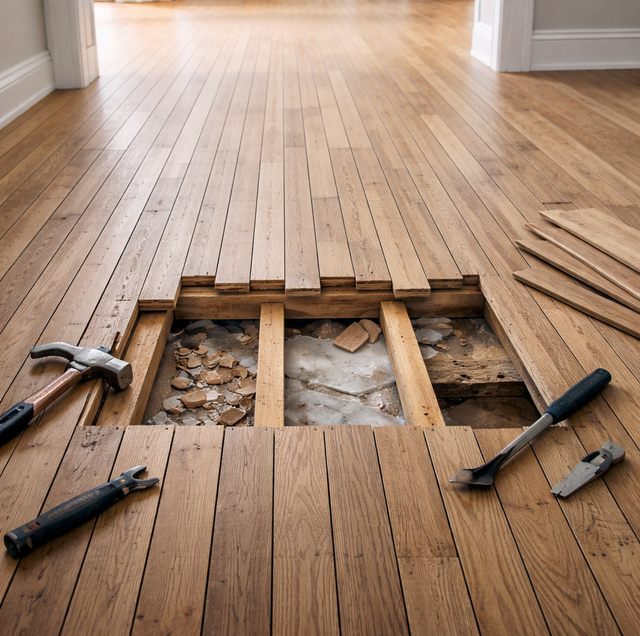
Quick Answer: A soft spot means the subfloor absorbed moisture and weakened, usually near a tub, sink, or exterior threshold. An uneven or dippy spot points to a framing issue, like a flexing joist or settled beam.
Walking across it on an ordinary day, you notice a spot that doesn't feel like the rest of the floor around it. A soft spot gives: the flooring flexes down like it's resting on a sponge, then springs back once you step off. An uneven spot behaves differently. Nothing sinks under a direct push; instead, a ball rolls toward it on its own, or a chair leg sits a little lower there than the other three. One is a texture problem in the material underfoot. The other is a shape problem in the floor itself, and mixing them up leads to the wrong repair.
This covers both separately: what a soft spot usually means, what a dip or bouncy stretch usually means, and how to tell which one you have before anyone opens up the floor. A noisy floor is a different issue: see our piece on why floors squeak. This one is about floors that move or give, often silently.
Soft and Uneven Are Two Different Problems
A soft spot is a localized area where the subfloor material itself has weakened. Step on it and you feel give, sometimes a faint crunch or squish, because the wood fibers or panel underneath have lost their stiffness. This almost always traces to moisture that sat against the subfloor long enough to start breaking it down, and it tends to show up in small footprints: a two-foot patch by the tub, a spot in front of the dishwasher, a strip along an exterior threshold.
An uneven or dippy spot is a shape change across a wider stretch of floor. Nothing feels mushy when you press on it; the floor is solid, just not level or stiff enough to stay flat under load. A marble set down rolls toward the low point. A door that used to clear the carpet now drags on one side of the room. This points to the framing below, not the surface material: a joist flexing more than its neighbors, or a beam or post under the house that's no longer holding its original position.
Both can exist in the same house for completely unrelated reasons, and neither is a floor "squeaking" problem. A squeak is friction, a fastener rubbing against wood as you cross it, and it's almost always harmless on its own. Soft and uneven spots are about give and slope, not noise, and a floor can flex or dip in complete silence.
Location, Likely Cause, and How Urgent It Is
| Where it shows up | What's likely happening | How urgent |
|---|---|---|
| Near a tub, shower, or toilet | Water leaking past a seal or supply line, rotting the subfloor | Act soon; rot spreads while hidden |
| In front of a sink, dishwasher, or fridge | A slow supply or drain leak soaking the subfloor from below | Act soon; source needs to stop first |
| Along an exterior door threshold | Rain or snowmelt working past the sill onto the subfloor | Act soon, especially before the next storm |
| A dip in the middle of a room, no wet signs | Joist deflection: undersized, damaged, or overspanned framing | Get it evaluated; not an emergency by itself |
| A slope running toward one wall or corner | A support beam or post that has settled or shifted | Get it evaluated, especially if it's progressing |
| Only under a rug, appliance, or heavy furniture | Often just the load itself; check if it's there without the weight | Low; confirm before assuming a real problem |
Why a Soft Spot Usually Means Water, Not Wear
A subfloor is plywood or OSB, engineered to be strong dry and much weaker wet. When water sits against that panel repeatedly, the wood fibers absorb it, swell, and start to break down. Fungi that cause rot need sustained moisture to feed on the wood's cellulose; a single spill that dries fast rarely does lasting damage, but a slow leak that keeps the same spot damp for weeks does. That's why soft spots cluster around wet-use areas: a wax ring that's lost its seal under a toilet, a supply line fitting that weeps instead of dripping, a dishwasher gasket that's let water track under the cabinet toe-kick, or a threshold that lets rain wick under the flooring during a storm.
The surface flooring often hides how far the damage has gone. Tile and vinyl in particular can look normal while the plywood underneath has gone soft, because the finish layer isn't what's failing, and there's rarely a stain the way there is with a ceiling leak below. Grout cracking near a tub, a musty smell, or discoloration at a baseboard are usually the first visible clues, and by the time you feel actual give underfoot, the panel has already lost real strength.
Why a Dip or Bounce Usually Means the Framing Underneath
Where a soft spot is about material strength, an uneven or bouncy spot is about geometry: the framing under that section isn't holding a flat, level plane the way it used to, or wasn't built to. A few causes show up again and again in older homes:
A joist flexing more than its neighbors: Joists carry the floor's load in a row, and if one has a long-standing crack, a section notched out for old plumbing or wiring, or was simply undersized for the span it covers, it deflects more under the same weight than the joists beside it. That difference is what you feel as a soft bounce, even with nothing wet or rotted.
A settled support beam or post: Many floor systems rest on a center beam carried by posts or piers, and if one has shifted or sunk into compacted soil, the beam drops a fraction of an inch, tapering into a visible slope several feet away.
Add-on or renovated sections: A room added later, or a floor reframed around a duct or stairwell, sometimes ties into the original framing at a slightly different height, leaving a permanent step or slope where the two systems meet.
The usual fix for a flexing joist is to sister a new joist alongside the weak one, fastening the two together so the healthy lumber shares the load. A settled beam typically gets addressed at the support itself, sometimes with jacking and shimming to bring it back level. That structural framing repair is a job for a structural engineer or licensed structural contractor, not a walkthrough guess. A handyman and carpentry company is not a structural engineering firm: its role is tracing which joist or support is behind the movement and handling the subfloor and flooring repair once the structural fix is in place, while a structural engineer or other licensed professional confirms the framing cause and specs the repair itself.
Telling the Two Apart Before You Call Anyone
A few quick checks narrow it down fast, and none require opening anything up:
- Press directly on the spot: Give it a slight spring-back under your palm or heel; a soft subfloor points to a soft subfloor. A spot that stays firm but sits lower or slopes is a framing issue, not a material one.
- Check the footprint: Soft spots are usually small and close to a plumbing fixture, appliance, or exterior door. Uneven spots tend to run wider and rarely line up with a water source.
- Look for a companion sign: Peeling caulk, a musty smell, discolored grout, or bubbling paint points toward water. A dragging door, gaps at the baseboard, or a marble rolling toward a low point points toward the structure.
- Note whether it's getting worse: A spot that feels the same as it did six months ago is different from one that's clearly larger or mushier now, or a slope that's holding steady versus increasing against a level.
When to Watch It and When to Get It Looked At
Not every uneven spot is urgent. A slight, stable dip that's been there for years, with no wet-area signs and no progression, is often just settled framing that isn't actively getting worse, and watching it periodically is reasonable.
A soft spot is different, because rot doesn't pause on its own. The subfloor won't heal once the moisture source is stopped; it will only stop getting worse. Every month it sits soft and wet is more of the panel losing strength, and eventually more square footage that needs replacing instead of a single patch. The same logic applies to a spot that's clearly spreading or sloping further: movement over time signals that something below is still active, not settled, and worth having looked at before more of the floor is affected.
Frequently Asked Questions
Yes. Condensation from a poorly insulated cold-water supply line, a slow ice-maker connection behind a fridge, or chronic crawlspace humidity can keep a subfloor damp enough to soften it over months without a single drip anyone would call a leak. These sources are harder to trace than an obvious pipe failure because there's no puddle to point to.
No. Once the moisture source is stopped and the area is fully dry, a repair typically only needs to cut out and replace the damaged section, not the whole panel or room. How far the cut extends depends on how far the softness reaches, since rot can travel a few inches past where the floor still feels firm.
For ordinary foot traffic, a mild bounce from joist deflection is rarely an immediate safety issue, since the joist is still carrying the load, just flexing more than it should. It's a different question if the bounce comes with cracking sounds or visible sagging seen from below, either suggesting the framing has lost more capacity than simple deflection.
Heavy furniture on its own doesn't create a structural dip; a properly sized floor system carries normal loads without deforming. What furniture does is concentrate weight onto a small footprint, which can make an existing weak spot, already close to its limit from age or water damage, show a lower reading than it does under a spread-out human step.
Often, yes. Vinyl and laminate float or glue over an underlayment that adds cushion of its own, which can mask early give in the subfloor longer than a hardwood floor fastened straight down that telegraphs movement almost immediately. A soft spot under resilient flooring can be more advanced than it feels.
It can. A dip along the edge of a room near an exterior wall is sometimes tied to that wall's foundation or sill rather than the floor framing, a separate question from joist or beam issues out in the open field of the floor. A dip away from any wall more often points to the joists or a center support directly beneath it.
Get a soft or uneven floor spot looked at — we'll trace it to the subfloor or the moisture source and repair the flooring at the cause, not just the surface. Precision Home Worx serves Wilmington, Bear, and Newark. Call (302) 500-3676.


