
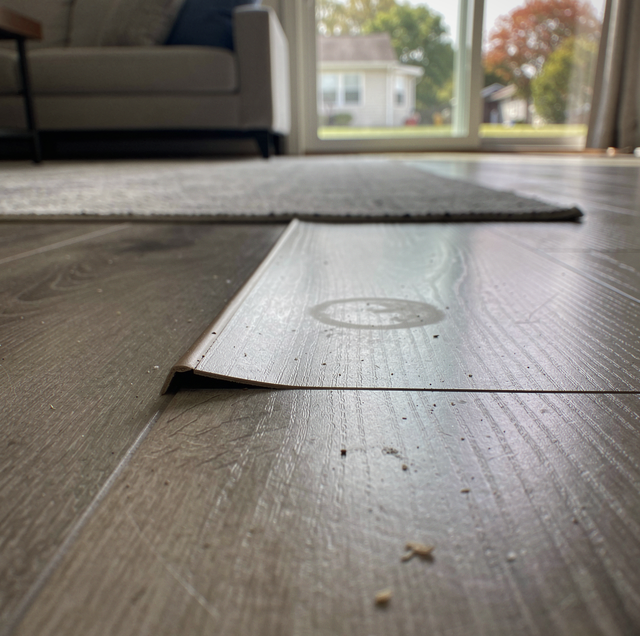
Quick Answer: A floating laminate floor is not fastened down. Each plank locks into its neighbors along a tongue-and-groove edge, and the assembled sheet rests on the subfloor rather than being nailed or glued to it. That construction lets the floor expand and contract as a single connected piece when humidity shifts, moving as a single field rather than plank by plank. The seams are where that movement becomes visible, because a seam is the one place two planks meet and either slide past each other cleanly or catch. When something stops the floor from moving the way it's built to, or feeds moisture into one section faster than the rest, the strain shows up as a gap that won't close, a seam raised in a line, or a joint that flexes and clicks underfoot. Each of these signs has its own likely cause:
| What You're Seeing | Likely Cause |
|---|---|
| Gaps opening between plank ends across the room | The floor is pinned so it can't slide as one sheet, and dry air shrinks it apart at the seams |
| Seams peaking up in a line | Moisture pushing from both sides at once, or trim and cabinetry pinning the perimeter |
| A raised seam along a wall or cabinet run | The gap at that edge is closed off or covered too tight to let the floor move |
| Seams lifting only near a dishwasher, entry, or bathroom | Water reaching the joint and swelling the core |
| A joint that clicks or flexes underfoot | An uneven subfloor flexing the boards at that spot |
| Swollen or chipped plank edges | Water swelled the core at that seam, or an impact chipped the edge |
The Expansion Gap and What Pins It Shut
Every floating floor installation is meant to leave a narrow gap around the room's perimeter so the assembled sheet has room to expand. Baseboard or quarter-round covers that gap; it doesn't fill it. The floor only stays free to move if nothing bridges across that space and touches the planks directly. A kitchen island or a heavy piece of furniture set down without a floating gap underneath it, cabinetry installed tight against the flooring instead of stopping short of it, or a door jamb trimmed flush to the boards all pin the floor at that point. Everywhere else in the room, the sheet keeps expanding and contracting; at the pinned point, it can't. That mismatch is what can push a seam into a peak away from the obstruction, since the plank has nowhere else to go but up.
A raised or peaked seam is a trip hazard in a spot crossed every day, so traffic stays off it; pressing it flat can crack the locking edge, and a handyman crew resets or replaces the affected boards.
Humidity and the Seasonal Swing in the Seams
Laminate's core takes on and releases moisture from the air itself, not only from standing water, and that alone moves the seams enough to notice. In a dry stretch, the boards shrink. On a floor free to slide as one sheet, that change shows at the perimeter gap under the trim; where something pins the floor, the shrinkage opens hairline gaps at the seams instead, and they can close again when humidity climbs back. The problem starts when there isn't enough room left for that swing, which loops back to the expansion gap: a floor with room to move absorbs the seasonal change quietly, while a floor pinned at the edges has nowhere to put that same expansion except up, at whichever seam is weakest.
Water at the Seams and Swollen Edges
Standing water at a dishwasher, a damp entry mat, or a slow leak under a vanity can reach the fiberboard core through the edge at the joint, and that swelling remains after the plank dries, raising the edge above its neighbor in a small ridge. This pattern appears only at the seams near that fixture or damp spot, not scattered across the room as expansion or humidity gaps are.
Water found under a lifted plank comes before any flooring work: the leak is stopped at its source, and water pooled near a floor or wall receptacle stays untouched until that circuit is off at the panel.
An Uneven Subfloor and Flexing Joints
A floating floor needs a reasonably flat subfloor to keep its seams from carrying stress they weren't designed for. Where the subfloor dips or humps under a run of planks, that section flexes every time someone crosses it. Repeated flexing loosens a locking edge that used to hold snug, and a hard enough flex can crack it. A high spot under the boards has the same effect as a low one, since either keeps the plank from sitting flat across the full width of the joint. A joint doing that feels like it clicks or gives slightly underfoot rather than looking raised, so it can go unnoticed until the surrounding seams start opening from that movement. A dip that comes from the framing below, not the flooring surface, is a framing repair, settled before any flooring goes back down.
Damaged Locking Profiles
The tongue-and-groove edge that locks two planks together is a thin, precisely cut profile, and it only has to be compromised once to leave a seam that won't seat flush again. A board dropped edge-first during installation, a heavy object dragged across a finished floor, or planks forced together at an angle other than the one the locking system calls for can crack or round over that edge. A damaged profile behaves differently from every other cause here: freeing a pinned perimeter or drying out a swollen edge can put a healthy joint back where it belongs, but a broken tongue or groove won't hold once it's reseated, because the piece that's supposed to grip is gone, not just displaced.
Repairing a Pinned, Peaked or Swollen Seam
A seam repair starts by finding and removing whatever is pinning the perimeter, whether that's trim installed too tight, a cabinet base resting on the flooring, or furniture set without room underneath, since a seam that's still pinned won't hold a fix. From there, a seam that's only peaked or gapped from lost room to move can be walked back into place: releasing the boards back to the nearest wall or transition, letting the field relax, and relocking the run. A plank with a swollen edge or a broken locking profile is a different job, since it comes out and a matching replacement goes in, one plank or a short run at a time depending on how far the damage reached. Planks are freed from an edge rather than cut or pried up in place wherever wiring, heating tubing, or pipes may run below. Where an uneven subfloor is driving the movement, the fix goes a step further by correcting the subfloor itself before any new flooring goes back down, or the same seam can open again due to the same flex.
Frequently Asked Questions
It can. Near a wall, planks are released back to the damaged one. Farther into the room, away from any edge and where no wiring, heating tubing, or pipe runs below, the damaged plank can instead be cut out in place and a replacement glued in with its locking lip trimmed, a method that trades the locked joint for glue on that one board.
They can share a cause. A click-lock joint can squeak as its edges rub while the plank flexes over an uneven spot, the same flex that loosens a joint until it clicks. A squeak that persists after the flooring above it is lifted comes from the subfloor or a fastener below; it is a separate repair from the seam.
A stuck-but-intact joint clicks solidly once the groove is cleared of debris and the board is pressed back into line. A truly broken tongue or groove won't re-engage even after it's cleaned and pressed straight, because the small tab or channel that's supposed to grip has cracked or rounded off rather than just being blocked.
Matching a discontinued run exactly is not always possible. One option is to pull spare planks from a low-visibility spot, inside a closet or under a large appliance, and install the closer color match there instead, which moves any mismatch out of the main sightline rather than leaving it in the middle of the room.
Not necessarily. A neighboring plank that was only pushed out of plane, with no swelling at its edge and no crack in its locking profile, can be relocked once the obstruction is gone, so both of its edges judge each plank along a lifted seam.
It risks the edge. Foot traffic across a raised seam can chip the exposed edge or grind the two boards together. A seam that could have been relocked as-is can turn into one that needs a full plank replacement just from being walked on while it waits.
Engage laminate floor repair for seams that lift or separate — perimeter release, plank replacement and subfloor repair where the floor flexes. Precision Home Worx serves Wilmington, Bear, Newark. Call (302) 500-3676.

