

Ceiling Fan Installation in Wilmington, DE
- Old Fans Replaced
- Fans Where a Light Hangs Now
- Fan-Rated Boxes Fitted
Micro-copy under the buttons: Labor is quoted per fan once the ceiling box has been seen.
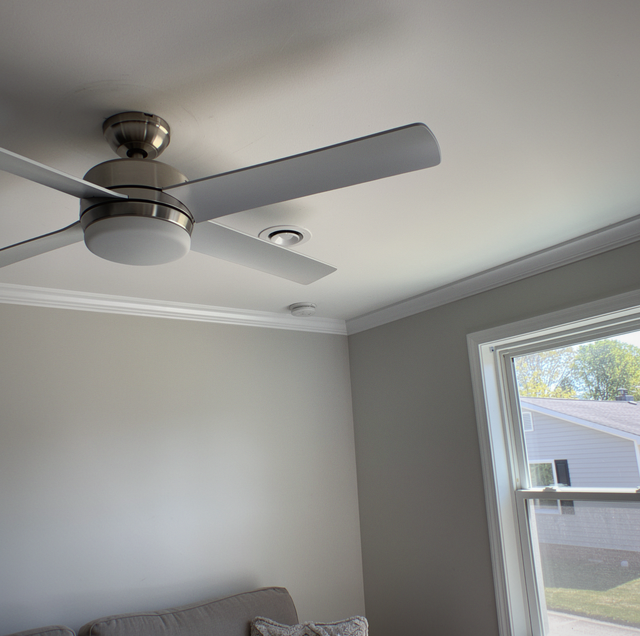
A ceiling fan hangs from a single point in your ceiling, and that point has to carry a motor and a set of blades that pull on it every time they turn. A light fixture just hangs there. That is why the box a light was screwed to may not be fit for a fan, and why the part of a fan install that counts sits above the canopy, out of sight.
We take down tired fans and hang new ones, put fans where a ceiling light hangs today, and set fans in new spots fed from a circuit already in the house. The work runs from the box in the ceiling to the last blade screw.
Insured, Bonded and Rated 5.0 on Google
The marking inside the box reads first
A box listed for fan support says so; one that doesn't is replaced or braced.
Blades at the right height
A downrod or a flush mount, picked to suit how high your ceiling is.
Drop cloths before drilling
Floors and furniture under the work are covered before anything is cut overhead.
Can the Box in Your Ceiling Carry a Fan?
Ceiling fans are made to hang from an electrical box listed for fan support, and a box with that listing is marked accordingly. Whether your ceiling already has one is the first thing the job turns on.
A new fan in place of an old one
A fan already hanging is no proof that the box above it was rated for one. Years of vibration can also loosen its screws or its fastening to the framing. The old fan, its bracket and its canopy come down. The box is checked to be tight, and the wires sound, and the new fan goes up on the bracket that came with it, since brackets differ from one fan maker to the next.
A fan where a ceiling light hangs now
A light fixture can hang from a box that was never meant for a fan: a shallow pan, a plastic box nailed to a joist or a box on a light strap. Where the box can't carry a fan, it is replaced. If it sits between two joists, a fan brace can go in through the existing hole: a steel bar slides into the ceiling above the opening and is turned until its ends bite into the joists on both sides, and a fan-rated box hangs from the bar. If the box sits against a joist, a fan-rated box fastened to the joist does the same work. Either way, the ceiling is opened only as far as the box needs.
A fan in a spot with no fixture
A fan over a bed or a sofa may belong where the ceiling has no box at all. Then the wiring has to be brought to the new spot from a switch or circuit already in the house, routed through the space above the ceiling, and a fan-rated box installed where the fan will hang. Drywall and plaster may need small openings along the way to get the cable across, and those are patched afterward.
drywall and plaster repairThe box, the joists and the ceiling height
With the old fixture's cover down, the box shows what it is fastened to and whether it moves when pushed. The direction of the joists shows whether a brace will fit or the box has to fasten to a joist. Then comes the ceiling height. Fan makers call for the blades to sit at least 7 feet above the floor, so a fan in a room with a low ceiling goes up as a flush mount tight to the ceiling, and a fan under a tall or sloped ceiling hangs on a longer downrod to keep the blades clear of the slope and down where they move air.
A fan with a light kit can replace the room's ceiling light. If you also want the room lit more evenly, recessed lights can go in around it.
recessed lighting and light fixturesTop-floor bedrooms under a low Wilmington roof
Where a Wilmington bedroom sits right under the roof, its ceiling can be flat only through the middle and slope down toward the outside walls. That flat strip is where the fan goes, because the blades have to stay at least 7 feet above the floor and clear of the slope on either side, and a short ceiling often means a flush mount. If the box has to hang on the sloped part, a fan with an angled mount and a downrod long enough to clear the slope is chosen instead.
The attic over a top-floor room has an upside: a brace or a fan-rated box can be set from above, where the joists are in plain view, and the ceiling below is opened only at the box.
What Happens on the Day the Fan Goes Up
Fan or light up there now
Text the room to (302) 321-3577, or call, along with whether a fan or a light is up there now, whether you have already bought the fan, and the ceiling height if you know it.
A look at the box and the ceiling
With the fixture cover down during an evening visit, the box is inspected, the joists are found, the floor-to-ceiling height is measured, and the switch that runs the light today is noted.
Picking the fan
You choose the fan, with its blade span and mounting style matched to the room.
Breaker off, fan up
The breaker for that circuit is switched off, and any box or brace work is done first. Then the bracket, wiring, motor, blades, and light kit go up.
Remote or pull chain handed over
You get the controls once the fan has run through each speed and the reverse setting, with the light switched on and off and any wobble balanced out.
Above and Below the Canopy
| Piece of the job | On a fan install | Good to know |
|---|---|---|
| Old fan or light fixture | Taken down | Its bracket comes down with it |
| Ceiling box | Checked for a fan rating; replaced where needed | A box change is priced at the estimate |
| Fan brace between joists | Where the box sits between joists | Fitted from below through the existing hole |
| Fan motor, blades and canopy | Assembled and hung | On a downrod or as a flush mount |
| Wiring at the box | Connected to the existing circuit | Breaker off for that circuit only |
| Light kit | Connected if the fan has one | Runs from the same switch unless wired for its own |
| Balancing | Checked at each speed | Blades balanced where needed |
| Painting a ceiling patch | Not included | Left ready for your painter |
Every fan we hang runs on wiring the house already has. Adding a circuit or working in the panel is not something we take on.
Already bought the fixture or the material? We can usually install it, as long as it suits the job. On customer-supplied materials, our warranty covers the labor only.
Fan Labor and What a Ceiling Can Add
- Fan work
Ceiling fan installation, labor only
Price$150 per fan - Fan work
Fan-rated box or fan brace, where the old box can't carry a fan
PricePriced at the estimate - Fan work
A fan in a new spot, fed from an existing circuit
PricePriced at the estimate
Labor is $150 per fan on a box that can carry it, and the fan itself is bought separately. What adds to a job is above the ceiling: a box that has to be replaced or braced before it can carry a fan, or cable brought across to a spot that has never had a fixture, with the small openings along the way patched. Jimmy looks it over in person, and the written price follows.
Our warranty
Our work carries a one-year workmanship warranty, dated from the day the job is finished.
Drop Cloths, a Ceiling Cut and No Mess
A ceiling light and fan where there was no wiring
Dennis Martin, Google review, March 2025
“Needed a ceiling light and fan installed where there was no existing wiring. They covered everything with drop cloths to ensure there was no mess from cutting through the ceiling. Work was completed in the time stated and it looks great.”
More reviews from our customers, straight from Google.
Getting the Most From a New Ceiling Fan
In summer, set it to spin counterclockwise as you look up at it, so it pushes air down onto you. In winter, flip the reverse switch so it turns clockwise on a low speed. That draws air up and moves warm air off the ceiling without a breeze you can feel.
No. A dimmer made for lights can make a fan motor hum and can damage it. A fan needs a speed control built for fans, or the pull chain or remote that came with it. If the wall switch is a dimmer today, swapping it for a fan control is something Jimmy goes over with you once he has seen the switch.
Separate wired switches need an extra wire between the switch box and the ceiling box. With a single-switch cable, one wall switch turns the power on, and the pull chains or a remote controls the fan and the light separately. Another route is a wireless wall control paired with a receiver in the fan's canopy, which places separate fan and light buttons on the wall without new wiring.
Yes, if the fan is rated for it. A covered porch where the fan stays out of the rain needs one rated for damp locations. A fan where rain or snow can reach it needs a wet-location rating. An indoor fan outside will rust, and its blades can warp.
Loose blade screws, a bent blade iron, blades that weigh slightly different amounts or a box that moves. A balancing kit with a clip and small weights evens out the blades. A box that moves is the one cause to fix before the fan runs again.
A Fan for the Room That Runs Hot
If an upstairs bedroom holds the heat every July, a fan over the bed is worth having up before summer arrives. Tell Jimmy which ceiling it's for and whether a fan or a light hangs there now.
Precision Home Worx · Based in Claymont, DE · (302) 321-3577 (call or text) · Monday through Sunday, 7 a.m. to 8 p.m.
Delaware business license #223872998 · General liability insurance and RLI surety bond #LMS1971327
Serving Wilmington, Claymont, North Wilmington, Hockessin, Pike Creek, Greenville, Newark, New Castle, Bear and the rest of northern Delaware.
Related services
The main service
Light fixtures, fans and outletsRelated work
Where we work
Around the room
Where we hang ceiling fans
Ceiling fans installed in Wilmington, Claymont, North Wilmington, Hockessin, Pike Creek, Newark, New Castle and Bear.

