

Recessed Lighting and Light Fixtures in Wilmington, DE
- New Recessed Lights
- Old Cans Updated to LED
- Pendants, Vanity Lights and Chandeliers
Swapping one fixture is a small job; a room of new lights is planned with you first.

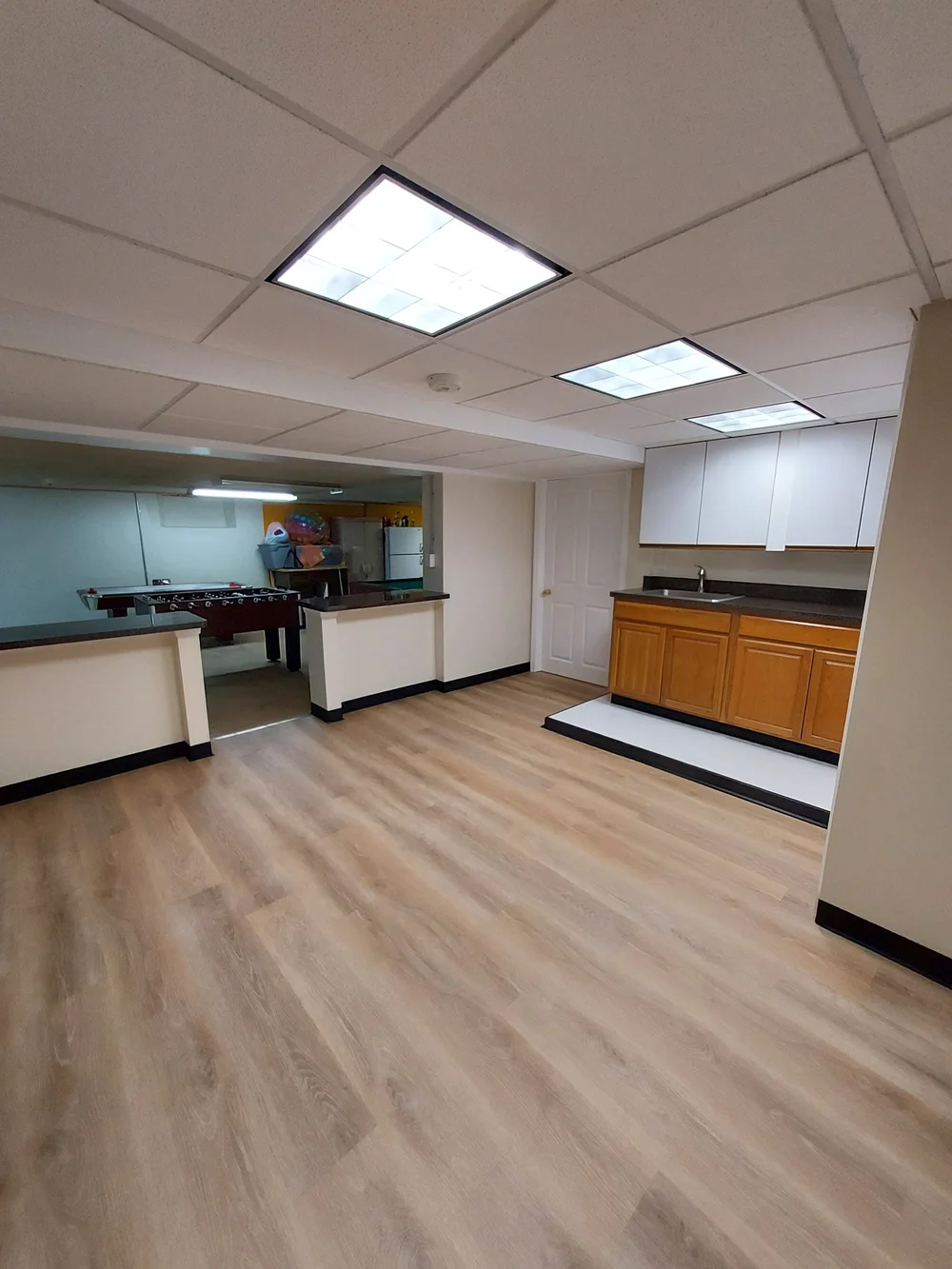
Recessed lights sit up inside the ceiling and spread light across a room from several points, so the corners get as much as the middle. Getting them there means cutting a row of holes in a ceiling you live under, running cable between them through spaces nobody can see into, and choosing housings and a switch that suit that ceiling and those bulbs.
The layout is planned with you before Jimmy Grubb and his son work between the joists from below and wire the new lights from the switch that already runs the room. We also take down tired pendants, vanity lights, chandeliers, and outdoor lights, and hang new ones on the existing wiring.
Reasons to Let Us Up the Ladder
Layout marked before the first cut
You see where every light lands on the ceiling while it's still moving.
Light color picked with you
Warm or cool is settled before the fixtures are ordered.
Dimmers that suit LEDs
Lutron and Leviton dimmers chosen to work with the fixtures going in.
What Is Above the Ceiling Before the Lights Go In
A recessed light needs a clear pocket between two ceiling joists, deep enough for its housing or its junction box and free of pipes, ducts, and blocking. What is up there sets the layout before anyone picks a trim.
Recessed lights in a ceiling that has none
In a finished ceiling, the lights go in from below. Remodel housings are made for this: a hole is cut, the housing is wired, and spring clips grip the back of the ceiling to hold it. Canless LED fixtures go further. Each is a slim light with its own small junction box, which passes up through the same hole and rests on the ceiling beside it. Cable runs to the first light, then from light to light. Running along a joist bay is the easy direction. Crossing joists means drilling through each one, which, in a closed ceiling, requires access from above or a small opening at each joist.
Old cans brought up to date
Recessed cans from the days of floodlight bulbs can stay where they are when the housing is sound. An LED retrofit insert screws into the old socket and clips into the can, replacing the bulb and the trim in one piece. Where the housing itself is the trouble, such as a can that has rusted, one that no longer holds a trim tight, or one in a spot you no longer want lit, it is taken out, and a new fixture goes in, or the hole is closed up.
Pendants, vanity lights and chandeliers
A fixture swap uses the existing box: the old fixture comes down, and the new one is mounted on its own bracket and wired to the same connections. The box has to suit the new fixture. A heavy chandelier needs a box, and a support rated for its weight, and a high foyer ceiling needs the right ladder or scaffold to reach. Over a bathroom mirror, the new vanity light has to cover the old fixture's footprint, or the wall behind it will show. Outside, porch and security lights can be set to a timer or a programmable switch.
The switch box and the bays above, checked before any hole
At the estimate, Jimmy finds the joists and the direction they run, because every light has to land between two of them, and the cable path follows them. He works out what is above the ceiling: an attic, a floor with a bathroom over it, or a duct run. Where insulation will touch a light, the fixture must be IC-rated, meaning it is rated for direct contact with insulation; a housing without that rating must be kept at least 3 inches clear of it. He also opens the switch box for the room. LED fixtures draw a small part of the power old floodlight cans did, so a row of them still asks little of that switch.
A ceiling fan can share a ceiling with recessed lights. Hanging a fan means a fan-rated box and the right mounting height.
ceiling fan installationAttic floors and plaster ceilings in Wilmington houses
A plaster-and-lath ceiling can run close to an inch thick, and remodel clips and canless fixtures are each designed for a range of ceiling thicknesses, so the fixture has to be one whose clips extend past the plaster and lath. The hole is cut cleanly through both layers, because lath that chatters under a saw can crack the plaster around it. On a top floor, the attic above opens up the cable path and shows the insulation the lights will sit in. A first-floor ceiling under a second floor is a closed bay that may have no insulation, but the fixture is still chosen for whatever is in the bay. The cable is fished through without a view inside.
drywall and plaster repairHow New Lights Get Into a Finished Ceiling
A rough light count
Message or call (302) 321-3577, or write in through the form below. Name the room, the lights it has now, and the kind of change you have in mind, such as a grid of recessed lights, a few over a counter, or a new fixture in place of an old one.
Above the ceiling
During the visit, Jimmy finds the joists, checks the attic or the floor above, and notes which switch currently runs the room.
Fixtures, trim and dimmer
You choose canless fixtures or housings, the trim, the light color, and the dimmer or switch. Bought something already? Mention it at the estimate.
The layout on the ceiling
Each light is marked for where it will go, and you check the marks before anything is cut.
Cut, wire and set
Drop cloths go down, and the circuit for that room is switched off. The holes are cut, the cable is fished through, and each fixture is wired and clipped into the ceiling.
Through the dimmer's whole range
The lights are switched on, and the dimmer is run through its full range before we pack up, so any flicker or buzz at the low end shows up while we are still there.
Our Share of a Lighting Job
| Part of the work | How it's handled | Detail |
|---|---|---|
| Layout | Planned with you and marked on the ceiling | Placed in clear joist bays |
| Recessed fixtures | Canless LED or remodel housings | IC-rated where insulation touches them |
| Holes | Cut from below | Sized to the fixture you chose |
| Wiring | Run from the existing switch and circuit | Fished through the ceiling |
| Dimmer or switch | Installed with the lights | Matched to the fixtures going in |
| Old recessed cans | LED insert, or removed and replaced | Where the housing is sound, it can stay |
| Pendants, vanity lights, chandeliers | Old fixture down, new one hung | On the box already there |
| Small access openings | Patched where needed | Left ready for your painter |
| Painting the ceiling | Not included | We don't paint walls, ceilings, or trim |
New lights hang on the circuit that already serves the room. Panel work and added circuits stay off the job.
Already bought the fixture or the material? We can usually install it, as long as it suits the job. On customer-supplied materials, our warranty covers the labor only.
Light Count and Fixture Choice Shape the Lighting Price
- Lighting work
Recessed lighting and light fixtures, per project
Price$1,200 to $3,500 - Lighting work
One existing fixture swapped on its own
PriceA small job: $100 service call plus $25 for every 15 minutes of work
Each light is its own hole, its own set of connections, and its own cable length, so the count of lights is the first thing that shapes the price of lighting. The fixture is the second: a slim canless LED, a remodel housing with a separate trim, or a wet-rated trim over a shower each cost and fit differently, and the dimmer has to match whichever you choose. Any patching of small access openings is priced in the estimate once the ceiling can be seen.
Jimmy prices every project in person at your home, never from a photo or a text. Project estimates are free and are usually scheduled in the evening.
Our warranty
Our work carries a one-year workmanship warranty, dated from the day the job is finished.
Switches and Driveway Lights in Two Reviews
A programmable switch for the lights
Jim Crissman, Google review, March 2025
“He also installed a programmable switch to control the lights.”
Driveway lights for an 80-foot drive
Tony Rizzo, Google review, March 2025
“Excellent electric work on my drive way lights. Lights up the entire 80 foot drive way.”
More reviews from our customers, straight from Google.
Recessed Lights You Will Like Living Under
LED color is listed in kelvins. A 2700K light is warm and close to an old incandescent bulb, 3000K is a touch whiter, and 4000K to 5000K reads as cool daylight. Living rooms and bedrooms tend to suit the warm end, and work areas the cooler end. Some fixtures have a switch on the junction box to set the color.
The dimmer and the LED driver don't agree. Older dimmers were built for incandescent bulbs and can drop out, flicker or hum with an LED load. A dimmer marked for LED use, checked against the fixture maker's list of compatible dimmers, is what pairs the two properly. Some Lutron and Leviton dimmers also have a low-end adjustment that trims out flicker at the bottom of the range.
A starting rule lighting designers use is to space them about half the ceiling height apart, so roughly 4 feet on an 8-foot ceiling, and half that distance from the walls. The joists and the room's use adjust it from there.
Yes, with a fixture and trim rated for a wet location. The trim seals the light against the spray and steam. A standard trim over a shower is the wrong part for that spot.
Not all of them; some housings leak air. A housing or canless fixture marked airtight limits the warm air that passes from the room into the attic around the light. In a top-floor ceiling under an attic, that marking is worth having.
Yes. Housings made for sloped ceilings set the light square to the slope, and adjustable, or gimbal trims tilt the beam back toward the floor so it does not shine across the room. A canless fixture on a steep slope casts light at an angle, so the ceiling pitch is part of the fixture selection.
More Light in the Corners of the Room
Before you call or text, jot down three things: the room, roughly how many lights you picture, and whether an attic or another floor sits above that ceiling.
Precision Home Worx · Based in Claymont, DE · (302) 321-3577 (call or text) · Monday through Sunday, 7 a.m. to 8 p.m.
Delaware business license #223872998 · General liability insurance and RLI surety bond #LMS1971327
Serving Wilmington, Claymont, North Wilmington, Hockessin, Pike Creek, Greenville, Newark, New Castle, Bear and the rest of northern Delaware.
Related services
The main service
Light fixtures, fans and outletsRelated work
Where we work
In the same ceiling
Where we install recessed lighting
Recessed lights and new fixtures in Wilmington, North Wilmington, Claymont, Hockessin, Pike Creek, Greenville, Newark and New Castle.

