

Deck Board, Post and Railing Repair in Wilmington, DE
- Soft Boards Replaced
- Loose Railing Posts Made Firm
- Split Stair Treads Swapped
Board, post, and rail counts are taken at the estimate visit.
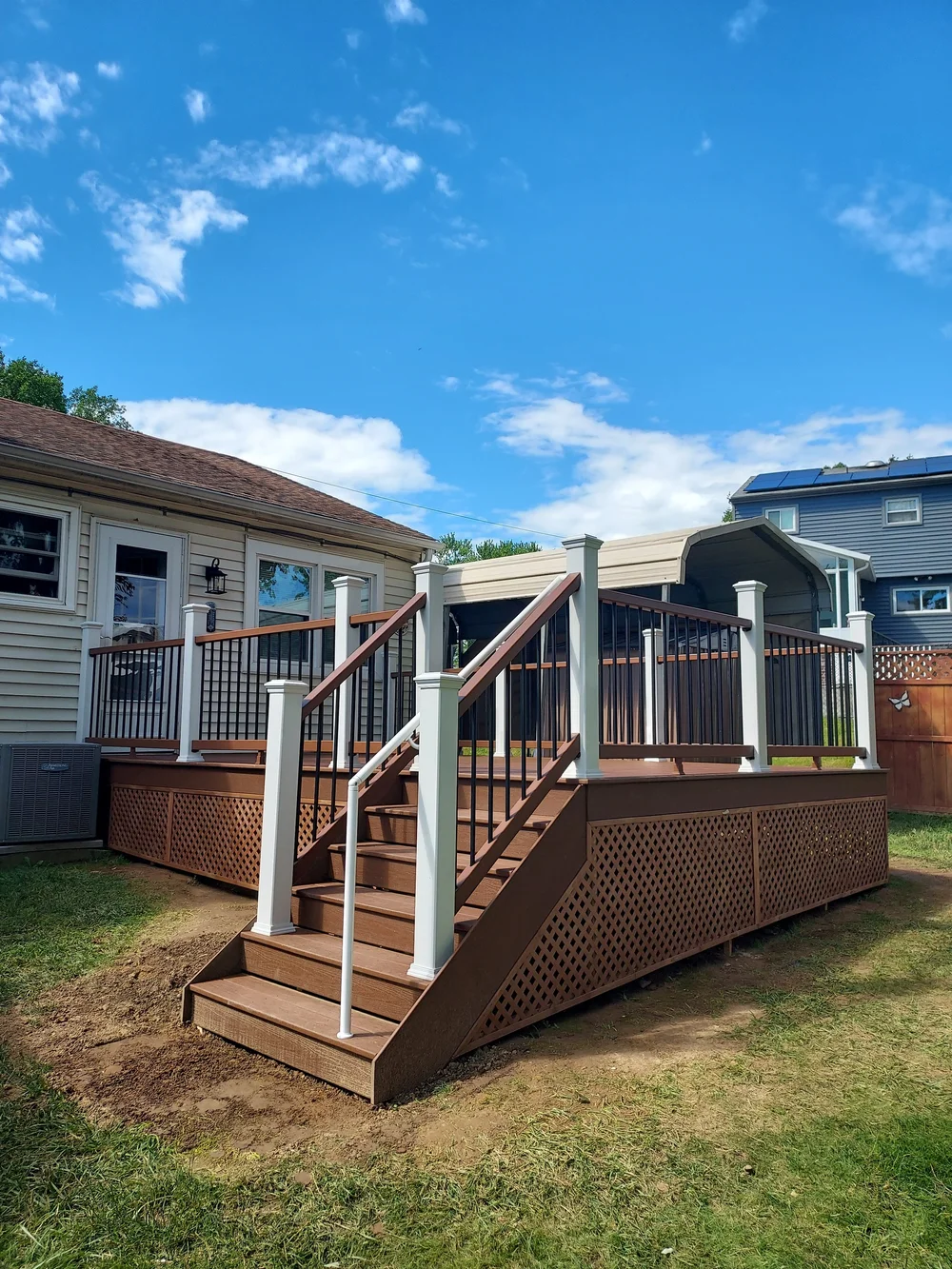
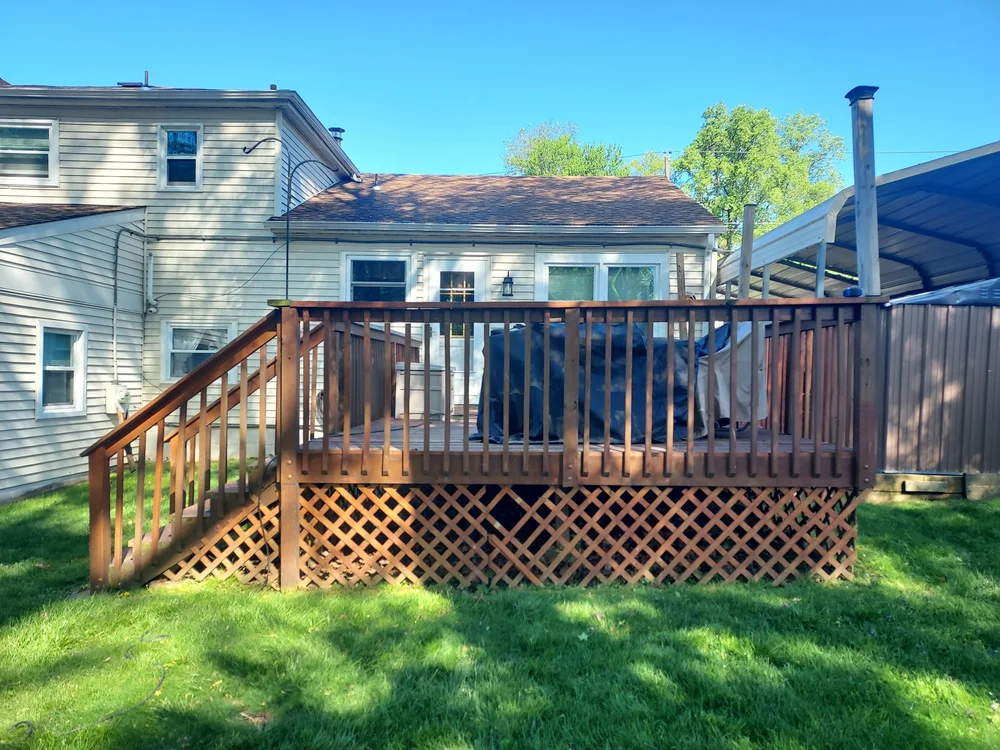
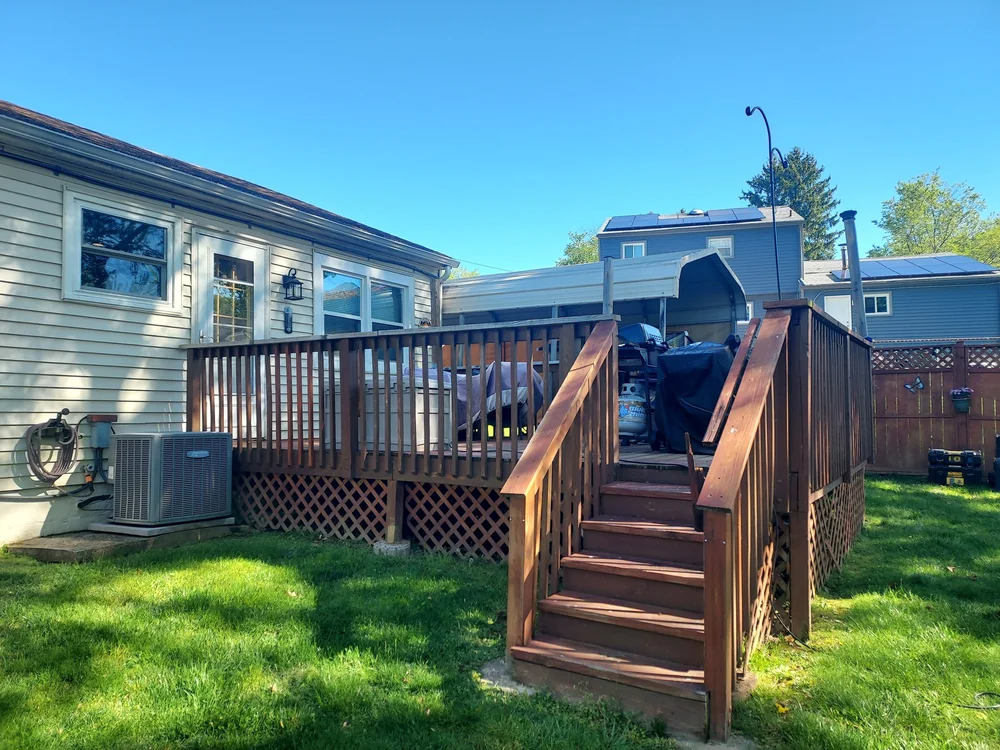
A deck can look fine from the kitchen window and still have a board that sags underfoot, a railing post that moves when someone leans on it, or a stair tread splitting along its grain. The parts you walk on get the attention. The parts holding them up stay out of sight, and that is where a deck repair has to start.
We repair decks around Wilmington, replacing the boards, posts, and railing sections that have given out and checking the frame they hang on.
Insured and Bonded for Work on Your Deck
Stairs in the repair
Split or soft treads are replaced, and the stringer feet are checked; any repairs are priced in the estimate.
Your choice of decking
Replacement boards in pressure-treated lumber or composite decking.
Railings that hold
Loose railing posts re-secured to the frame, and worn sections replaced.
Decks Rot From the Wet Spots Out
Wood rots where it stays wet, and on a deck the wettest places are the ones you can't see: the top edge of each joist under the boards, the gaps where boards cross a joist and hold water between them, the ledger against the house wall and the post bases near the ground. Sun and wind dry the surface after a rain, but not the spots below it.
Deck boards and stair treads
Boards take the sun, the rain, and every footstep. Pressure-treated boards check and split as they dry over the years, fasteners loosen and lift, and the ends of boards soak up water through their open grain. A board that has gone soft, split through, or cupped enough to catch a toe is replaced, cut to length, and fastened to the joists below it. Stair treads are boards too, and a split or soft tread is replaced the same way. Where a whole section is being redone, replacing full runs of boards end-to-end keeps the surface even.
Posts at ground level
A support post carries the deck down to its footing, and the bottom of that post is where it meets the ground: a concrete pier or a puddle that never quite drains. End grain at the base pulls water up into the post. A post that is soft at the bottom, or has split where its bolts pass through, is replaced, and how the deck is held up while a post is out is worked out at the visit. If the footing under it has to be replaced, new footings and who pours them are planned at the estimate. Stair stringers have the same weak point where their feet rest on the ground or a pad.
Railings that move when you lean on them
A railing post is a lever. It is fastened to the outside of the deck frame near the bottom and pushed on at the top, so a little play at its base becomes a lot of movement at hand height. Fasteners corrode, the wood around them softens, and the post starts to rock. A loose post is re-secured to sound framing and a rotted one is replaced. Worn or broken railing sections are matched in wood, or the run is redone in vinyl or aluminum railing. A railing is there to prevent a fall, so a loose one takes precedence over anything cosmetic.
Joists, beams and the ledger, probed from underneath
From underneath, where the deck can be reached, Jimmy probes along the top edges of the joists, the joist ends where they meet the ledger and the beam, the tops and bottoms of the posts, and the ledger itself, the board that carries the house side of the deck. Rusted joist hangers and fasteners are looked at in the same pass. What the probe finds sets the scope. Rot in boards, posts, or railings is a deck repair. Rot running along the joists or into the ledger goes beyond a board-and-railing repair, and it is talked through with you as its own job.
A sound frame can also carry a roof, framed to meet the house wall or roofline.
roofs over decks and porchesScreen walls can go up on an existing deck, too.
screened porch construction on an existing deckWilmington-area decks from the 1990s
Pressure-treated decks built around Wilmington in the 1990s have reached the age where the framing can be rotting while the surface still passes for fine.
Height plays into it. A deck that sits close to the ground leaves little air under the joists and little room to crawl, so the wood stays damp and goes unchecked for years. The boards may have been replaced or refinished over time and may look newer than the frame they sit on. Treated lumber resists rot, but the treatment is strongest near the surface, and the cut ends left when the deck was built expose wood that took less of it. On a deck of that age, the joist ends at the ledger, and the post bases at the ground are the places a fresh-looking surface can hide soft wood.
The Repair Sequence on an Older Deck
Size and height of the deck
Say roughly how big the deck is, how high it sits off the ground, and what has you worried about it. The form or a call books the visit.
A look from above and below
The deck surface is walked first. Then the joists, beams, posts, and ledger are looked at from underneath, since new boards hold no better than the joists they are screwed to.
Repair or rebuild, priced
You get a price for the repair. If the frame is beyond saving, a rebuild is priced as well, so the choice is laid out in front of you.
Boards and railing chosen
The board material is settled for the deck surface and the stairs, along with the railing material for any section being replaced.
Repairs, from the frame up
Any frame repair agreed at the estimate comes first. Then posts are replaced or re-secured, and railing sections go up.
New boards down
Replacement boards and treads are fastened to the joists, and their ends are cut straight along the deck's edge.
Boards, Posts, Rails and the Frame They Sit On
| Deck part | Repair | Material or note |
|---|---|---|
| Deck boards | Soft, split or loose boards replaced | Pressure-treated, Trex or TimberTech/AZEK |
| Stair treads | Replaced where soft or split | Same choices as the deck boards |
| Railing posts | Re-secured to sound framing, or replaced | Rotted posts replaced |
| Railing sections | Replaced where worn or broken | Matched, or redone in a new material |
| Support posts | Replaced where rotted | Support while a post is out planned at the estimate |
| Joists, beams and ledger | Probed for rot | Frame repair priced at the estimate once seen |
| Joist hangers and fasteners | Checked | Rusted hardware noted at the estimate |
| Frame rebuild or a new deck | Not part of a repair | Priced separately at the estimate |
| Painting, staining or sealing | Not included | New boards left as installed |
We don't paint siding, trim or doors, and we don't stain or seal deck boards.
A porch floor under a roof is a different job from an open deck: porch floors are one of the surfaces we do paint.
Already bought the fixture or the material? We can usually install it, as long as it suits the job. On customer-supplied materials, our warranty covers the labor only.
Deck Repair Prices and Where a Rebuild Begins
- Work
Deck repair: boards, posts and railings
Price$500 to $2,500 - Work
Frame rebuild or new deck
PricePriced at the estimate
A deck repair is priced based on how many boards, treads, posts, and railing sections need to be replaced, and on the material each is replaced with, since composite boards and aluminum or vinyl railings carry a different material cost than treated lumber. Soft wood found in the joists or the ledger is a different kind of work, so it is priced at the estimate once its extent is clear.
Jimmy prices every project in person at your home, never from a photo or a text. Project estimates are free and are usually scheduled in the evening.
Our warranty
Our work carries a one-year workmanship warranty, dated from the day the job is finished.
How Wilmington-Area Customers Rate Us on Google
More reviews from our customers, straight from Google.
Keeping an Older Deck in Service
Sometimes. Composite boards come with the manufacturer's own requirements for joist spacing and fastening, and a frame built for wood boards may have its joists set wider apart than composite boards allow. The joist spacing and the condition of the frame are checked against the board you choose before any composite goes on.
Not at first. New treated lumber is a different color from boards that have weathered for years, and it can stay damp from treatment for a while after it goes down. It weathers toward the rest of the deck over time and with sun.
Our replacement boards are pressure-treated lumber, Trex, or TimberTech/AZEK. A few of those set into a cedar deck or another composite won't match, so where the look matters, it is worth considering a full section or the whole surface in one of those materials.
Yes. Railing sections can be replaced with vinyl or aluminum, as long as the posts and their connection to the frame are sound. Mixing materials along one run looks pieced together, so a full side or the whole railing keeps it consistent.
A board flexes between the joists it spans. Boards that are thin for the spacing, a board split on its underside, or a joist that has softened beneath it all show up as bounce underfoot. The fix depends on which it is: a new board for a split one, framework for a soft joist.
It comes down to the frame. Repairs on a sound frame keep the deck in use; new boards on a frame that is giving out are money spent on the wrong layer.
A Deck That Feels Solid Underfoot Again
A loose railing post or a soft stair tread comes first, because those are the parts that catch a fall. Call, text or use the form, and the look underneath goes on the calendar.
Precision Home Worx · Based in Claymont, DE · (302) 321-3577 (call or text) · Monday through Sunday, 7 a.m. to 8 p.m.
Delaware business license #223872998 · General liability insurance and RLI surety bond #LMS1971327
Serving Wilmington, Claymont, North Wilmington, Hockessin, Pike Creek, Greenville, Newark, New Castle, Bear and the rest of northern Delaware.
Related services
The main service
Decks, porches and porticosRelated work
Where we work
Where we repair decks
Deck repairs across Wilmington, North Wilmington, Claymont, Pike Creek, Hockessin, New Castle, Newport and Stanton.

