

Kitchen Cabinet Painting in Wilmington, DE
- Fully Sanded
- Hardware Removed
- Urethane-Based Enamel, Not Latex
Color chips welcome at the estimate.
Kitchen cabinets get grabbed, bumped, splashed, and wiped every day of the year. A coat of paint on them lasts only as long as its grip on the wood beneath and its own hardness once it cures. Get either one wrong and the edges of the doors start to chip, the finish stays tacky where a door meets the frame, and the corners by the trash pull wear through first.
A painted kitchen keeps everything but its color. The cabinets themselves are what change: the doors, the drawer fronts and the boxes they hang on, with your countertops, sink and layout left exactly where they are.
Forty Years in the Trade, Now at Your Cabinets
Doors kept in order
Each door goes back on its own opening.
Countertops stay put
The boxes are finished where they hang, with the tops, sink and appliances covered.
Grease off before sanding
Cleaning comes first, so the sandpaper doesn't push cooking film deeper into the wood.
Why Cabinet Paint Peels, and What Keeps It On
When painted cabinets fail in the first year or two, the trouble sits in one of three places: the bond between the paint and the old finish, the paint itself, or the spots a brush never properly reached. Each one is prevented before or during the painting.
Sanding for grip
Factory cabinet finishes are hard and slick by design, and kitchen cabinets near the range also carry a film of cooking grease. Paint bonds poorly to both. A liquid deglosser only softens and dulls the top of the old finish chemically. Sanding leaves fine scratches in it, which give the new coating something physical to hold onto, and it levels small dings and drips left by the last finish. We sand the doors, drawer fronts, and boxes all over.
An enamel that cures hard
We use a urethane-based enamel with a true oil-based finish. Latex coatings are not part of how we paint cabinets. Latex wall paint stays softer on a cabinet, and two latex surfaces pressed together, as a door closed against its frame, can stick and pull. An oil-based enamel flows out as it dries, so brush marks level into a smooth face, and it cures to a harder shell that takes wiping and handling better than wall paint does.
Hardware off, every face reached
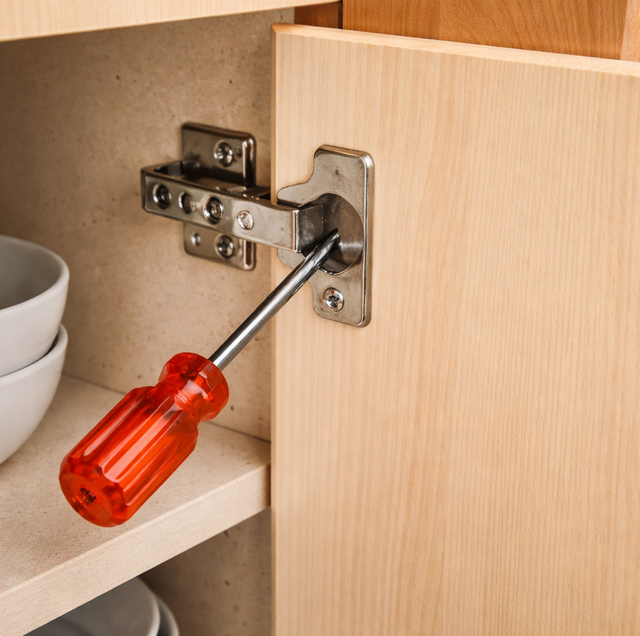
Knobs, pulls, and hinges come off before any sanding starts, and every door and drawer front is lifted out of the cabinet frame. Paint brushed around a pull leaves a ridge that chips, and a hinge painted in place binds and cracks the paint along its edge the first time the door swings. With the hardware off, the door edges get the same finish as the faces, and the hardware goes back on clean metal with nothing painted over it.
Door construction and old damage
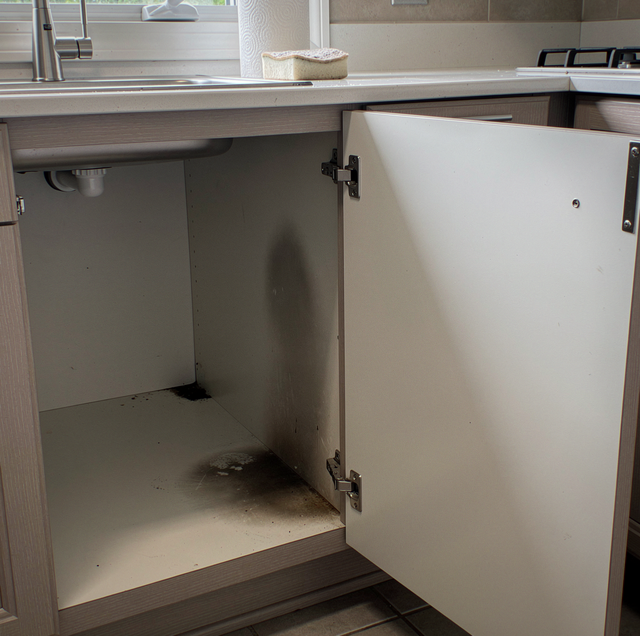
In the estimate, the doors themselves are examined closely because a solid-wood door, a veneered door, an MDF panel, and a vinyl-wrapped door each require sanding and enamel differently. Worn spots by the trash pull and any old touch-up paint are noted. So is the sink base. A base that a leak has swollen or softened is not a painting job, and replacing it is quoted as its own job.
sink cabinet replacement after a leakIf new countertops are on your list as well, the two jobs are planned together at the same estimate, so the cabinets and the new tops are scheduled in a sensible order.
quartz countertop replacementPaint changes the color of a kitchen and leaves its layout as it is. When the layout itself is the problem, or the boxes are swollen and coming apart, a kitchen remodel is the better conversation.
kitchen remodelingBuilder kitchens in Hockessin and Newark colonials
A 1990s or 2000s builder kitchen in a Hockessin or Newark colonial may have solid-wood face frames with door panels of MDF or a thin wood veneer over a composite core. Veneer is sanded with a light hand, because sanding through it at an edge exposes the core. MDF sands smooth on its faces, but its cut and routed edges soak up finish faster than the faces do. Oak doors from that era show their open grain through paint as a texture you can feel.
So one kitchen can hold three surfaces that each want a different hand with the sandpaper: the wood frames, the panel faces, and the routed edges. Which ones yours has is checked door by door at the estimate.
Your Kitchen During a Cabinet Painting Job
Cabinets, color and timing
Send Jimmy a text or give him a call and let him know what the cabinets are finished in now and when the kitchen could be out of use. He sets up a visit to see them.
Counting and choosing at the estimate
The doors, drawers and boxes are counted, the door construction is checked, and you talk through the color and whether the knobs and pulls are staying or changing.
Emptied, covered and taken apart
With the cabinets emptied, the countertops, floor, and appliances are covered. Hardware comes off, and the doors and drawer fronts are removed and kept in order so each one returns to its own opening.
Cleaned and sanded
Grease is washed off, then the doors, drawer fronts, and box faces are sanded all over, and the dust is cleaned away before any finish is opened.
The enamel goes on
The urethane-based enamel is applied to the boxes in place and to the doors and drawer fronts, and each coat is left to harden before the next.
Doors rehung, gaps even
The hardware goes back on, the doors are rehung, and the hinges are adjusted so the gaps between doors run even. Every door and drawer is opened and closed before the covers come up.
Doors, Drawer Fronts and Boxes: What's Painted
| Surface or task | On a cabinet painting job | Detail |
|---|---|---|
| Cabinet doors | Taken off, sanded all over and enameled | Back faces talked through at the estimate |
| Drawer fronts | Removed, sanded and enameled | Faces and edges finished alike |
| Cabinet boxes and face frames | Sanded and enameled in place | The faces and sides that show |
| Knobs, pulls and hinges | Removed first, reinstalled at the end | New pulls you supply can go on instead |
| Finish | Urethane-based enamel, oil-based | Cures to a hard shell |
| Countertops, floors and appliances | Covered and protected | Uncovered once the doors are back on |
| Walls, ceiling, trim and backsplash | Not included | Wall and trim painting is not offered |
| New doors or veneer on old boxes | Not included | Cabinet refacing is not offered |
On this page, we paint cabinets. We don't paint walls, ceilings, trim, or the exterior of the house, and we don't offer cabinet refacing.
Basement and porch floors are the other painting we take on.
Already bought the fixture or the material? We can usually install it, as long as it suits the job. On customer-supplied materials, our warranty covers the labor only.
Piece Count and Old Touch-Ups in the Price
- Work
Kitchen cabinet painting
Price$1,500 to $6,000 - Work
Sink base replaced before painting, if a leak ruined it
Price$2,500 to $3,500
The price follows the piece count because every door, drawer front, and box is handled individually: taken off, cleaned, sanded on its faces and edges, finished, then rehung and adjusted. A kitchen with tall pantry cabinets, an island, and a wall of narrow drawers has more storage than its floor space suggests. The condition of the old finish matters too. Heavy grease, chipped edges, old touch-up paint and deep dings all add sanding and filling time before the enamel can go on.
Jimmy prices every project in person at your home, never from a photo or a text. Project estimates are free and are usually scheduled in the evening.
Our warranty
Our work carries a one-year workmanship warranty, dated from the day the job is finished.
Google Reviews of Our Work
More reviews from our customers, straight from Google.
Painted Cabinets After the Doors Go Back On
The cabinets can be opened and closed once the doors are back on, but an oil-based enamel is dry to the touch long before it is fully hard. It keeps curing for weeks. Through that stretch, go easy on the edges, skip scrubbing, and don't hang damp dish towels over the doors.
Oil-based enamels can mellow toward a warmer tone over the years, and the change shows more in a kitchen that gets little daylight. A soft white or an off-white hides it better than a stark white. If a crisp white is the whole point, raise it at the estimate before the color is chosen.
Yes. A knob needs one hole, and a pull needs two holes at a set distance, measured center-to-center. Pulls with the same spacing as the old ones go straight back into the old holes. If the new pulls don't match, the old holes can be filled and sanded flush before the enamel goes on, with the new holes drilled afterward. That is settled at the estimate.
Thermofoil is a vinyl film pressed over an MDF door. Paint does not bond well to vinyl, and the film itself tends to peel away near heat sources, such as beside the oven or under the toaster. Painting over a lifting wrap holds nothing down. Doors like these are looked at in person before anything is promised.
A soft cloth with warm water and a little dish soap, then a dry wipe. Abrasive pads, scouring powder, and strong degreasers dull the enamel and wear through it at the edges over time. Wipe up splashes near the sink and the dishwasher rather than letting water sit on the finish.
Have a Color in Mind for the Kitchen?
Maybe it is a soft white, or a deep green you saw in a friend's kitchen. Book an evening estimate, and the color can be settled at your own kitchen table, in your own kitchen light.
Precision Home Worx · Based in Claymont, DE · (302) 321-3577 (call or text) · Monday through Sunday, 7 a.m. to 8 p.m.
Delaware business license #223872998 · General liability insurance and RLI surety bond #LMS1971327
Serving Wilmington, Claymont, North Wilmington, Hockessin, Pike Creek, Greenville, Newark, New Castle, Bear and the rest of northern Delaware.
Related services
The main service
Kitchen remodelingWhere we work
Other painting we do
Where we paint kitchen cabinets
Cabinet painting for kitchens in Wilmington, Claymont, Talleyville, Arden, Hockessin, Pike Creek, Greenville and Newark.

