

Soffit and Fascia Repair in Bear, DE
- Capping Opened
- Soft Fascia Boards Replaced
- Soffit Backing Checked
Loose capping or a sagging panel is enough to start with.
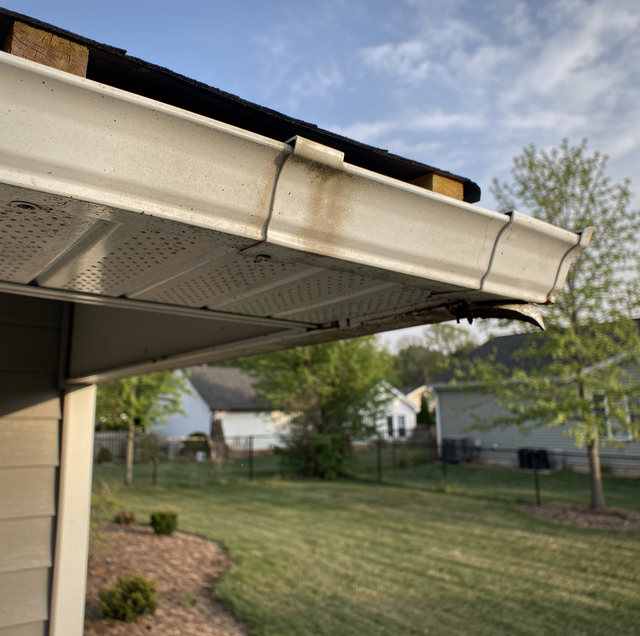
Behind the aluminum on a capped roof edge sits a wood fascia board, and behind the vinyl soffit sit the strips of wood that hold it up. Both can soften while the cover stays straight, and the first outside sign may be nothing more than a panel that sits a little low.
Precision Home Worx opens capped eaves on houses in Bear, identifies where the wood has softened, and rebuilds them with new stock.
Who Opens Up Your Roof Edge
Laps and nail lines first
The probe goes in where one length of capping overlaps the next or is nailed through, since those are the ways water gets behind it.
Soft wood followed by firm wood
The probe tracks each soft board in both directions before any cut is made.
Backing checked behind the panels
The nailers that carry the soffit are tested along with the fascia.
Rot Behind Metal and Vinyl
How water gets behind fascia capping
Capping is thin aluminum coil bent to the shape of the fascia and nailed over it. It sheds the rain that hits its face, but it has laps where one length overlaps the next, nail holes along its edges, and a top edge that tucks up under the roof's drip line. Water that gets in through any of those spots runs down the back of the metal and into the board along the nail line, then spreads lengthwise from the lap where it came in.
Vinyl and aluminum soffit panels share the problem. The panels themselves hold up to water, but they are fastened to a wood nailer along the house wall and to the back of the fascia. When that wood softens, the panels start to drop or wave even though the vinyl is in good shape.
What shows through the metal
- Capping that pulls away from the board or flaps in a strong wind, because the wood under its nails can no longer hold them.
- Nail heads backing out in a row along one length.
- A dent or bulge that gives when pressed, where the board behind it has swollen or crumbled.
- Soffit panels sagging between their fastening points or slipping out of the channel along the wall.
- A dark streak running down from the bottom edge of the capping after rain.
Any one of those is a reason to open the capping at that spot. The probe goes into the wood behind it, and the board is followed in both directions until the probe meets firm wood.
Capped roof edges on Bear's 1990s houses
Aluminum-capped fascia and vinyl or aluminum soffit are common on Bear's 1990s houses, alongside brick-and-vinyl walls and aluminum-wrapped window trim. On a 1990s house, the capping may be original or a later add-on, and either way, the board beneath it has not been seen since it was installed. A slow leak at a lap or a nail line has had that whole time to work.
That changes the order of the job in Bear. The repair starts by removing the cap from the suspect lengths so the board beneath it can be probed and inspected. Softwood is cut out, new stock goes up primed on both faces, and the fascia is left ready to be re-covered.
Rot in window trim, porch posts, or siding lower on the house is covered separately.
exterior wood rot repairOur Share of a Capped Eave
| Layer | Our work | Heads-up |
|---|---|---|
| Aluminum fascia capping | Taken off the lengths being repaired | Removed length by length |
| Wood fascia board | Soft sections cut out and new stock fitted | Joints set on firm rafter ends |
| Vinyl or aluminum soffit panels | Lowered along the repaired lengths and kept at the house | Only the panels over softwood come down |
| Soffit nailers | Checked, and soft lengths replaced | They carry the panels along the wall |
| Rafter ends behind the board | Inspected when the old board comes down | Firm ends take the new board |
Shingles and re-roofing are outside our work. Our part ends at the wood trim under the roof edge.
We don't install or replace gutters. Where one hangs on a length of fascia we are replacing, it must be lowered first, and that step sits outside our quote.
We don't paint walls, ceilings, trim, or siding.
Questions About Capped Fascia and Vinyl Soffit
It can go either way. Capping goes on for plenty of reasons, among them to stop repainting the trim, and it covers sound boards and soft ones alike. What it does do is hide whatever was there, so a capped eave gets probed the same as any other.
Not always. Vinyl grows and shrinks with temperature, and panels nailed too tight have nowhere to go, so they bow in the heat and settle back when it cools. A wave that stays put in cool weather, or a panel slipping out of its channel, is the kind that points to soft wood behind it.
It is safer to leave it for the estimate. A pried edge can open a fresh path for water, and ladder work at the eave is best left to someone set up for it.
Reusing it and fitting new metal are both options Jimmy goes over with you. Whether a length can be bent back depends on how it comes off: aluminum coil kinks when pried, and a creased piece may not lie flat again.
Have a look in the attic, if you can reach it safely, along the low edge of the roof. A dark stain on the roof boards near the eave or damp insulation at the outer wall points Jimmy to the right length outside.
Four Steps From Loose Capping to Solid Wood
Show us the spot
Get in touch with Jimmy by phone or text, naming the side of the house the trouble is on and whether it is the capping, the soffit, or both.
The estimate visit
Jimmy walks every side of the house and tests the wood through loose capping and panel gaps.
Opened and rebuilt
On the workday, the capping and panels are cut to the agreed lengths, soft wood is cut back to the firm framing, and new stock is fastened in place.
Ready to cover
The new fascia is left primed, and the lowered panels stay at the house. Rehanging them and re-covering the fascia are options discussed in the estimate, so the finish is planned before the first length is removed.
Before You Book Fascia Work, See Our Google Reviews
More reviews from our customers, straight from Google.
How a Capped Eave Repair Is Quoted
- What is being priced
Fascia and soffit repair under capping or panels
HowAt the estimate, after probing - What is being priced
Nailers behind vinyl or aluminum panels
HowChecked; soft lengths priced at the estimate
Capped fascia is quoted from what the probe can reach through the metal, at loose laps, nail lines, and gaps between soffit panels. Where the metal has kept water out, the board under it can be firm from end to end, and that length stays as it is.
Jimmy prices every project in person at your home, never from a photo or a text. Project estimates are free and are usually scheduled in the evening.
Our warranty
Our work carries a one-year workmanship warranty, dated from the day the job is finished.
Capping Pulling Loose on Your Bear House?
If the capping on your Bear house has started to lift or the soffit has begun to drop, call or text Jimmy. He looks it over in person, and the written price follows.
Precision Home Worx · Based in Claymont, DE · (302) 321-3577 (call or text) · Monday through Sunday, 7 a.m. to 8 p.m.
Delaware business license #223872998 · General liability insurance and RLI surety bond #LMS1971327
Serving Wilmington, Claymont, North Wilmington, Hockessin, Pike Creek, Greenville, Newark, New Castle, Bear and the rest of northern Delaware.

